
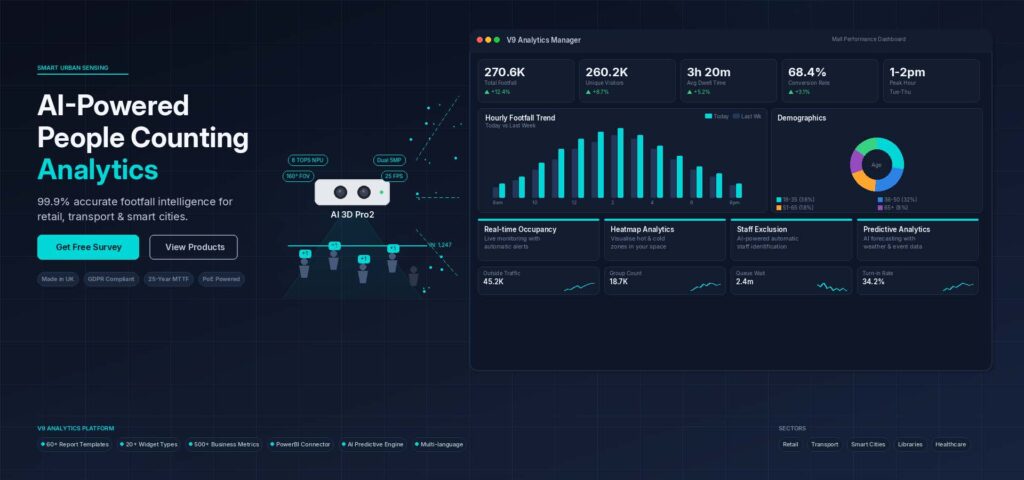
Footfall counter accuracy ROI is the make-or-break question for buyers — and it’s what determines whether a people-counting investment pays back in months, or becomes shelfware. This guide answers both parts in plain English, then shows you how Smart Urban Sensing’s AI 3DPro2 changes what a modern footfall counter is actually for.
Does footfall counter accuracy really matter for ROI?
Short answer: yes — because every downstream number you rely on (conversion rate, staff-to-traffic ratios, marketing attribution, dwell time) is built on top of the count. A 10% counting error doesn’t stay a 10% error; it compounds through every KPI it touches.
Legacy beam-break and basic thermal counters typically deliver 80–90% accuracy in real-world conditions, drop sharply in groups, and can’t distinguish staff from customers. Modern AI 3D stereo vision counters operate at 99% accuracy, handle groups, and filter staff automatically. Without that accuracy baseline, no ROI model can be trusted.
Footfall counter accuracy comparison: legacy vs AI 3D vision
| Feature | Beam / Basic Thermal | AI 3D Stereo Vision (SUS 3DPro2) |
|---|---|---|
| Typical accuracy | 80–90% | 99% |
| Group counting | Poor | Excellent |
| Staff exclusion | No | Yes |
| Direction & dwell | Limited | Full |
| GDPR / EU AI Act ready | Varies | Yes — no PII captured |
| Edge AI processing | No | Yes |
What is the true footfall counter ROI?
Footfall counter ROI comes from four levers: labour optimisation, conversion uplift, marketing attribution, and lease/location decisions. Published retail benchmarks suggest accurate footfall data typically drives a 5–15% conversion uplift and 10–20% labour efficiency gain when rostering is aligned to real traffic patterns.
Typical footfall counter ROI drivers
| Lever | Typical impact | Why it matters |
|---|---|---|
| Staff scheduling to real traffic | 10–20% labour saving | Stops over/under-staffing |
| Conversion rate visibility | 5–15% uplift | Turns browsers into buyers |
| Campaign attribution | Measurable | Proves marketing spend |
| Lease & location benchmarking | Strategic | Evidence for rent reviews |
Live footfall counter ROI calculator
Use the calculator below to estimate the annual revenue uplift a more accurate footfall counter could unlock for your site. Adjust the numbers to match your own traffic, transaction value, and conversion rate.
Estimate your annual footfall counter ROI
Beyond retail: community health and welfare
Smart Urban Sensing combines footfall analytics with real-time welfare monitoring. The same 3DPro2 sensor that counts customers can flag falls, prolonged inactivity, or unusual occupancy patterns — valuable for community venues, supported housing, and addiction services. No cameras, no PII, just anonymised 3D data processed at the edge. That dual-use capability is a differentiator very few legacy footfall counter vendors can match.
How to choose a footfall counter: checklist
Before buying, validate any potential footfall counter against these five criteria:
- Accuracy in groups — insist on >95% in real conditions, not ideal lab tests.
- Staff exclusion — essential for clean conversion metrics.
- Data privacy — no PII, edge processing, GDPR and EU AI Act alignment.
- Integration — open API into your BI, EPOS, or rostering tools.
- Support and calibration — UK-based support and periodic recalibration.
Why legacy footfall counter accuracy ROI models fall short
Most legacy footfall counter ROI models were built for a world of single-door stores, small groups, and static opening hours. Today’s retail, venue, and community environments behave very differently: traffic is spikier, group sizes are larger, staff move in and out of counting zones constantly, and visitors dwell in ways that pure entry counts can’t capture. An accuracy error of even 5–10% in that environment doesn’t just distort the count — it distorts conversion, staff productivity per visitor, marketing attribution, and the per-square-metre performance you’ll use to defend your rent or justify new sites.
That’s why Smart Urban Sensing treats footfall counter accuracy ROI as a single, linked metric. Our AI 3D stereo vision isn’t just “more accurate” in a benchmark — it produces data clean enough that the ROI model built on top of it survives contact with real operations.
Footfall counter accuracy ROI in practice: what changes day one
When an organisation switches from a legacy counter to the SUS 3DPro2, the first 30 days typically reveal three things:
- True peak hours — often 20–40 minutes different from what legacy data suggested, immediately improving rostering accuracy.
- Real conversion baseline — corrected for staff-in-zone, groups, and re-entries, giving marketing and operations a trustworthy number to improve against.
- Zone-level dwell — insight into which areas, aisles, or services are attracting or losing attention, enabling layout and staffing changes that were previously guesswork.
These are the operational wins that turn footfall counter ROI from a theoretical model into a measurable P&L impact within a single quarter.
Footfall counter accuracy ROI for community and welfare settings
Footfall counter ROI is not only a retail story. For supported housing, recovery services, community venues, and healthcare-adjacent environments, accurate occupancy and movement data drives a different kind of return — one measured in safety, safeguarding, and staff efficiency rather than tills. The SUS 3DPro2 extends the same high-accuracy people-counting into anonymous welfare signals such as fall detection, prolonged inactivity, or unusual occupancy patterns, all processed at the edge with no images leaving the device. For commissioners and operators, that combination is rare: a single sensor that delivers both commercial footfall analytics and community welfare monitoring, without the privacy risk of a camera-based system.
Frequently asked questions about footfall counter accuracy and ROI
How accurate is the SUS 3DPro2 footfall counter?
The 3DPro2 delivers 99% accuracy using AI-enhanced 3D stereo vision, including in groups and high-traffic environments.
Is the footfall counter GDPR compliant?
Yes. No images or personal data leave the device — only anonymised count and movement data.
Can the footfall counter exclude staff from counts?
Yes, through uniform recognition, zoning, and behavioural filtering.
How long does installation take?
Typical single-door installation is under two hours, including calibration.
Does the footfall counter work in low light?
Yes. 3D stereo vision is not dependent on ambient lighting.
How quickly will I see footfall counter ROI?
Most retail and venue deployments recover the investment within 6–12 months through labour optimisation and conversion uplift alone.
Next step: book your free footfall counter ROI assessment
Book a free site assessment and we’ll model your specific footfall counter accuracy and ROI using your real visitor volumes. Book a free 20-minute footfall review
Further reading: for the underlying data-protection framework referenced above, see the UK ICO’s guide to UK GDPR guidance.
Retail and shopping centres
Find out what your entrance data should be telling you
In 20 minutes we review your entrances, current counting setup and conversion questions, then tell you what accurate footfall data would change. No obligation, no hard sell.


