

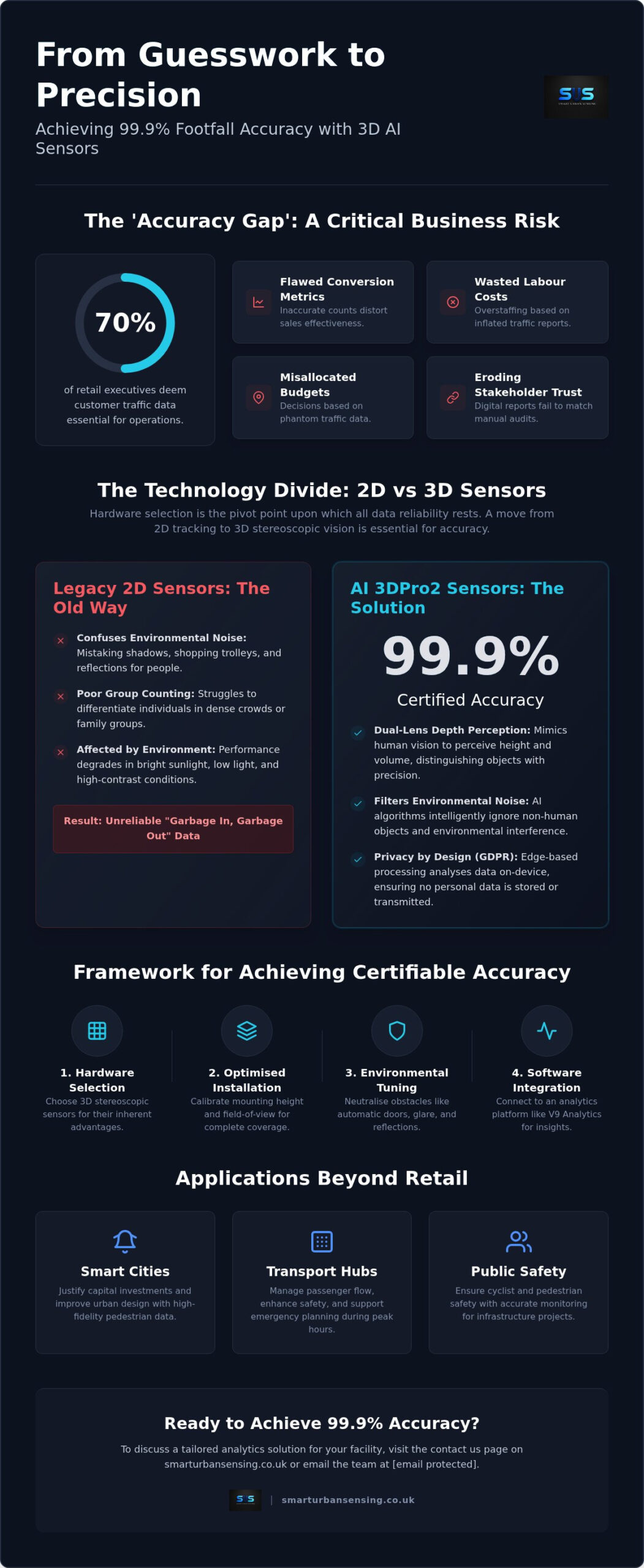
Over 70% of retail executives now consider customer traffic data essential for their operations, yet many remain trapped by the accuracy gap that renders their conversion metrics unreliable. You likely recognise the frustration of inconsistent data between different entrances or the technical difficulty of counting groups and children with precision. When sensors fail to distinguish a delivery driver from a genuine prospect, your entire staffing strategy rests on a foundation of guesswork. Learning how to measure footfall accurately is a hardware-first discipline that separates market leaders from those struggling with legacy systems.
We understand that privacy concerns often slow down the adoption of advanced technologies, especially as global regulations evolve. This guide provides a technical framework for achieving 99% footfall counting accuracy through 3D stereoscopic sensors and edge-based AI, ensuring your data is both precise and ethically handled whilst maintaining strict GDPR compliance. We’ll explore how the AI 3DPro2 and V9 Analytics Software transform raw movement into a future-proofed analytics platform. For more information on achieving certifiably accurate footfall measurement for your business, please visit the contact us page on smarturbansensing.co.uk or email our team at sales@smarturbansensing.co.uk.
Key Takeaways
- Understand how to measure footfall accurately by correlating physical entries with digital records, eliminating the operational risks and staffing inefficiencies associated with flawed data.
- Recognise the technical advantage of 3D stereoscopic sensors, such as the AI 3DPro2, which utilise depth perception to distinguish human traffic from environmental noise like shadows.
- Follow a methodical implementation framework to achieve 99% accuracy by optimising mounting heights and field-of-view, neutralising common environmental obstacles like swinging doors.
- Maintain strict GDPR compliance whilst capturing high-fidelity metrics by adopting edge processing technology that analyses data directly on the device rather than in the cloud.
- To discuss a tailored analytics solution for your facility, visit the contact us page on smarturbansensing.co.uk or email the team at sales@smarturbansensing.co.uk.
The Strategic Importance of Footfall Accuracy in 2026
Footfall accuracy is the essential correlation between physical entries and digital records. It’s the difference between guessing your store performance and knowing it with absolute certainty. In an environment where 70% of retail executives consider customer traffic data vital, the margin for error has narrowed. Understanding how to measure footfall accurately is no longer a luxury for large-scale enterprises; it’s a fundamental requirement for any business managing physical space.
Relying on “good enough” data creates a ripple effect of poor decision-making. If your counts are off by even a small percentage, your conversion rate metrics become a fiction. Many organisations struggle with how to measure footfall accurately because they rely on estimated averages rather than verified counts. With average retail conversion rates typically falling between 20% and 40%, an inaccurate visitor count directly distorts your understanding of sales effectiveness. This leads to flawed real estate decisions and misallocated marketing budgets based on phantom traffic.
The Cost of Inaccurate Data
Financial waste is the most immediate consequence of poor data quality. A 5% error margin in a high-traffic environment can lead to thousands of pounds in wasted labour costs. If you’re overstaffing based on inflated traffic reports, your operational efficiency plummets. Conversely, undercounting leads to missed sales opportunities and poor customer service during peak times. Whilst older systems might provide a general idea of occupancy, modern infrastructure demands the precision of AI-powered sensors.
- Stakeholder Trust: When digital dashboards don’t align with manual audits, internal trust in the technology evaporates.
- Analytical Integrity: AI-driven analytics platforms like V9 Analytics Software follow the “garbage in, garbage out” rule. Predictive models are only as reliable as the raw data they ingest.
- Operational Clarity: Precise data allows for the seamless integration of people counting systems with POS and CRM platforms.
Beyond Retail: Accuracy in Smart Cities
In the public sector, the stakes are even higher. Urban planners and infrastructure managers use precise footfall data to justify significant capital investments. Smart Junctions and cycle lane monitoring projects require high-fidelity data to ensure cyclist and pedestrian safety. When managing transport hubs, a 99% accuracy rating is critical for emergency planning and managing passenger flow during peak hours. Inaccurate data isn’t just a business risk here; it’s a public safety concern. Precise counts allow for better resource allocation and future-proofed urban design.
For a consultation on implementing these high-accuracy frameworks, visit the contact us page on smarturbansensing.co.uk or email our specialists at sales@smarturbansensing.co.uk.
3D Stereoscopic vs Legacy Sensors: Choosing the Right Hardware
Hardware selection is the pivot point upon which all data reliability rests. Whilst many legacy systems claim high performance, the reality of complex retail and infrastructure environments often exposes their limitations. Understanding how to measure footfall accurately requires a move away from flat, two-dimensional tracking towards the sophisticated depth perception provided by 3D stereoscopic vision. This technology doesn’t just count moving objects; it understands the spatial environment in which they move.
The AI 3DPro2 represents the current industry benchmark, utilising dual-lens technology to mimic human sight. This allows the system to perceive height and volume, creating a precise 3D map of the entrance area. Unlike 2D video analytics, which often struggle in high-density environments or with varying light levels, 3D sensors maintain their integrity by distinguishing between a physical person and a shadow on the floor. In a crowded mall or transport hub, this distinction is the difference between actionable intelligence and misleading noise.
Why Depth Perception is the Accuracy Game-Changer
Dual-lens systems are engineered to filter out environmental noise that typically plagues lesser sensors. By establishing a Z-axis, or depth, these devices accurately identify human silhouettes whilst ignoring non-human objects. This capability is essential for businesses that need to understand how to measure footfall accurately without manual intervention. The technology provides several specific advantages:
- Filtering Objects: Pushchairs, shopping trolleys, and delivery pallets are automatically identified and excluded from the count.
- Lighting Resilience: Performance remains consistent under harsh sunlight, strobing shop lights, or dim evening conditions where 2D systems frequently fail.
- Group Separation: The sensor distinguishes between individuals walking in close proximity, a common challenge in busy urban centres.
Thermal and Infrared: When are they still relevant?
Thermal sensors still hold a niche in environments requiring total darkness, as they rely on heat signatures rather than visual light. However, their precision is often compromised during summer months when ambient temperatures rise, or when individuals wear heavy, heat-masking insulation. Infrared break-beam systems, once the standard, are now largely obsolete for professional analytics. They cannot provide bi-directional data or filter out multiple people crossing the beam simultaneously. To achieve a 99% accuracy rating, the modern approach favours Edge AI processing. This means the AI 3DPro2 analyses data locally on the device, providing real-time insights without the latency associated with cloud-based processing. If you’re looking to upgrade your infrastructure with specialised hardware, our team can guide you through the selection process.
For more information on achieving certifiably accurate footfall measurement for your business, please visit the contact us page on smarturbansensing.co.uk or email our team at sales@smarturbansensing.co.uk.
Overcoming Environmental Obstacles to Precise Counting
Physical surroundings often present the greatest challenge to data integrity. Even the most advanced sensors can be misled by environmental variables if not correctly calibrated. To understand how to measure footfall accurately, one must account for “accuracy killers” like swinging doors and highly reflective surfaces. Polished granite floors or glass partitions can create ghost images that confuse lesser sensors, whilst 3D stereoscopic technology mitigates this by validating the physical depth of every moving object.
Distinguishing between a single individual and a family walking side-by-side is a classic hurdle. AI algorithms within the AI 3DPro2 use sophisticated shape and height recognition to separate individuals in a group. This precision extends to distinguishing children from adults or pets, ensuring your conversion metrics reflect genuine potential customers rather than accidental triggers. The system also handles behavioural anomalies like U-turns and loitering near the threshold, filtering out those who linger at the door without truly entering the space.
Managing High-Density Traffic
In transit hubs or during peak retail event rushes, traffic often moves as a dense mass rather than distinct individuals. High-speed shutter sensors are essential in these fast-moving environments to prevent motion blur and maintain count integrity. AI-powered tracking logic identifies individual heads within a crowd, allowing for precise bi-directional counting even when multiple people cross the line simultaneously. Achieving high accuracy in these scenarios is the ultimate test of how to measure footfall accurately under pressure.
Filtering Out the Noise
Staff movement and security guards can significantly inflate footfall figures if not properly managed. By configuring specific zones within the sensor’s field of view, you can instruct the system to ignore movement in certain areas. An exclusion zone is a digital boundary that prevents false triggers. This capability allows you to account for staff greeting customers at the entrance or security personnel patrolling the threshold. Dealing with environmental changes, such as moving shadows or floor reflections, requires a system that understands the difference between a change in light and a physical presence.
For more information on achieving certifiably accurate footfall measurement for your business, please visit the contact us page on smarturbansensing.co.uk or email our team at sales@smarturbansensing.co.uk.
Implementation Framework: Five Steps to 99% Accuracy
Precision isn’t an accident; it’s the result of a structured methodology. Whilst the AI 3DPro2 provides the technical capability for industry-leading data, the physical installation and digital calibration determine the final outcome. If you’re investigating how to measure footfall accurately, you must move beyond simple “plug and play” expectations. A professional implementation begins with a thorough pre-installation audit, where we assess ceiling heights, entrance widths, and potential physical obstructions that could impede the sensor’s field of view.
Following the audit, the process moves through mounting optimisation, validation, and long-term health monitoring. This framework ensures that your data isn’t just a high-level estimate but a certifiable record of every entry and exit. By following these steps, you eliminate the common pitfalls that lead to the inconsistent data often found in legacy systems.
Optimal Mounting and Positioning
The relationship between ceiling height and the width of the counting zone is a critical technical calculation. If a sensor is mounted too low, the field of view becomes too narrow to capture wide entrances; if it’s too high, the AI may lose the fine detail required for 99% accuracy. We always recommend a top-down, “bird’s eye” view. This vertical perspective is vastly superior to horizontal or angled views because it eliminates occlusion, where one person hides another from the sensor’s sight. For a deeper technical breakdown of these requirements, consult our guide on High Precision 3D Counters: The Strategic Guide to 99% Accuracy.
The Validation Phase
Calibration must be verified through a “ground truth” test. This involves conducting manual video audits to compare physical movements against the digital logs generated by the sensor. This phase confirms that the AI logic is correctly identifying human silhouettes and ignoring environmental noise. Modern systems are increasingly capable of self-correction, but ongoing software updates are essential to ensure the device adapts to changes in the physical environment. Once validated, the sensor integrates with V9 Analytics Software to provide a clean, normalised data stream for your business intelligence reports.
Maintaining this level of precision requires continuous monitoring. We establish automated alerts for sensor health, notifying your team immediately if a device goes offline or if a lens obstruction is detected. This proactive approach ensures your analytics platform remains reliable for years to come. To begin your own precision journey, speak with our technical team today.
For more information on achieving certifiably accurate footfall measurement for your business, please visit the contact us page on smarturbansensing.co.uk or email our team at sales@smarturbansensing.co.uk.
Future-Proofing Footfall: Privacy-First Accuracy with AI 3DPro2
Data integrity and individual privacy are often viewed as competing interests. However, the next generation of spatial analytics proves that high-fidelity metrics don’t require the sacrifice of anonymity. When considering how to measure footfall accurately, decision-makers must prioritise solutions that are compliant with evolving global regulations like GDPR. The AI 3DPro2 achieves this through a privacy-first architecture that processes information at the edge, ensuring that no personally identifiable information (PII) ever leaves the sensor.
Unlike traditional CCTV-based systems that rely on high-definition video, stereoscopic sensors like the AI 3DPro2 generate low-resolution depth maps. These maps represent individuals as anonymous 3D silhouettes, allowing the system to track movement and height without capturing facial features or unique identifiers. This distinction is vital; people counting is a measure of traffic volume and behaviour, whereas facial recognition is a tool for identification. By focusing on the former, organisations can gain deep operational insights whilst remaining entirely non-intrusive in public spaces.
GDPR Compliance by Design
Achieving regulatory alignment is simpler when the hardware itself is engineered for anonymity. Privacy by design is the proactive integration of data protection into the technology’s architecture. This means the AI 3DPro2 doesn’t just mask data after it’s captured; it never creates a high-resolution record of the individual in the first place. The benefits of edge processing are significant here. Because the data is analysed directly on the device rather than being transmitted to a cloud server for processing, the risk of data interception or breach is virtually eliminated. This local analysis provides the real-time accuracy required for transport hubs and retail centres whilst satisfying the most stringent cybersecurity audits.
Selecting Your Analytics Partner
The complexity of modern data laws means that choosing a UK-based partner is a strategic advantage. Smart Urban Sensing Ltd provides the local expertise required to ensure your infrastructure meets British and European regulatory standards. A unified ecosystem, combining the AI 3DPro2 hardware with the V9 Analytics Software, allows for seamless data cleaning and reporting without the need for third-party intermediaries. This holistic approach ensures that your analytics platform isn’t only accurate but also future-proofed against shifting privacy legislation. To begin implementing a compliant, high-precision solution, Contact Smart Urban Sensing Ltd today to discuss your precision requirements.
For more information on achieving certifiably accurate footfall measurement for your business, please visit the contact us page on smarturbansensing.co.uk or email our team at sales@smarturbansensing.co.uk.
Mastering the Science of Spatial Intelligence
Achieving a 99% accuracy rating is no longer a theoretical ambition but a technical necessity for competitive retail and urban infrastructure. By transitioning from legacy infrared systems to the AI 3DPro2, you eliminate the guesswork that often plagues high-traffic environments. This guide has detailed the essential methodology behind how to measure footfall accurately; from finding the mounting “sweet spot” to implementing edge-based AI for full GDPR compliance. Reliable data is the foundation of every successful staffing model and conversion strategy.
The future of your facility depends on the clarity of your analytics. Whether you’re managing a busy shopping centre or a complex transport hub, our team is ready to help you deploy a future-proofed platform that respects individual privacy whilst delivering surgical precision. You can reach our expert consultants at sales@smarturbansensing.co.uk to discuss your specific requirements. Request a technical consultation for your site today and take the first step towards data-driven operational excellence. We look forward to helping you transform your spatial data into a powerful asset for growth.
Frequently Asked Questions
How accurate are modern footfall counters compared to manual counting?
Modern AI-powered sensors like the AI 3DPro2 achieve 99% accuracy, which significantly surpasses manual counting methods. Manual audits are frequently prone to human fatigue and distraction, especially during high-traffic periods where errors are most costly. By automating the process, businesses learn how to measure footfall accurately across multiple entrances simultaneously without the risk of human error or data inconsistency. This creates a reliable foundation for mission-critical conversion metrics.
Does 3D stereoscopic technology work in low-light or outdoor conditions?
Yes, the AI 3DPro series is designed to maintain high precision across diverse lighting environments. Whilst 2D video systems struggle with shadows or dim conditions, 3D sensors use depth perception to identify human silhouettes regardless of ambient light. For exterior applications, our dedicated outdoor counters provide the same level of reliability in variable weather conditions, ensuring consistent data year-round for urban planners and facility managers.
Is footfall counting GDPR compliant if it uses cameras?
People counting with Smart Urban Sensing is fully GDPR compliant because our sensors don’t record or store personally identifiable video. Instead, devices like the AI 3DPro2 use “privacy by design” principles, processing data at the edge to create anonymous depth maps. No facial features are ever captured, ensuring your analytics remain ethical and legally sound in public spaces. For more information, visit the contact us page on smarturbansensing.co.uk.
Can footfall sensors distinguish between staff and customers?
Advanced sensors can effectively filter out non-customer traffic through the use of exclusion zones and specialised AI logic. By defining digital boundaries, the system can ignore movement from security guards or greeters stationed at the door. This capability is essential for those seeking how to measure footfall accurately to calculate true conversion rates rather than inflated occupancy figures. Contact our expert team at sales@smarturbansensing.co.uk to discuss specific filtering requirements.
What is the ideal mounting height for an AI 3DPro2 sensor?
The optimal mounting height for the AI 3DPro2 depends on the specific entrance width and the required field of view. Whilst standard retail environments often mount sensors between 2.5 and 4 metres, there is no universal height for maximum precision. Our technical team conducts a pre-installation audit to determine the exact positioning needed to ensure a clear “bird’s eye” view and maintain our 99% accuracy rating across your estate.
How does V9 Analytics software improve the accuracy of raw sensor data?
V9 Analytics software acts as a sophisticated data-cleaning layer that normalises raw counts from various sensors. It identifies and removes anomalies, such as repetitive movements or technical glitches, providing a refined dataset for your business intelligence. This software transforms raw movement into actionable insights for staffing, marketing, and operational efficiency, ensuring that your long-term analytics platform remains robust and future-proofed against environmental changes.
Can footfall sensors count groups or families as separate individuals?
Yes, 3D stereoscopic sensors are specifically engineered to distinguish between individuals walking in close proximity. The AI logic identifies separate human silhouettes based on height and spatial volume, preventing a family or group from being miscounted as a single mass. This level of granular detail is a key reason why 3D technology is the industry benchmark for accuracy in busy shopping centres and transport hubs.
What happens if the internet connection is lost; is data still recorded?
Data integrity is protected even during network outages through onboard storage capabilities. The AI 3DPro2 continues to record and process counts locally on the device; once the internet connection is restored, the sensor automatically synchronises the cached data with the V9 Analytics platform. This ensures no information is lost during local connectivity issues, maintaining a continuous record for your conversion reports. For assistance, visit the contact us page on smarturbansensing.co.uk.
Retail and shopping centres
Find out what your entrance data should be telling you
In 20 minutes we review your entrances, current counting setup and conversion questions, then tell you what accurate footfall data would change. No obligation, no hard sell.


