
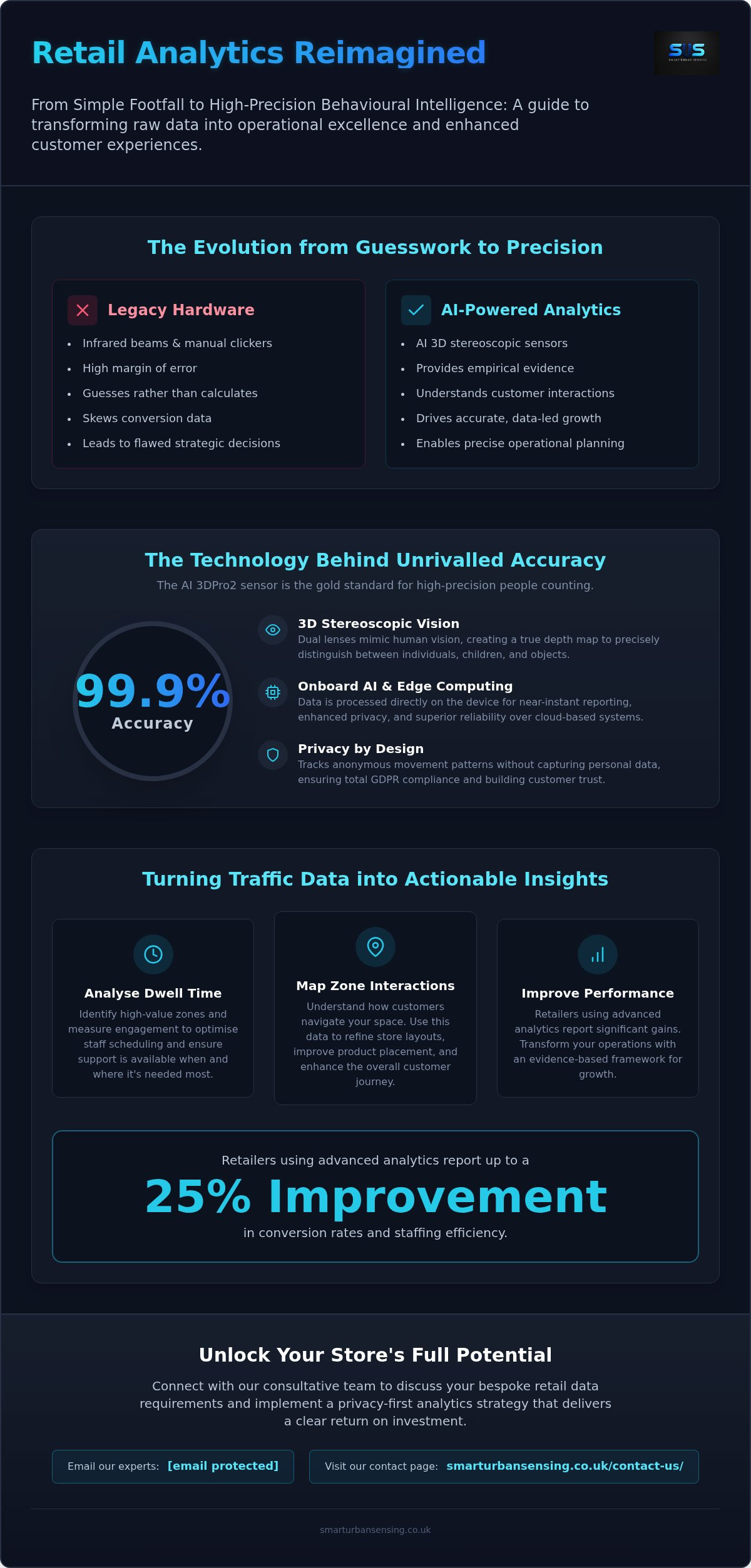
Retailers using advanced analytics report up to a 25% improvement in conversion rates and staffing efficiency, yet many still rely on legacy hardware that guesses rather than calculates. You likely recognise that footfall is the lifeblood of the high street, but the frustration of inaccurate data from outdated beam counters often leads to expensive guesswork. Accuracy is no longer optional. Professional store traffic analysis must now move beyond simple headcounts to provide a sophisticated understanding of how shoppers interact with your space whilst respecting their privacy.
This guide demonstrates how to transform raw footfall into high-precision behavioural insights to optimise store performance whilst maintaining total GDPR compliance. We’ll explore the transition from basic sensors to 3D stereoscopic AI, providing you with an evidence-based framework for layout changes and precise staff scheduling. By the end of this article, you’ll understand how to implement a privacy-first analytics strategy that delivers a clear return on investment. We’ll examine the technical shift towards non-intrusive monitoring and the practical ways this data informs long-term retail stability and growth.
Key Takeaways
- Understand why leading retailers are shifting from basic headcounts to high-precision interaction analytics to capture every nuance of the customer journey.
- Discover how AI 3DPro2 sensors achieve 99% accuracy, providing reliable store traffic analysis even in the most high-density retail environments.
- Learn to use dwell time and zone interaction data to optimise staff scheduling and refine store layouts based on empirical evidence.
- Maintain total GDPR compliance with non-intrusive technology that tracks movement whilst protecting customer anonymity and privacy.
- Connect with our consultative team at sales@smarturbansensing.co.uk or visit smarturbansensing.co.uk/contact-us/ to discuss your bespoke retail data requirements.
What is Store Traffic Analysis in the 2026 Retail Landscape?
Store traffic analysis is the systematic measurement of how visitors move through and interact with a retail environment. It is no longer sufficient to merely count heads at the entrance; retailers in 2026 require a deeper understanding of the customer journey. This discipline has evolved into “interaction analytics,” focusing on the quality of every visit rather than just the volume of footfall. By capturing these nuances, physical stores can achieve data parity with their digital-first competitors, using empirical evidence to drive growth. In a market where online platforms track every click, physical retailers must use these insights to justify their overheads and refine their unique value propositions amongst a crowded marketplace.
Modern systems rely on sophisticated AI to distinguish between genuine customers, staff members, and inanimate objects like pushchairs or shopping trolleys. This distinction is vital for maintaining the integrity of your metrics. Without it, your conversion data becomes skewed by internal operations or delivery staff, leading to flawed strategic decisions. High-precision data allows you to see the store through the eyes of the consumer, identifying which areas command attention and which are overlooked. It provides the clarity needed to transform a static floor plan into a dynamic, responsive sales environment.
The Shift from Footfall to Behavioural Intelligence
The era of manual clickers and basic infrared beams has passed. Manual counting is notoriously prone to human error and lacks the depth required for modern retail operations. We’ve moved from asking “how many” to asking “how do they interact” with the space. Capturing dwell time and path-to-purchase data is now essential for identifying high-value zones. This evolution in people counting technology allows retailers to map the entire customer experience, from the moment they cross the threshold to the point of sale. If you aren’t tracking these movements, you’re missing the context behind your revenue figures.
The Core Pillars of a Modern Analytics Strategy
Store traffic analysis serves as the essential foundation of operational transparency. A truly effective strategy integrates high-performance hardware, such as the AI 3DPro2, with cloud-based V9 Analytics Software. This combination ensures that data accuracy remains the primary driver for all downstream business decisions. When your sensors offer 99% accuracy, you can confidently adjust staffing levels and marketing tactics based on fact rather than intuition. For a bespoke consultation on your retail data needs, contact our team at sales@smarturbansensing.co.uk or visit our contact us page.
The Technology Behind 99% Counting Accuracy
The technological architecture supporting modern store traffic analysis has undergone a radical transformation, moving from rudimentary sensors to sophisticated spatial intelligence. Early 2D infrared beams were limited by their inability to perceive depth, often recording two people walking side-by-side as a single visitor. By contrast, current AI-powered 3D stereoscopic sensors utilise advanced vision processing to create a precise digital map of the entrance. This evolution ensures that the data driving your commercial strategy is grounded in reality, providing the granular detail necessary for high-stakes operational planning.
Why 3D Stereoscopic Sensors are the Industry Gold Standard
Unlike single-lens cameras or thermal sensors, 3D stereoscopic technology employs dual lenses to mimic human binocular vision. This creates a true sense of depth, allowing the system to distinguish between height, mass, and direction of movement with absolute precision. The AI 3DPro2 leverages this depth perception to eliminate common errors caused by shadows, floor reflections, or children moving amongst adult crowds. Discover the strategic value of high precision 3D counters for your infrastructure to ensure your data remains untainted by environmental noise.
Edge computing represents another critical leap forward. By processing data locally on the device rather than in the cloud, these sensors offer near-instantaneous reporting whilst significantly enhancing privacy. This approach avoids the pitfalls of WiFi-based tracking, which often suffers from MAC randomisation and delivers inconsistent results. Similarly, whilst thermal sensors can struggle with “heat bloom” in warm environments, 3D vision remains unaffected by temperature fluctuations. This makes it the most reliable method for retailers who require consistent performance across diverse store formats. The same 3D sensing principles that power retail analytics are also transforming public transport, where understanding the ROI of bus passenger counters has become equally critical for operators seeking to eliminate revenue leakage and optimise route efficiency.
Reliability in Challenging Retail Environments
Retail spaces are rarely perfect laboratories; they feature variable lighting, narrow corridors, and high-density crowds. AI-driven sensors are designed to maintain 99% accuracy even in these demanding conditions. For instance, our outdoor counters are engineered to track entrance flow in all weather conditions, ensuring that external factors don’t obscure your footfall trends. This level of durability is essential during peak trading periods and holiday sales when visitor volumes are at their highest and the margin for error is at its lowest.
Achieving this level of precision requires a consultative approach to hardware placement and configuration. If you’re looking to upgrade your current estate or require technical specifications for a new project, our specialists are available at sales@smarturbansensing.co.uk. You can also request a technical demonstration to see how these sensors integrate with the V9 Analytics Software to provide a complete picture of your store traffic analysis.
Key Metrics to Organise Your Retail Performance
Transforming raw data into actionable intelligence requires a structured approach to specific performance indicators. Whilst technology provides the foundation, the true value of store traffic analysis lies in how these metrics are interpreted to drive revenue. By moving beyond simple volume, retailers can identify precisely where the customer experience succeeds or falters. This objective approach eliminates the subjectivity of traditional consumer surveys, replacing guesswork with a continuous stream of high-fidelity data that reflects real-world shopper behaviour.
Conversion Rate remains the most critical KPI, measuring the percentage of visitors who complete a transaction. It provides a clear view of how effectively your store environment and staff translate interest into sales. Complementing this is the Turn-in Rate, which evaluates the “gravitational pull” of your storefront by comparing total passers-by with those who actually enter. This metric is essential for assessing the impact of window displays and seasonal marketing campaigns. Finally, Average Dwell Time and Flow Analysis allow you to identify “hot spots” where customers linger and “dead zones” that may require layout adjustments to improve engagement.
Analysing the Customer Journey and Path-to-Purchase
Mapping the routes shoppers take through your space reveals the hidden logic of your store layout. Our V9 Analytics Software creates visual heatmaps of customer movement, highlighting the most frequent paths and identifying bottlenecks that might discourage browsing. When you understand the typical path-to-purchase, you can strategically place high-margin items in high-traffic corridors. This data-driven layout optimisation ensures that every square metre of your floor space is working to support your commercial objectives.
Benchmarking and Predictive Analytics
Success in one location should provide a blueprint for your entire estate. Modern analytics allows you to compare performance across multiple locations nationally, identifying top-performing stores and the specific behaviours that drive their results. Using historical data, you can also employ predictive analytics to anticipate future traffic peaks for seasonal planning in 2026. This foresight allows you to adjust marketing spend and inventory levels based on real-time turn-in rate data rather than outdated projections.
Establishing these metrics is a consultative process that begins with clear business goals. To learn how to integrate these KPIs into your operational framework, contact our specialists at sales@smarturbansensing.co.uk. For a detailed look at our reporting capabilities, please visit our contact us page to request a bespoke analytics overview.
Turning Traffic Data into Operational Excellence
High-precision data is only as valuable as the operational shifts it inspires. By integrating store traffic analysis into your daily management, you move from reactive problem-solving to proactive optimisation. This transition allows retailers to refine their service levels and marketing strategies with the same rigour found in e-commerce environments. It’s about ensuring every operational pound spent is backed by empirical evidence of customer behaviour, ensuring your physical space remains as efficient as it is engaging.
Operational excellence is achieved when you can anticipate visitor needs before they manifest as friction. Whether you’re managing a flagship store or a national estate, the ability to act on real-time movement data provides a significant competitive advantage. This approach doesn’t just improve the bottom line; it enhances the overall brand experience by creating a frictionless environment for every shopper who crosses your threshold.
Data-Led Staffing and Scheduling
Labour is often a retailer’s largest controllable expense, yet it’s frequently managed through outdated rotas. Matching staff presence to real-world visitor peaks identified by sensors allows you to maintain high-quality customer interactions without over-scheduling during quiet periods. This balance reduces unnecessary labour costs whilst ensuring that your best sales talent is available when footfall is highest. Implementing data-led scheduling ensures your team is perfectly positioned to prevent service failures during critical peak hours.
Layout Optimisation and Visual Merchandising
Objective movement data removes the intuition from visual merchandising, allowing for a more scientific approach to floor management. By using A/B testing for display placements, you can measure exactly how changes in product positioning affect dwell time and interaction. Placing high-margin products in high-traffic flow zones maximises their exposure, whilst identifying underperforming areas allows you to revitalise the real estate value of the entire floor. This methodical refinement ensures that your store layout is always working to support your commercial objectives.
Queue management and marketing ROI also benefit from this level of granular insight. High-precision sensors can alert managers to growing queues before they lead to “walk-aways,” directly protecting your revenue and customer satisfaction levels. Similarly, you can evaluate the success of physical marketing campaigns by measuring the specific increase in dwell time around promoted displays. If you’re ready to move beyond basic headcounts and implement these advanced strategies, contact us for an operational audit or reach out to our team at sales@smarturbansensing.co.uk.
Navigating the Ethics of Data: A Privacy-First Approach
In 2026, data ethics aren’t just a legal requirement but a cornerstone of brand reputation. Whilst some legacy systems attempt to capture personal data through intrusive WiFi tracking or forced logins, a sophisticated approach to store traffic analysis prioritises complete anonymity. GDPR compliance for UK retailers is no longer just about avoiding regulatory fines; it’s about building a foundation of trust with a public that’s increasingly wary of surveillance. By adopting a “Privacy by Design” philosophy, you ensure that your analytics strategy remains robust, ethical, and respected by your customers.
Our approach centres on non-intrusive sensors that track movement without ever capturing facial recognition or personal IDs. This is a critical distinction in a surveillance-heavy environment. By processing data at the edge, hardware like the AI 3DPro2 ensures that sensitive visual information never leaves the device. Only anonymous, numerical data is transmitted to the V9 Analytics Software. This methodology provides the deep behavioural insights you need whilst ensuring that your business remains beyond reproach regarding privacy standards.
Achieving 99% Accuracy Without Personal Identification
The technological leap in 3D stereoscopic data allows for near-perfect precision whilst remaining entirely anonymous from the point of capture. Instead of identifying a specific person, the AI tracks a “human object” based on mass, height, and movement patterns. This mathematical representation allows the system to distinguish between a shopper and a display unit without needing to know who the shopper is. This ensures your data strategy meets the highest UK national security and privacy standards, providing a secure environment for both the retailer and the visitor.
Future-Proofing Your Retail Analytics
As privacy regulations in the smart city and retail sectors continue to evolve, staying ahead of the curve is essential for long-term stability. Future-proofing your estate means choosing an analytics framework that can adapt to new legal requirements without requiring a total infrastructure overhaul. AI plays a pivotal role in this, acting as a filter that transforms raw environmental data into anonymous, actionable insights. The same privacy-first principles that underpin retail analytics are equally central to smart city footfall monitoring, where local authorities and urban planners are applying identical edge-processing technology to optimise cycle lanes and smart junctions whilst maintaining strict GDPR compliance. This balance of high-tech capability and human-centric ethics is what defines a modern retail leader.
Ready to transform your retail data whilst maintaining total compliance? Contact our expert team at sales@smarturbansensing.co.uk to discuss a privacy-first strategy. You can also visit our contact us page to learn more about our consultative approach to retail infrastructure and GDPR-compliant technology.
The Future of High-Performance Retail Intelligence
Mastering store traffic analysis is no longer a luxury for UK retailers; it’s a strategic necessity for long-term stability. By transitioning from basic footfall to high-precision behavioural data, you gain the clarity needed to optimise every square metre of your floor space. High-fidelity insights allow you to align staffing levels with actual visitor peaks and refine store layouts based on empirical movement patterns rather than intuition.
Our AI 3DPro2 technology delivers 99% accuracy whilst maintaining a rigorous, privacy-first design that ensures full GDPR compliance. When paired with the V9 Analytics Software, these sensors provide actionable insights that directly improve conversion rates and customer satisfaction. This methodical approach to data allows your physical store to compete effectively against digital-first rivals whilst respecting shopper anonymity at every stage. For retailers looking to go further, using footfall data to increase retail conversion is the natural next step in translating high-precision analytics into measurable sales growth aligned with the latest 2026 UK trends.
To begin your journey towards data-driven retail excellence, contact our expert team today or reach out directly via sales@smarturbansensing.co.uk. We’re ready to help you transform your infrastructure into a responsive, high-performing environment that’s built for the challenges of 2026 and beyond.
Frequently Asked Questions
How does store traffic analysis differ from simple people counting?
Store traffic analysis moves beyond basic headcounts to provide a qualitative understanding of visitor behaviour. Whilst simple people counting tells you how many people entered, analysis reveals where they lingered, which displays they ignored, and the specific paths they took through your store. By using V9 Analytics Software, you can transform raw numbers into actionable heatmaps and dwell time metrics, allowing for a more sophisticated approach to inventory and layout management.
Is store traffic tracking GDPR-compliant in the UK?
Yes, our store traffic tracking is fully GDPR-compliant because it employs a privacy-first, non-intrusive design. Sensors like the AI 3DPro2 don’t capture facial recognition, personal identifiers, or images of individuals. Instead, they track anonymous “human objects” as mathematical data points. This “Privacy by Design” approach ensures your retail estate meets the highest UK standards for data protection whilst still delivering the high-precision insights necessary for operational growth.
Can 3D stereoscopic sensors work in low-light retail environments?
Modern 3D stereoscopic sensors are engineered to maintain 99% accuracy across a wide range of lighting conditions. Unlike traditional 2D cameras that rely on high contrast, the AI 3DPro2 uses dual-lens depth perception to distinguish objects even in dim or variable light. This ensures consistent data collection during evening trading or in stores with moody, atmospheric lighting, providing a reliable stream of information regardless of your interior design choices.
How do I use traffic data to improve my store layout?
You can improve your layout by identifying underperforming “dead zones” and high-traffic “hot spots” through flow analysis. By mapping the most frequent routes shoppers take, you can strategically position high-margin items or new collections in areas with the highest visibility. V9 Analytics Software provides the visual evidence needed to move displays and test new configurations, ensuring your floor plan is always optimised to encourage browsing and maximise transaction potential.
What is a “good” conversion rate for a physical retail store in 2026?
Whilst a “good” conversion rate varies significantly between luxury boutiques and high-volume grocery stores, the focus should be on the rate of improvement. Retailers using advanced store traffic analysis typically report a 10% to 25% increase in conversion rates after implementing data-led changes. The goal is to establish a reliable baseline and use behavioural insights to refine your service levels, ensuring that a higher percentage of visitors leave as paying customers.
Can I integrate traffic analysis software with my existing POS system?
Integration with your existing Point of Sale (POS) system is a standard feature of our V9 Analytics Software. By combining transaction data with footfall figures, you can calculate real-time conversion rates and average transaction values per visitor. This holistic view allows you to see exactly how changes in staffing or marketing affect your bottom line, creating a unified data ecosystem that supports clear, evidence-based business decisions across your entire estate.
How long does it take to see an ROI from behaviour analysis technology?
Most retailers observe a full return on their investment within three to six months of implementing behaviour analysis technology. This rapid ROI is driven by immediate improvements in staff scheduling and the reduction of labour costs during quiet periods. Additionally, by identifying and correcting layout inefficiencies that cause “walk-aways,” the system pays for itself through recovered sales and enhanced operational efficiency, making it a sustainable long-term investment for growing brands.
What is the most accurate way to measure customer dwell time?
The industry gold standard for measuring dwell time is AI-powered 3D stereoscopic technology. Sensors in the AI 3DPro series track the precise duration a visitor remains within a specific zone, such as a promotional display or a checkout queue. This method is far more accurate than WiFi tracking or thermal sensors. For a bespoke assessment of your needs, please contact our team at sales@smarturbansensing.co.uk or visit our contact us page.
For a deeper understanding of how shopper intent drives store performance, our guide on retail customer behaviour analysis explores how bridging the gap between raw footfall data and actual customer demand can reduce operational waste and drive measurable growth in 2026.
Researching footfall analytics?
Get the supplier-neutral footfall & occupancy buyer checklist
Entrance survey sheet, 24 buyer checks, a simple ROI worksheet and the red flags to watch for. We will email it to you — and, if you like, a short monthly retail analytics briefing.


