

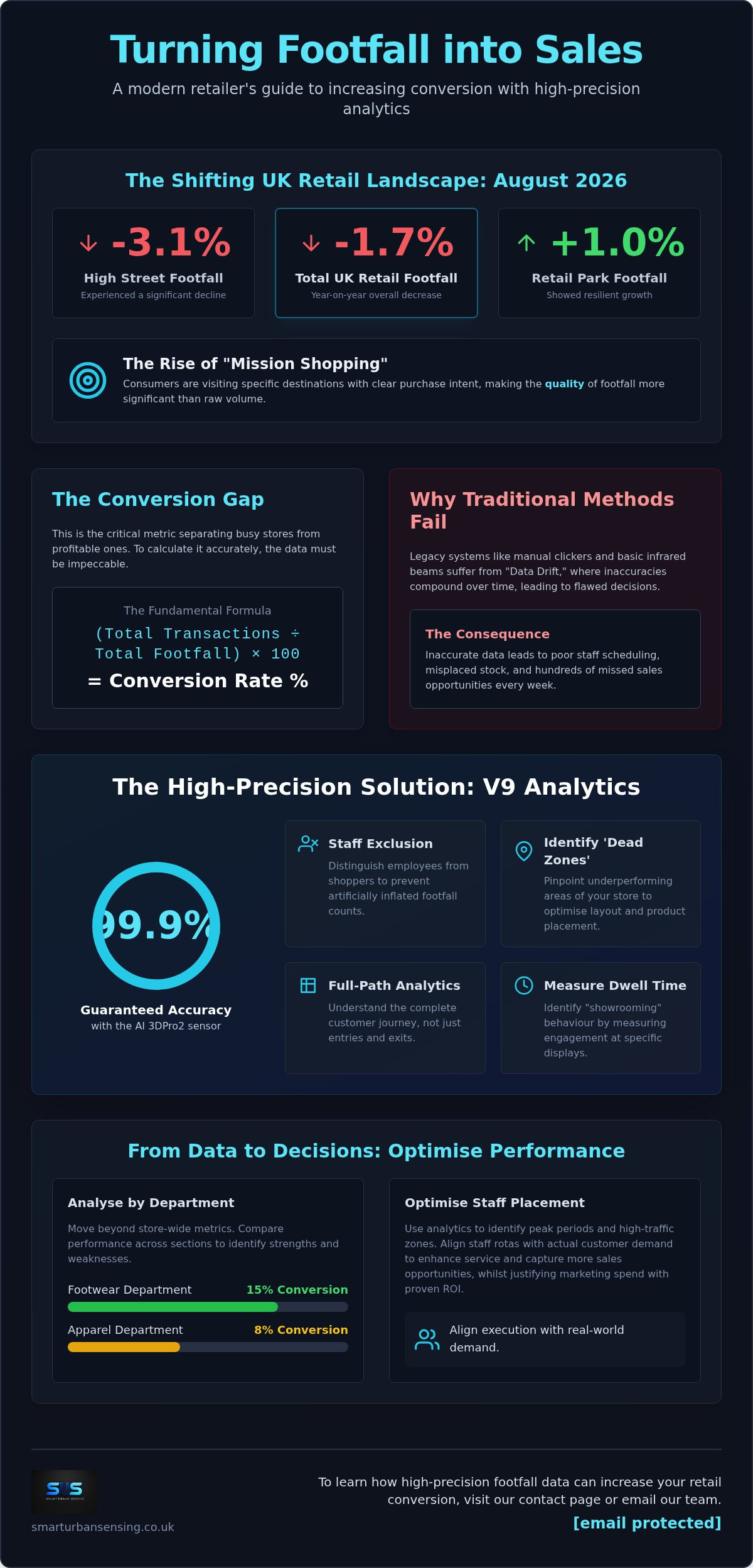
In August 2026, total UK retail footfall fell by 1.7% year-on-year, yet retail parks managed a 1.0% increase, revealing a fragmented landscape where timing and location are everything. For the modern retailer, simply counting heads is no longer sufficient to maintain a competitive edge. By using footfall data to increase retail conversion, businesses are moving beyond raw visitor numbers to uncover the actionable insights hidden within customer behaviour. You’ve likely felt the sting of rising labour costs and the frustration of a store full of “lookers” who never quite make it to the point of sale.
This article explores how to bridge this gap by transforming high-precision analytics into measurable sales growth. We’ll examine the latest 2026 trends, providing a roadmap to optimise staff rotas and prove the ROI of your marketing campaigns with 99% accuracy using the V9 Analytics Software. By understanding how to distinguish between browsing and buying, you can ensure your operational execution meets the actual demand of your floor. To learn more about how high-precision footfall data can help you increase your retail conversion, please visit our contact us page at smarturbansensing.co.uk or email our team at sales@smarturbansensing.co.uk.
Key Takeaways
- Analyse how ‘Mission Shopping’ is redefining UK retail patterns and why footfall quality is becoming more significant than raw volume.
- Master the fundamental formula for using footfall data to increase retail conversion to accurately measure the delta between potential demand and actual sales.
- Explore how the AI 3DPro2 sensor achieves 99% accuracy, providing the ground truth necessary to justify marketing spend and infrastructure changes.
- Utilise V9 Analytics Software to identify ‘Dead Zones’ and optimise staff placement during critical peak periods to enhance the customer experience.
- Request a consultation through our contact us page at smarturbansensing.co.uk or email sales@smarturbansensing.co.uk to learn how our Retail Starter Kit can transform your store performance.
The Evolution of Retail Footfall Trends in the UK
The UK retail environment is experiencing a profound transformation. Total retail footfall decreased by 1.7% in August 2026, yet this headline figure masks a complex reality. High streets saw a 3.1% decline whilst retail parks enjoyed a 1.0% increase. This divergence highlights the rise of “Mission Shopping,” where consumers visit specific destinations with a clear purchase intent rather than just browsing. For managers, using footfall data to increase retail conversion is now about capturing this high-intent traffic and ensuring every visitor is met with the right service levels.
Hybrid working has permanently altered the traditional Saturday peak. With more professionals working from home on Mondays and Fridays, mid-week traffic in suburban hubs has strengthened. This shift demands a move from simple entrance counting to sophisticated full-path analytics. It’s no longer enough to know how many people entered. You need to know where they went and why they left.
Current UK Retail Trends and Consumer Behaviour
Consumer habits in 2026 are heavily influenced by cost-of-living pressures. Shoppers are more discerning, often engaging in “showrooming” where they inspect products in-store before purchasing online. Modern people counting technology has evolved to detect these patterns by measuring dwell time and engagement at specific displays. If a customer spends ten minutes at a high-value display but leaves empty-handed, your data should trigger a review of your pricing or staff intervention strategies. A deeper understanding of retail customer behaviour analysis can help you bridge the gap between shopper intent and actual purchase decisions. Using footfall data to increase retail conversion requires this level of granular insight to turn browsers into buyers.
Why Traditional Counting Methods are Failing Retailers
Legacy systems like manual clickers or basic infrared beams are increasingly obsolete. These methods suffer from “Data Drift,” where inaccuracies compound over time, leading to flawed staffing and stock decisions. In a high-volume environment, even a small margin of error can result in hundreds of missed sales opportunities every week. Sophisticated AI-powered sensors, such as the AI 3DPro2, eliminate these blind spots. By integrating high-precision counts with V9 Analytics Software, retailers can align their operational execution with real-world demand.
To discuss how our Retail Starter Kit can modernise your data collection, visit our contact us page at smarturbansensing.co.uk or reach out to us at sales@smarturbansensing.co.uk.
Understanding the Conversion Gap: Beyond Basic People Counting
Retail conversion is the critical metric that separates busy stores from profitable ones. It represents the percentage of visitors who complete a purchase, providing a clear window into operational efficiency. The mathematical formula is straightforward: (Total Transactions / Total Footfall) x 100. However, the data feeding this equation must be impeccable. Using footfall data to increase retail conversion effectively requires a precise distinction between a family of four entering as a single buying unit and four individual shoppers. Without 99% accuracy, your conversion rate is merely a guess.
Calculating Your True Store Performance
To achieve a granular view of success, you must integrate Point of Sale (POS) data directly with V9 Analytics Software. This synchronisation allows you to move beyond “Store Conversion” and analyse “Department Conversion.” For instance, your footwear section might convert at 15% whilst apparel lags at 8%. Comparing these internal metrics against broader UK retail footfall data provides the context needed to understand if your performance is a result of internal strategy or national economic shifts. To see how these insights apply to your specific layout, you can request a tailored performance audit from our specialists.
The Role of Staff Exclusion in Accuracy
Precision is often undermined by the “noise” of employee movement. Staff members frequently cross entrance thresholds to assist customers, manage stock, or take breaks. If your system cannot distinguish between a sales assistant and a high-intent shopper, your footfall counts will be artificially inflated. This error directly suppresses your conversion rate, making your team’s performance appear lower than the reality. It’s a statistical flaw that leads to poor management decisions.
The AI 3DPro2 sensor utilises advanced stereoscopic vision to automatically exclude staff from the final count. This ensures that the Top of Funnel (TOFU) data remains pure. When you remove employee “white noise,” you gain a clear view of the true demand on your floor. This level of detail is essential for identifying missed opportunities, such as periods where high visitor numbers didn’t lead to sales because the staff-to-customer ratio was insufficient. Using footfall data to increase retail conversion starts with trusting the numbers you collect.
Accurate data is the foundation of any retail growth strategy. To learn more about how high-precision footfall data can help you increase your retail conversion, please visit our contact us page at smarturbansensing.co.uk or email our team at sales@smarturbansensing.co.uk.
How High-Precision 3D Sensors Reveal Conversion Opportunities
Precision is the foundation of any analytical strategy. Whilst many systems claim high accuracy, the reality of high-volume retail environments often leads to significant data drift. Thermal sensors and 2D cameras frequently struggle with shadows, overlapping crowds, or rapid lighting changes, leading to skewed metrics. In contrast, 3D stereoscopic sensors provide a topographical view of the floor, ensuring that every individual is accounted for with 99% accuracy. This final 1.9% of precision makes the difference in ROI, as it prevents the misallocation of resources based on faulty demand signals. Using footfall data to increase retail conversion requires this level of ground truth to turn analytical insights into profitable actions.
The AI 3DPro2 Advantage for UK Retailers
The AI 3DPro2 utilises dual-lens stereoscopic vision to mimic human depth perception, allowing it to distinguish between customers and inanimate objects like pushchairs or shopping trolleys. This technology remains reliable across varying entrance widths and ceiling heights, making it ideal for the diverse architecture found in British shopping centres and historic high streets. 3D stereoscopic sensors are the gold standard for 2026 retail due to their ability to provide high-precision, real-time data for immediate operational response. When you can trust the count, you can confidently adjust your strategy to capture every sales opportunity.
GDPR and the Privacy-First Analytics Model
Ethical responsibility is paramount when deploying technology in public spaces. Our non-intrusive sensors ensure 100% GDPR compliance by design, protecting both the retailer and the consumer. Through a process known as “Edge Processing,” all analytical computations happen directly on the AI 3DPro2 device. This means that video images are processed into anonymous data points instantly and never leave the sensor; no personal images are ever stored or transmitted over the network. This privacy-first approach builds customer trust whilst gathering the sophisticated metrics needed for growth. By anonymising data at the source, retailers can focus on broad behavioural patterns and engagement levels without compromising individual privacy.
Adopting high-precision technology is the first step towards a truly data-driven retail environment. Using footfall data to increase retail conversion is only possible when the underlying numbers are beyond reproach. To explore how our AI 3DPro2 can transform your store’s performance, visit our contact us page at smarturbansensing.co.uk or email our team at sales@smarturbansensing.co.uk.
Practical Tactics to Increase Conversion Using Footfall Insights
Data without action is merely overhead. To move the needle on your bottom line, you must translate these counts into floor-level changes. Using footfall data to increase retail conversion involves a systematic approach to identifying where your operations are failing to meet visitor demand. It’s about spotting the “Power Hours” where traffic is high but sales lag, often due to preventable friction. When you understand the ebb and flow of your store, you can stop guessing and start growing.
Staffing Optimisation for Peak Conversion
Fixed rotas are a relic of a less competitive era. By moving to data-led scheduling, you can ensure your most experienced staff are on the floor during peak traffic windows. This reduces the “walk-away” rate. Research indicates that shoppers are likely to abandon a queue and leave without purchasing after waiting for just 9 minutes. If your staff-to-customer ratio is misaligned, you’re essentially gifting sales to your competitors. For a practical framework on using footfall data for staff scheduling to reduce idle hours and boost conversion, explore our dedicated labour optimisation guide. For a deeper dive into implementation, consult our Retail Staffing Optimization: Data-Led Scheduling Guide.
Visual Merchandising and Layout Effectiveness
Most retailers focus on entrance counts, but zonal conversion is where the real profit lives. Using heatmaps allows you to identify “Dead Zones” where customers rarely venture. You can then test the effectiveness of “End-cap” promotions by measuring the dwell time and subsequent uplift in that specific zone. High dwell time with low sales usually indicates interest but confusion over pricing or product benefits. This level of detail allows you to refine your merchandising before a poor layout drains your quarterly revenue.
This data also empowers you to justify premium shelf-space pricing for suppliers. When you can prove exactly how many people pass a specific aisle and how long they linger, your merchandising becomes a revenue stream in its own right. Similarly, measuring the “Attraction Rate” of window displays helps you understand which creative concepts actually drive foot traffic into the store. You can then tailor your marketing spend based on high-conversion time slots, ensuring every pound spent on advertising correlates with a peak in store entries. Combining these metrics with a structured approach to retail customer behaviour analysis and store performance data ensures your testing and refinement cycle is grounded in accurate shopper intent. Using footfall data to increase retail conversion is a continuous cycle of testing, measuring, and refining.
Implementing these tactics requires a robust technological foundation. To learn more about how high-precision footfall data can help you increase your retail conversion, please contact our expert team at smarturbansensing.co.uk or email us at sales@smarturbansensing.co.uk.
Optimising Retail Performance with Smart Urban Sensing Technology
Deployment speed is essential for retailers looking to capture 2026 growth. Our Retail Starter Kit provides a streamlined entry point for those beginning their data journey, offering everything needed for rapid deployment in a single location. As your business expands, our infrastructure scales seamlessly with you. Whether you manage a single boutique or a national retail chain, the transition to an enterprise-level network is managed through the V9 Analytics Software. This centralised platform ensures that using footfall data to increase retail conversion remains a consistent, data-driven process across every site in your portfolio.
Reliability is maintained through our dedicated UK-based technical support team. We don’t just supply hardware; we ensure your sensors are calibrated and maintained for long-term stability. To future-proof your investment, we offer a clear path to the next generation of sensing, including the AI 3DPro3, ensuring your analytics capabilities stay ahead of industry shifts. This methodical approach values accuracy and long-term stability over quick, superficial results.
Actionable Insights via V9 Analytics Software
Data is only as valuable as the decisions it informs. The V9 Analytics Software features customisable dashboards that speak the language of retail managers, translating technical metrics into clear, visual signals. Automated reporting allows for effortless regional performance comparisons, highlighting which shopping centres are leading in conversion and which require strategic intervention. Integration is a core strength; our software connects with your existing ERP and workforce management tools to create a unified view of your operational health. Using footfall data to increase retail conversion becomes a simplified, automated part of your weekly management cycle whilst providing the depth required for quarterly board reviews.
Your Strategic Partner in Data-Driven Growth
Choosing a technology provider is about more than purchasing a sensor. Smart Urban Sensing projects the persona of a strategic partner, showing a deep understanding of the logistical challenges within the UK retail sector. We take a consultative approach, working closely with you to solve complex problems through innovation rather than simply listing product features. By framing technical capabilities in terms of their practical utility, we bridge the gap between high-level engineering and everyday management.
We are committed to ethical responsibility and technological sophistication. To begin your journey toward high-precision retail analytics, please visit our contact us page at smarturbansensing.co.uk or reach out to our specialist team today at sales@smarturbansensing.co.uk.
Future-Proofing Your Retail Strategy with High-Precision Analytics
The UK retail landscape of 2026 demands a shift from passive observation to active, data-led intervention. Success no longer depends on the volume of visitors entering your store, but on the precision with which you convert that interest into transactions. By using footfall data to increase retail conversion, you can align your staffing levels with documented “Power Hours” and eliminate the operational friction that leads to abandoned baskets. This transition from basic counting to deep behavioural analysis is what distinguishes market leaders from their competitors.
Smart Urban Sensing provides the technological foundation for this growth. With 99% counting accuracy and a GDPR-compliant by design architecture, our solutions deliver the ground truth needed for confident decision-making. Our UK-based expert support ensures your infrastructure remains robust as you scale from a single boutique to a national network. We’re committed to helping you navigate the complexities of modern consumer behaviour with clarity and integrity.
The delta between potential demand and measurable sales growth is narrower than it’s ever been for those with the right insights. Contact our retail analytics experts today to increase your conversion rates or email our team directly at sales@smarturbansensing.co.uk. We’re ready to help you transform your raw visitor numbers into a sustainable competitive advantage.
Frequently Asked Questions
What is the difference between footfall and conversion rate?
Footfall represents the raw number of visitors who enter your premises, whilst the conversion rate is the percentage of those individuals who actually complete a purchase. It’s the critical delta between potential and realised sales. Using footfall data to increase retail conversion involves analysing this ratio to identify operational gaps. By integrating POS data with V9 Analytics Software, managers can see exactly how many browsers become buyers in real time.
How accurate are AI people counters compared to manual counting?
AI people counters, specifically the AI 3DPro2, deliver up to 99% accuracy, whereas manual counting is prone to human error and fatigue. Manual clickers often suffer from “Data Drift” and fail to distinguish between buying groups and individuals. Our 3D stereoscopic technology provides a topographical view of the floor, ensuring that every head is accounted for even in dense crowds or challenging lighting conditions found in historic UK high streets.
Is people counting technology GDPR compliant in the UK?
Yes, our technology is GDPR-compliant by design and follows a privacy-first analytics model. We utilise “Edge Processing,” meaning that video images are processed into anonymous data points directly on the sensor and never leave the device. No personal images or identifiable features are ever stored or transmitted over the network. This approach ensures you gather sophisticated behavioural metrics whilst fully protecting the anonymity and trust of your customers and staff.
Can footfall data help reduce retail labour costs?
High-precision data allows you to significantly optimise expenditure by aligning staff rotas with actual visitor demand. Instead of relying on fixed schedules, you can use these insights to identify “Power Hours” and “Dead Zones.” This prevents overstaffing during quiet periods and ensures you have enough coverage during peak traffic to avoid missed sales. Learn more about using footfall data for staff scheduling and labour optimisation to protect your margins. For tailored advice on your staffing, visit our contact us page at smarturbansensing.co.uk.
What is a 3D stereoscopic sensor and why is it better for retail?
A 3D stereoscopic sensor uses dual lenses to mimic human depth perception, creating a topographical map of the monitored area. This is significantly superior to thermal or 2D sensors because it can distinguish between people and objects, such as pushchairs or shopping trolleys. It also excels in varying entrance widths and ceiling heights. Using footfall data to increase retail conversion requires this level of ground truth to ensure your strategies are effective.
How long does it take to install a retail footfall system?
Installation is designed for minimal disruption to your daily operations. Our Retail Starter Kit is built for rapid deployment, typically taking only a few hours per entrance for a standard setup. Once the AI 3DPro2 sensor is mounted and connected to your network, our UK-based expert support team assists with remote calibration. This ensures your system is active and providing 99% accurate data to your management team almost immediately.
Can I monitor multiple store locations from one central dashboard?
Yes, the V9 Analytics Software is built to scale from a single boutique to a national retail chain seamlessly. It provides a centralised dashboard where you can compare regional performance and identify trends across your entire portfolio in real time. You can set up automated reporting to highlight which sites are leading in conversion. To discuss your specific national requirements, please email our specialist team at sales@smarturbansensing.co.uk.
Do I need to exclude my staff from the footfall count?
Excluding staff is essential for maintaining the integrity of your conversion metrics. If employees are counted as visitors, your footfall is artificially inflated and your conversion rate is suppressed, leading to flawed management decisions. The AI 3DPro2 sensor automatically identifies and excludes staff members from the final count. This ensures that your analytical data reflects true customer demand rather than internal operational movements, providing a clear view of your store’s performance.
Researching footfall analytics?
Get the supplier-neutral footfall & occupancy buyer checklist
Entrance survey sheet, 24 buyer checks, a simple ROI worksheet and the red flags to watch for. We will email it to you — and, if you like, a short monthly retail analytics briefing.


