
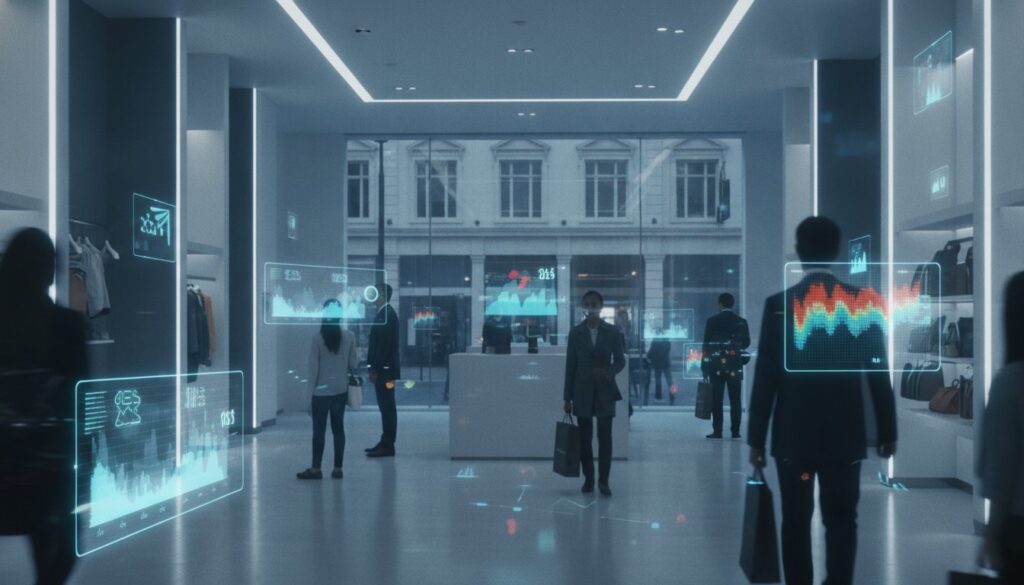
What if the primary reason your conversion rates are stalling isn’t your product range, but the invisible gap between your shop floor data and actual shopper intent? With e-commerce expected to claim 21.1% of global sales in 2026, the pressure on physical stores to justify every pound of operational spend has never been higher. You’re likely feeling the strain of rising labour costs whilst struggling with the erratic, unreliable data produced by legacy infrared counters. Mastering retail customer behaviour analysis is no longer about simply counting heads; it’s about bridging the “Demand Gap” to ensure your staffing levels perfectly mirror peak demand. This guide explores how transitioning to 99% accurate sensing technology allows you to move beyond guesswork. We’ll show you how to transform raw footfall into actionable insights that reduce waste and drive measurable growth. For bespoke advice on optimising your store performance, visit our contact us page at smarturbansensing.co.uk or reach out to our team at sales@smarturbansensing.co.uk.
Key Takeaways
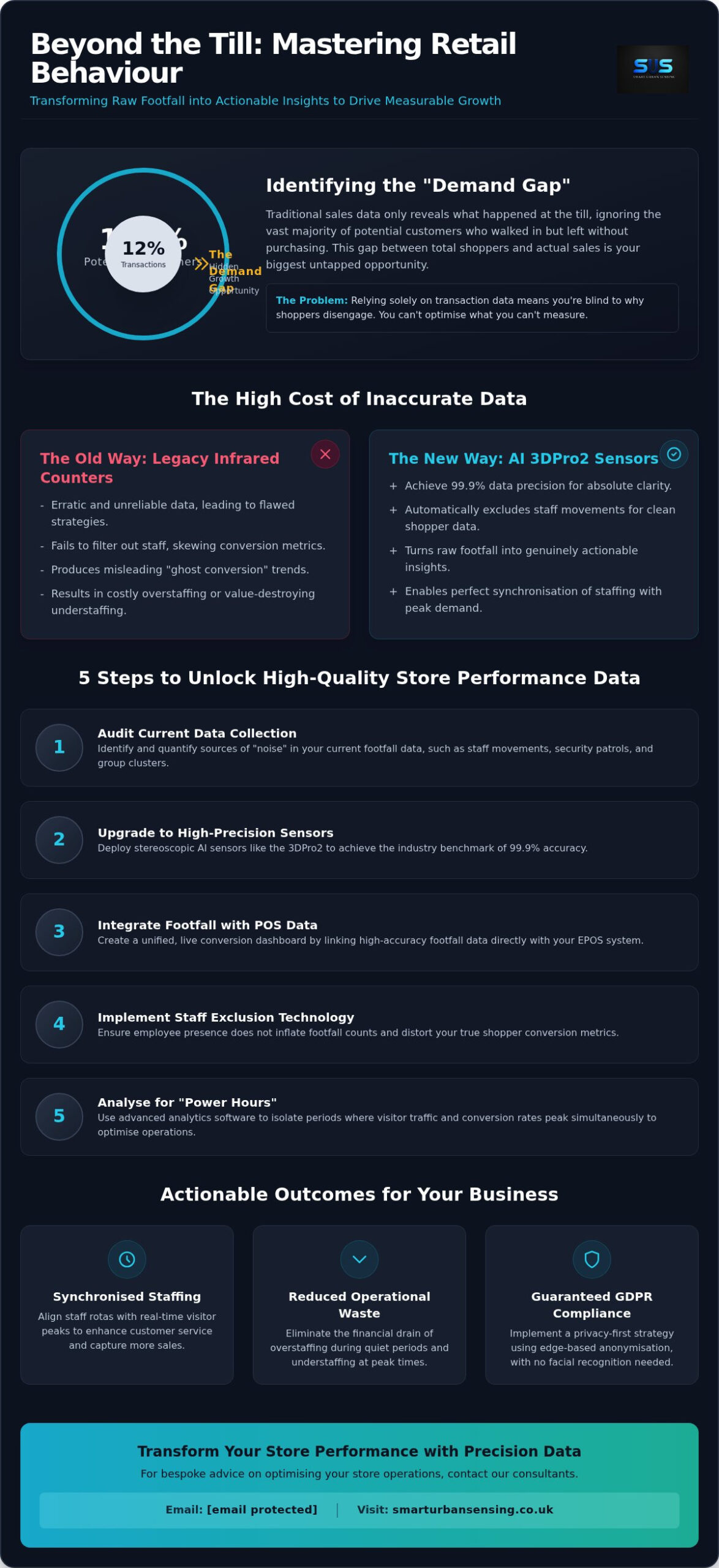
- Identify the “Demand Gap” by distinguishing between completed transactions and the total volume of potential customers to uncover hidden growth opportunities.
- Achieve 99% data precision by deploying AI 3DPro2 sensors that automatically filter out staff movements and shopping groups for cleaner insights.
- Leverage advanced retail customer behaviour analysis to synchronise staff rotas with real-time visitor peaks, reducing operational waste whilst improving service.
- Maintain strict GDPR compliance through a privacy-first approach that utilises edge-based anonymisation without the need for intrusive facial recognition.
- To transform your store performance data, visit our contact us page at smarturbansensing.co.uk or email our consultants at sales@smarturbansensing.co.uk.
The Demand Gap: Why Sales Data Isn’t Enough for Retail Customer Behaviour Analysis
Traditional retail management often relies heavily on Electronic Point of Sale (EPOS) data. Whilst transaction figures tell you what happened at the till, they remain silent on the hundreds of potential customers who walked through your doors and left empty-handed. This distinction between sales data and demand data is the cornerstone of sophisticated retail customer behaviour analysis. Sales data is merely the end of a story; demand data is the entire narrative, including the missed opportunities and the friction points that prevent a purchase.
The “Demand Gap” represents the volume of potential revenue lost within your store. It’s the primary metric for identifying underperforming units that might otherwise appear successful based on turnover alone. In 2026, staying competitive requires more than a retrospective look at yesterday’s takings; it demands real-time visibility into the total number of people interacting with your brand. To better understand this concept, watch this helpful video:
Understanding the psychological and economic factors behind consumer behaviour allows retailers to address why shoppers disengage before reaching the checkout. High-fidelity footfall data provides the essential foundation for these insights, turning a physical shop floor into a measurable digital environment where every movement can be optimised for better performance.
Defining Conversion Rate in the Modern Retail Context
In its simplest form, you calculate conversion by dividing total transactions by total footfall. However, the value of this percentage depends entirely on the accuracy of your denominator. If your sensors fail to filter out staff members, security guards, or delivery couriers, you’re left with “ghost conversion” trends that mislead senior management and result in flawed strategic pivots. High-accuracy retail customer behaviour analysis ensures that your conversion metrics reflect genuine shopper intent rather than operational noise. For a deeper look at how to refine these metrics, explore our guide on store traffic analysis.
The Operational Cost of Retailing in the Dark
Operating without precise data is a significant financial risk. It leads to expensive overstaffing during quiet periods and, more critically, understaffing during peak demand, which directly causes abandoned baskets and frustrated shoppers. Poor data also compromises stock management and floor layout decisions. Relying on manual clickers or basic legacy sensors in 2026 is no longer a viable strategy for high-growth retailers. To ensure your data reflects the reality of your shop floor, visit our contact us page at smarturbansensing.co.uk or email our team at sales@smarturbansensing.co.uk.
How to Improve Store Performance Data Quality in 5 Strategic Steps
High-quality data is the lifeblood of retail customer behaviour analysis. Without a rigorous strategy to eliminate inaccuracies, your insights will remain anecdotal rather than actionable. Improving your data quality requires a shift from basic counting to sophisticated sensing. Following these five strategic steps ensures your store performance metrics are built on a foundation of absolute precision.
- Step 1: Audit current data collection points to identify “noise” like staff movements, security patrols, and shopping group clusters.
- Step 2: Upgrade to stereoscopic sensors, such as the AI 3DPro2, to achieve the industry benchmark of 99% accuracy.
- Step 3: Integrate footfall data directly with your POS system to create a live, unified conversion dashboard.
- Step 4: Implement staff exclusion technology to ensure employee presence doesn’t skew your shopper performance metrics.
- Step 5: Deploy V9 Analytics Software to isolate “Power Hours” where visitor traffic and conversion rates peak simultaneously.
Eliminating Data Noise with AI Sensors
The AI 3DPro2 uses advanced stereoscopic vision to distinguish between adults, children, and shopping trolleys. This level of granularity is vital for accuracy; height filtering ensures that children or inanimate objects don’t inflate your visitor counts during dense crowd periods. Accuracy is the difference between a successful campaign and a wasted budget. Staff Exclusion is the ability to remove employees from total footfall counts via wearable tags or AI recognition.
Integrating Demand with Supply-Side Metrics
Modern Retail analytics tools often fall short when they ignore the relationship between visitor flow and available labour. By combining high-fidelity footfall data with your recorded labour hours, you can calculate Sales per Labour Hour (SPLH) with total precision. This data provides the objective evidence needed to justify budgets for store refurbishments or significant layout changes. Utilising high precision 3D counters ensures these high-stakes financial decisions are based on the most reliable metrics available. This approach moves retail customer behaviour analysis from the back office to the heart of your operational strategy.
If you’re ready to refine your data stream and eliminate the guesswork from your operations, you can speak with our technical consultants or reach out directly via sales@smarturbansensing.co.uk.
Comparing Sensor Technologies: Accuracy vs Operational ROI
Selecting the right hardware is the most critical decision in establishing a reliable retail customer behaviour analysis programme. Whilst the temptation to minimise initial capital expenditure is strong, the long-term cost of poor data often dwarfs the price of premium sensors. Legacy infrared (IR) beam counters, once the industry standard, are increasingly inadequate for modern UK high streets. These sensors fail to distinguish between multiple people entering a store simultaneously, leading to significant undercounting during peak trading periods when accuracy matters most.
Thermal imaging sensors offer an alternative by detecting heat signatures, which makes them effective in low-light conditions. However, they frequently struggle in temperature-variable environments, such as shop entrances affected by winter draughts or overhead heaters. For retailers seeking a definitive solution, 3D stereoscopic sensing has emerged as the gold standard. By investing in high-accuracy hardware, you avoid the “low-cost trap” where inaccurate data leads to expensive errors in staffing and inventory management.
Why 3D Stereoscopic Technology Wins in 2026
The superiority of 3D stereoscopic technology lies in its dual-lens system, which mimics human depth perception to create a three-dimensional map of the entrance area. This allows the sensor to count individuals within dense crowds with up to 99% accuracy. Unlike simpler systems, the AI 3DPro2 remains unaffected by common environmental challenges such as floor glare, moving shadows, or complex architectural features like revolving doors. This precision ensures that your retail customer behaviour analysis is based on reality rather than digital estimations, providing a stable foundation for every operational pivot you make.
Maintenance and Calibration Requirements
Operational ROI isn’t just about the initial count; it’s about sustained data uptime across a national estate. Industrial-grade AI sensors are built for longevity, far outlasting consumer-grade alternatives that require frequent physical adjustments. A key advantage of modern systems is the ability to perform remote calibration. This feature eliminates the need for expensive on-site service visits, as technicians can fine-tune sensor zones and health via the cloud. When you factor in reduced maintenance costs and the high value of consistent data, the ROI of professional-grade sensing becomes undeniable.
To discuss which sensor technology best suits your specific store layout, visit our contact us page at smarturbansensing.co.uk or email our technical team directly at sales@smarturbansensing.co.uk.
Actionable Insights: Using Behavioural Data to Optimise Store Operations
Transforming high-fidelity data into operational profit requires a shift from passive monitoring to active intervention. Whilst previous sections established how to capture 99% accurate data, the true value lies in the retail customer behaviour analysis that follows. By identifying stores that exhibit high footfall but disappointing conversion rates, managers can pinpoint specific local issues, such as poor stock availability or inadequate service levels. Queue management data is equally vital; it allows you to monitor checkout friction in real time, providing the insights needed to deploy extra staff before a long wait leads to basket abandonment. This proactive approach ensures that the demand you’ve worked hard to generate isn’t lost at the final hurdle.
Staffing Optimisation and Scheduling
Static, fixed rotas are a relic of a less data-driven era. Modern retailers use predictive analytics to transition towards dynamic, data-led scheduling that aligns perfectly with visitor flow. Learning how to use footfall data to increase retail conversion is particularly critical during seasonal peaks when the cost of a missed customer is at its highest. V9 Analytics software facilitates this by highlighting “dead hours” where labour costs can be safely reduced without impacting the shopper experience. This synchronisation of staff levels with visitor peaks directly reduces operational waste whilst protecting service standards across your estate. For a comprehensive framework on building precision rotas, explore our guide on using footfall data for staff scheduling and labour optimisation.
Zone Analytics and Heat Mapping
Understanding how shoppers navigate your physical space is essential for effective merchandising and layout design. 3D behavioural sensors allow you to measure which aisles attract the most engagement and where dwell times are highest, revealing the “hot zones” of your store. This level of detail enables you to prove the tangible value of premium end-cap displays to suppliers with objective evidence, potentially opening new revenue streams through co-marketing agreements. Additionally, measuring your “Capture Rate”, the ratio of passers-by to store entrants, allows you to test the effectiveness of window displays and marketing campaigns with scientific rigour. If a window refresh doesn’t move the capture rate, you’ll know within hours rather than weeks.
To begin optimising your estate with advanced retail customer behaviour analysis, you can book a technical consultation today or contact our team at sales@smarturbansensing.co.uk.
Implementing a Privacy-First Retail Analytics Strategy
Ethical data collection is the cornerstone of a sustainable retail strategy. Whilst the desire for deep insights is understandable, it must never come at the expense of consumer privacy or regulatory compliance. Modern retail customer behaviour analysis relies on understanding patterns, not identifying individuals. This is why our approach strictly avoids facial recognition technology, ensuring that every visitor remains a statistic rather than a subject. By prioritising GDPR compliance, retailers can build long-term brand trust and loyalty, demonstrating a clear commitment to protecting the personal information of their shoppers.
V9 Analytics software plays a vital role in this ethical framework by providing secure, cloud-based data management for national retail estates. It ensures that sensitive operational data is encrypted and accessible only to authorised decision-makers. When privacy is baked into the technology from the outset, it ceases to be a hurdle and becomes a competitive advantage. Transparently communicating these standards to your customers reinforces your reputation as a responsible and sophisticated operator.
Anonymisation at the Edge
The AI 3DPro2 sensor is engineered with a “privacy-by-design” philosophy. Instead of recording or transmitting video files, the device processes images locally into mathematical coordinates. This method, known as edge processing, ensures that no identifiable visual data ever leaves the sensor. It’s the safest way to handle visitor data in the UK, as it eliminates the risks associated with storing or transferring sensitive imagery. It’s vital to distinguish between people counting for analytics and intrusive surveillance; our technology is built solely to quantify movement and behaviour, providing the clarity you need without compromising anonymity.
Future-Proofing Your Retail Data Strategy
The UK’s data privacy environment is constantly evolving. Preparing for potentially stricter regulations requires an investment in non-intrusive technology that respects the shopper’s right to privacy. Choosing a system that is compliant today ensures you won’t face expensive retrofitting costs tomorrow. Our solutions are designed to grow with your business, allowing you to scale your strategy seamlessly. You might start with a single Retail Starter Kit for a pilot store and eventually expand to a national network of hundreds of units, all managed through a unified, secure interface. For those managing larger multi-unit environments, our guide on shopping centre analytics software selection and implementation provides a detailed framework for deploying precision analytics at scale.
Taking the first step toward a more transparent and effective data strategy is simple. To begin your data transformation and secure your 2026 growth, visit our contact us page at smarturbansensing.co.uk. Alternatively, you can reach our specialist team directly at sales@smarturbansensing.co.uk to discuss your specific requirements.
The Path to Total Store Performance Clarity
Mastering retail customer behaviour analysis in 2026 is no longer a luxury for high-street brands; it’s a fundamental requirement for survival. By bridging the “Demand Gap” with the AI 3DPro2, you gain the 99% counting accuracy necessary to make high-stakes decisions with confidence. This transition from basic footfall to deep behavioural insight allows you to align your labour spend with actual visitor flow, ensuring that every shop floor interaction is optimised for conversion rather than left to chance.
Our commitment to privacy-first, fully GDPR-compliant sensing means you can scale your data strategy across a national estate without compromising consumer trust. With expert UK-based support and consultative guidance available at sales@smarturbansensing.co.uk, we’re here to help you transform raw data into a strategic asset. Embracing these technological benchmarks today will safeguard your competitive edge and drive sustainable growth for years to come.
Contact our expert team today to optimise your retail customer behaviour analysis and unlock the full potential of your physical retail space.
Frequently Asked Questions
How can accurate footfall data directly improve my store conversion rate?
Accurate footfall data provides the essential denominator for calculating your true conversion rate with total precision. By identifying the gap between store entries and completed transactions, you can pinpoint exactly where potential revenue is being lost. This insight allows you to test changes to store layouts or merchandising and measure the direct impact on sales. Understanding this aspect of retail customer behaviour analysis ensures your operational decisions are based on objective reality.
Is retail customer behaviour analysis technology GDPR compliant in the UK?
Yes, our sensing technology is fully GDPR compliant and prioritises a privacy-first approach across your estate. We don’t use facial recognition; instead, the AI 3DPro2 processes images into anonymous mathematical coordinates directly on the device. This edge processing ensures that no identifiable visual data ever leaves the sensor or enters the cloud. It’s a secure way to conduct retail customer behaviour analysis whilst respecting the anonymity and legal rights of every shopper.
What is the difference between 3D stereoscopic and thermal people counters?
3D stereoscopic sensors use dual lenses to mimic human depth perception, allowing for up to 99% accuracy even in dense crowds. In contrast, thermal counters rely on heat signatures to detect movement. Whilst thermal sensors work well in low light, they often struggle in environments with fluctuating temperatures, such as entrances with heaters or draughts. 3D technology remains the industry benchmark for high-traffic environments where precision is non-negotiable for reliable data.
Can I integrate footfall data with my existing POS system?
Integration is a core feature of our V9 Analytics Software, allowing you to merge footfall data with your existing POS transactions seamlessly. This connection creates a live conversion dashboard that reveals how visitor peaks correlate with sales volume. By synchronising these data streams, you can identify “Power Hours” and adjust your strategy in real time. For technical details on POS integration, please visit our contact us page at smarturbansensing.co.uk or email sales@smarturbansensing.co.uk.
How does staff exclusion technology work for retail performance data?
Staff exclusion technology ensures that employees, security guards, and couriers don’t inflate your visitor counts or lower your conversion metrics. Our systems use advanced AI recognition or specialised wearable tags to identify staff members and automatically remove them from the total footfall data. This process happens at the edge, maintaining the integrity of your performance metrics. It’s an essential step for retailers who require an untainted view of genuine customer demand.
What is the typical accuracy level of the AI 3DPro2 sensor?
The AI 3DPro2 sensor delivers an industry-leading accuracy level of up to 99%. This precision is achieved through high-performance stereoscopic vision and on-board AI that filters out non-human objects like shopping trolleys or pushchairs. Unlike basic infrared beams, this sensor can distinguish between individuals walking side-by-side in a busy entrance. Such high-fidelity data is the only way to ensure your store performance metrics are reliable enough for high-level corporate reporting.
Do I need cloud-based software to manage my store performance data?
Whilst sensors can operate locally, cloud-based software like V9 Analytics is vital for managing data across a national estate. It provides a centralised platform where you can monitor sensor health, perform remote calibrations, and generate estate-wide reports. The cloud ensures your data is secure, backed up, and accessible to decision-makers from any location. This infrastructure is particularly beneficial for retailers who need to scale their operations whilst maintaining consistent data standards.
How often should retail sensors be recalibrated for maximum accuracy?
Modern industrial-grade sensors rarely require frequent physical recalibration, but we recommend a digital health check every six months. Our V9 Analytics Software allows for remote calibration, meaning our technicians can adjust counting zones or sensitivity without visiting your store. You should also trigger a recalibration if you make significant changes to your store entrance or lighting. For bespoke advice on sensor maintenance, visit our contact us page at smarturbansensing.co.uk or reach out to our team at sales@smarturbansensing.co.uk.
Researching footfall analytics?
Get the supplier-neutral footfall & occupancy buyer checklist
Entrance survey sheet, 24 buyer checks, a simple ROI worksheet and the red flags to watch for. We will email it to you — and, if you like, a short monthly retail analytics briefing.


