
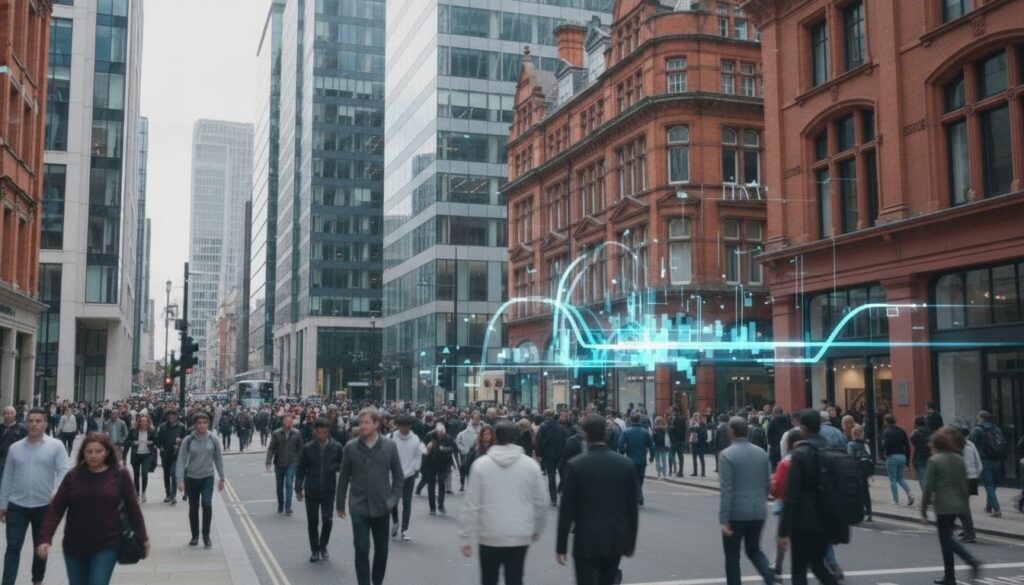
Theoretical models and static counts can no longer keep pace with the fluid, unpredictable reality of modern urban environments. For many infrastructure planners and retail managers, the primary challenge isn’t a lack of data, but the persistent inaccuracy of that data which leads to inefficient staffing and missed operational opportunities. Relying on legacy systems often causes more friction than clarity, yet the transition to advanced pedestrian flow analysis software offers a definitive path toward precision and strategic growth.
You likely recognise that true urban intelligence requires more than just numbers; it demands a real-time understanding of how people actually navigate a space, especially under the UK’s 2026 vision-led planning framework. This guide will demonstrate how to bridge the gap between raw footfall and actionable insight, leveraging high-precision 3D sensing to achieve a 99% accuracy rate. We will explore the latest advancements in AI-driven hardware, the role of the V9 Analytics platform in generating real-time flow visualisations, and how to maintain rigorous GDPR compliance whilst seamlessly integrating these systems into your existing physical infrastructure.
Key Takeaways
- Understand the evolution of urban monitoring as it moves from legacy manual counting to advanced, AI-driven automated sensing for superior data integrity.
- Learn to distinguish between predictive simulations and the real-time insights provided by modern pedestrian flow analysis software to enhance operational efficiency.
- Master the integration of V9 Analytics Software with high-precision hardware to achieve a 99% counting accuracy whilst maintaining strict GDPR compliance.
- Discover a structured strategy for defining critical KPIs and selecting the appropriate sensing hardware for complex public or retail environments.
- For bespoke urban intelligence solutions, visit our contact us page at smarturbansensing.co.uk or reach out to our team at sales@smarturbansensing.co.uk.
Understanding Pedestrian Flow Analysis in 2026
Pedestrian flow analysis is the systematic tracking of movement, speed, and density within a defined environment. It provides a foundational understanding of how human traffic interacts with physical space. Historically, this process relied on manual “clicker” counting, which was often prone to fatigue and human error. In 2026, the industry has shifted decisively toward AI-driven automated sensing. This transition allows for the capture of complex metrics such as “dwell time”, which measures how long a person remains in a specific area, and “pathway analysis”, which tracks the specific routes taken through a site. For a deeper look at the core principles of speed and density, Understanding Pedestrian Flow Analysis through academic frameworks helps clarify why these metrics are vital for modern transportation engineering.
Modern pedestrian flow analysis software serves as the analytical engine that transforms raw sensor data into executive-level insights. Instead of interpreting thousands of individual data points manually, decision-makers receive high-level visualisations and automated reports. This clarity enables strategic planning for urban developments and retail environments, moving beyond guesswork toward empirical evidence.
Why Real-Time Data is Essential for Modern Infrastructure
City management and retail operations have moved toward a “live” model where static data from previous months is no longer sufficient. Real-time data is critical for preventing overcrowding and ensuring public safety by identifying bottlenecks as they form. Within the context of smart city initiatives, this includes “active travel” monitoring at smart junctions. By understanding the real-time flow of pedestrians and cyclists, infrastructure can respond dynamically to improve safety protocols and traffic light timings. This responsive approach ensures that urban spaces remain fluid and safe even during peak usage.
The Role of AI in Eliminating Human Error
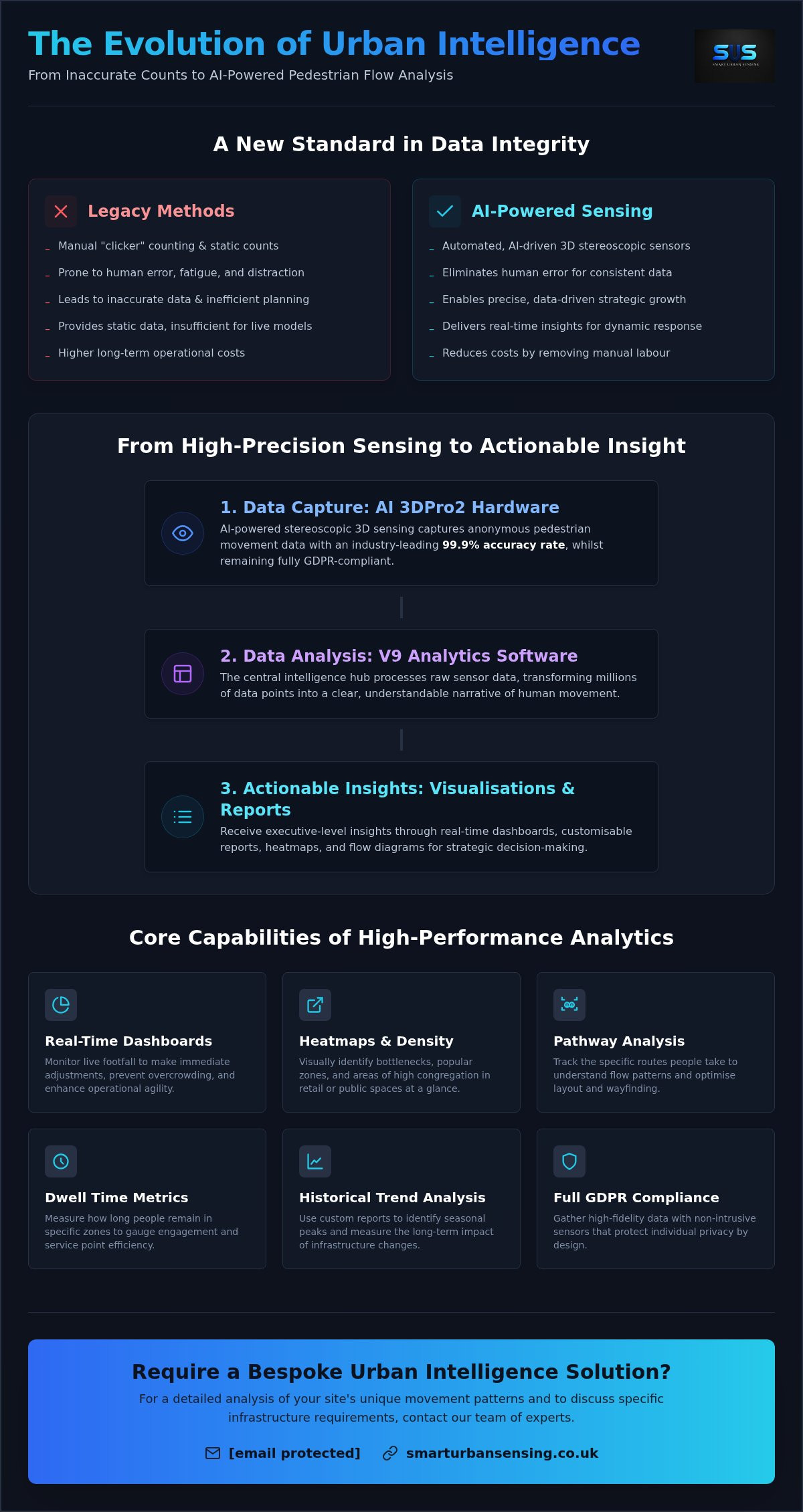
Traditional methods of monitoring often fail because of inherent human limitations. AI-powered stereoscopic 3D sensing, such as that found in the AI 3DPro2, removes the variables of exhaustion and distraction. Achieving a 99% accuracy rate is now the industry benchmark for reliable data. This level of precision is essential for long-term logistical planning and stakeholder transparency. Automating data collection also significantly reduces operational costs by eliminating the need for manual labour. By using non-intrusive sensors, organisations can gather high-fidelity data whilst remaining fully GDPR-compliant.
If you require a bespoke analysis of your site’s movement patterns, visit our contact us page at smarturbansensing.co.uk. Our team is available at sales@smarturbansensing.co.uk to discuss your specific infrastructure requirements and how our V9 Analytics Software can support your goals.
Key Features of High-Performance Analytics Software
The efficacy of any modern urban strategy relies on the seamless transition from physical sensing to digital intelligence. Whilst many competitors focus solely on cloud-based experimentation, the V9 Analytics Software distinguishes itself by maintaining a rigorous hardware-to-software accuracy chain. It acts as the central intelligence hub for both retail and transport environments, ensuring that the 99% accuracy captured by AI 3DPro2 sensors is reflected in every report. This software does not just present numbers; it interprets the complex rhythms of human movement to provide a clear, actionable narrative for decision-makers.
Operational agility is driven by real-time dashboards that allow for immediate adjustments. If a transport hub experiences an unexpected surge in passengers, the software alerts managers instantly, enabling them to redeploy staff or open additional gates. Long-term strategic planning, however, requires a different lens. Customisable reporting modules allow stakeholders to perform historical trend analysis, identifying seasonal peaks or the long-term impact of infrastructure changes. This dual-layered approach ensures that you remain responsive today whilst being prepared for the requirements of 2026 and beyond.
Visualising the Journey: Heatmaps and Flow Diagrams
Understanding how people move requires sophisticated visualisation tools that go beyond simple charts. High-performance pedestrian flow analysis software utilizes colour-coded heatmaps to illustrate density, allowing managers to identify “bottlenecks” in retail aisles or transport concourses at a glance. Path analysis further refines this by tracing the most popular routes amongst visitors. By visualising these journeys, planners can optimise layouts to reduce congestion and improve the overall user experience. To see how these visualisations can transform your space, you can request a technical demonstration from our consultancy team.
Integration and Scalability: From Single Entrances to City-Wide Networks
Enterprise-level software must be as versatile as the environments it monitors. The V9 platform is designed to manage data from multiple AI 3DPro2 sensors simultaneously, providing a unified view of a single retail unit or an entire national transport network. An API-first approach is central to this flexibility. It ensures that flow data integrates effortlessly with existing Building Management Systems (BMS) or ERP platforms, creating a holistic data ecosystem. Whether you are monitoring a small boutique or coordinating city-wide smart junctions, the infrastructure remains scalable and resilient.
For more information on integrating these capabilities into your current infrastructure, please contact us at smarturbansensing.co.uk. Our technical specialists are available at sales@smarturbansensing.co.uk to assist with your specific requirements.
Simulation vs. Real-Time Sensing: Choosing the Right Approach
Urban planners and retail strategists often rely on microscopic modelling to predict movement within a space. Whilst these digital twins are useful for forecasting, they frequently suffer from a “reality gap” where theoretical models fail to account for the erratic nature of human behaviour. Pedestrian flow analysis software that focuses on real-time sensing provides the empirical counterweight to these simulations. In 2026, the gold standard for urban management is a hybrid approach. It’s best to use simulation to design the space, but you must rely on high-precision sensing to operate it effectively.
Choosing the right pedestrian flow analysis software involves balancing these two distinct methodologies. Simulation addresses the “what-if” scenarios of the future, whilst real-time sensing manages the “what-is” of the present. By integrating both, organisations can move from speculative planning to evidence-based management, ensuring that infrastructure remains resilient under the pressure of real-world variables.
When to Use Pedestrian Simulation Software
Simulation software excels during the pre-construction or design phase. It’s the ideal tool for testing new building designs, emergency evacuation planning, and structural stress testing. By modelling various scenarios, architects can identify potential safety risks before a single brick is laid. However, simulations are inherently limited. They cannot account for unpredictable daily events such as sudden weather changes or local transport disruptions. For the hardware precision required to validate these models with actual data, refer to our High Precision 3D Counters: The Strategic Guide to 99% Accuracy.
The Operational Power of Live Flow Analytics
Once a space is occupied, the focus must shift from prediction to performance. Live flow analytics allow for immediate operational adjustments that simulations cannot provide. Real-time data enables managers to optimise staffing levels and manage queues dynamically, ensuring that visitor comfort is maintained even during peak periods. This data is also vital for verifying the success of new store layouts or street designs. If a new pedestrianised zone doesn’t meet its projected footfall, live sensing provides the diagnostic data needed to understand why. Crucially, using actual footfall data through non-intrusive 3D sensors is the only way to achieve true GDPR compliance in practice, as depth data is processed without capturing identifiable facial features.
If you need to bridge the gap between simulation and reality, visit our contact us page at smarturbansensing.co.uk. Our consultancy team is also available at sales@smarturbansensing.co.uk to help you implement a sensing strategy that delivers measurable results.
Implementing a Data-Driven Pedestrian Management Strategy
A successful urban intelligence framework requires a methodical approach that prioritises clarity and technical precision. It is not enough to simply gather data; you must build an ecosystem where information informs every operational choice. Establishing this framework involves a four-step process designed to move your organisation from passive observation to active management. This structured implementation ensures that your investment in pedestrian flow analysis software delivers measurable returns across safety, efficiency, and revenue.
- Step 1: Define Key Performance Indicators (KPIs). You must identify what success looks like for your specific environment. In retail, this often focuses on conversion rates or dwell times. For public infrastructure, peak occupancy levels and flow velocity are the primary metrics.
- Step 2: Select Appropriate Hardware. The physical environment dictates the sensor choice. For high-ceiling transit hubs, the AI 3DPro3 offers the necessary range, whilst the AI 3DPro2 is the industry standard for standard retail entrances.
- Step 3: Configure V9 Analytics Software. Customise your digital dashboards to align with your KPIs. This includes setting up real-time alerts for occupancy thresholds and automated reporting for weekly stakeholder reviews.
- Step 4: Train Staff for Action. Data is only as useful as the response it triggers. Staff must be trained to interpret real-time visualisations and act on automated alerts, such as opening additional service points when queues exceed predefined limits.
Optimising Retail Performance Through Behavioural Data
Retailers often struggle with “dead zones”, which are areas of the store where footfall is high but engagement is low. High-precision flow software identifies these anomalies by mapping the exact pathways customers take. By linking this footfall data directly to sales transactions, managers can calculate conversion metrics with surgical precision. This allows for evidence-based decisions regarding product placement and staff allocation. For a more comprehensive look at these techniques, read our Store Traffic Analysis: The 2026 Guide to Retail Behavioural Data.
Managing Public Transport Hubs and Smart Cities
In the context of modern transit, safety and efficiency are inseparable. Bus passenger counter systems now integrate directly with central urban analytics, providing a holistic view of the commuter journey. This integration allows for “smart junction” management where cycle lane monitoring and pedestrian flow are analysed together to reduce congestion. Real-time occupancy alerts ensure that transit networks never exceed safe capacities, maintaining passenger comfort whilst meeting strict regulatory standards. To begin your implementation, contact our team to schedule a site survey. You can also reach us directly at sales@smarturbansensing.co.uk for technical specifications.
Why Smart Urban Sensing is the UK’s Leading Choice
Smart Urban Sensing represents the pinnacle of urban intelligence within the UK market. Our leadership is defined by the unique synergy between the AI 3DPro2 hardware and the V9 Analytics platform. This integrated ecosystem ensures that the 99% accuracy captured at the sensor level is translated directly into executive-level insights. Whilst many providers offer generic pedestrian flow analysis software, we provide a consultative partnership that addresses the specific logistical challenges of national infrastructure and high-street retail. We don’t simply deliver a product; we provide a strategic framework for growth.
Choosing a UK-based strategic partner provides distinct advantages for national projects. We understand the local regulatory environment and the specific requirements of British urban planning. This local expertise allows us to provide professional installation and ongoing data consultancy that global vendors often struggle to match. We take the time to explain the rationale behind our solutions, creating a sense of thoroughness that builds long-term stability. This methodical approach ensures that your organisation moves beyond surface-level metrics to achieve deep, operational clarity.
Privacy-First: GDPR Compliance Without Compromise
Maintaining public trust is paramount in urban sensing. Our 3D stereoscopic sensors are engineered to count people by measuring physical depth and volume rather than capturing facial identities. This non-intrusive approach relies on infrared and thermal technologies that process movement data without ever recording personal information. It’s this ethical advantage that makes us the trusted choice for sensitive public sector projects. By using pedestrian flow analysis software that prioritises privacy by design, organisations can gather high-fidelity insights whilst remaining entirely compliant with GDPR standards. This ensures that your data collection is both high-tech and human-centric.
Expert Support and National Delivery
The value of a sensing strategy is only realised when the data is accurate and actionable. We support our clients through professional installation and dedicated data consultancy to ensure that every sensor is optimised for its specific environment. Our team works alongside you to interpret complex dashboards and refine your KPIs as your project evolves. This level of support ensures that your urban intelligence remains resilient and scalable across multiple sites. Whether you are managing a single entrance or a city-wide network, our commitment to reliability remains constant.
If you are ready to transform your urban or retail environment with high-precision data, enquire about our pedestrian flow solutions today. For a detailed technical consultation regarding your specific requirements, please contact our team at sales@smarturbansensing.co.uk.
Mastering Urban Intelligence for the Future
The transition from theoretical modelling to real-time sensing is no longer a luxury for urban planners; it’s a necessity for operational excellence. By integrating high-performance pedestrian flow analysis software with non-intrusive 3D hardware, you can achieve a level of clarity that legacy systems simply cannot match. We’ve explored how the synergy between AI 3DPro2 sensors and the V9 Analytics platform delivers a 99% accuracy rate whilst maintaining absolute GDPR compliance. This data-driven approach ensures that your retail or transport environment remains safe, efficient, and responsive to the unpredictable rhythms of human movement.
As the UK moves toward vision-led planning in 2026, having a strategic partner with full national support is vital for long-term stability. Our team is ready to help you transform raw footfall into actionable intelligence. Contact our expert team to discuss your pedestrian analytics requirements or reach out via sales@smarturbansensing.co.uk to begin your journey toward a smarter, more efficient urban space. We look forward to helping you optimise your environment with precision and integrity.
Frequently Asked Questions
How does pedestrian flow analysis software maintain GDPR compliance?
Pedestrian flow analysis software maintains GDPR compliance by utilising non-intrusive sensing technologies like 3D stereoscopic and infrared monitoring. Instead of capturing facial identities, these sensors measure physical depth and volume to count individuals. No personal data is recorded, ensuring that privacy is protected at the hardware level. This approach allows organisations to gather high-fidelity urban insights without compromising the ethical handling of public information.
Can V9 Analytics Software integrate with my existing retail POS system?
Integration is a primary capability of the V9 platform. The software features an API-first design that allows it to connect seamlessly with retail POS systems, Building Management Systems (BMS), and ERP platforms. By linking footfall data with sales transactions, retailers can accurately measure conversion rates and optimise store layouts. This holistic view of the customer journey is essential for data-driven decision-making in competitive retail environments.
What is the difference between 3D stereoscopic and thermal sensors for flow analysis?
The choice between these technologies depends on your specific environment. 3D stereoscopic sensors, like the AI 3DPro2, use dual lenses to create a depth map, distinguishing between adults, children, and objects with 99% accuracy. Thermal sensors detect heat signatures, which is particularly useful in low-light conditions or outdoor spaces. Both methods are non-intrusive and ensure that no identifiable facial imagery is ever captured or stored.
Is it possible to track the movement of cyclists and vehicles with the same software?
The V9 Analytics Software is engineered for multi-modal urban monitoring. It supports smart junctions and cycle lane monitoring, enabling the simultaneous tracking of pedestrians, cyclists, and vehicles. This capability allows local authorities to understand how different modes of transport interact in real-time. By providing a unified view of urban movement, the software supports more effective infrastructure planning and improves safety protocols across national transit networks.
How accurate is automated pedestrian flow data compared to manual counting?
Automated data is far superior to manual counting, which often suffers from inconsistencies caused by human fatigue. Our AI-powered sensors deliver a 99% accuracy rate, providing a reliable foundation for logistical planning. This level of precision ensures that staffing decisions and safety protocols are based on empirical evidence rather than guesswork. For a detailed site survey, please contact our expert team to discuss your requirements.
What hardware is required to run V9 Analytics Software effectively?
The V9 platform is optimised for use with our specialised hardware, such as the AI 3DPro series and bus passenger counter systems. These sensors are designed to capture the high-resolution depth data required for accurate analysis. Our technical specialists can help you select the right hardware based on ceiling heights and environmental factors. For specific technical queries, please reach out to our team at sales@smarturbansensing.co.uk.
Can this software monitor real-time occupancy for event safety?
Monitoring real-time occupancy is a critical function for event safety and public space management. The software provides live alerts when density reaches predefined thresholds, allowing for immediate operational responses. This proactive approach prevents overcrowding and ensures that venues remain compliant with safety regulations. By using live visualisations, managers can redeploy staff dynamically to manage queues and maintain a safe environment for all visitors.
Does the system work in outdoor environments with varying light conditions?
The system is designed to be highly resilient in outdoor environments. Our outdoor counters use robust sensing technology that remains accurate despite varying light conditions, including direct sunlight and darkness. This ensures that urban data collection remains consistent throughout the year, regardless of seasonal weather changes. If you require a bespoke solution for a public space, visit our contact us page at smarturbansensing.co.uk.


