

With U.S. retail sales seeing a recent 8.4% year-over-year increase, the difference between a thriving store and a struggling one often rests on a 0.1% margin of data accuracy. You understand that staffing an empty floor is a costly drain on resources, whilst missing a peak period due to inaccurate scheduling is a missed opportunity for revenue. It’s a common frustration for decision-makers who rely on legacy infrared sensors that fail to distinguish between groups or staff members. This strategic guide explores how sophisticated footfall analysis for retail stores can eliminate these inefficiencies, providing the clarity needed to synchronise your workforce with actual customer demand.
We’ll demonstrate how to transition from basic counting to high-precision operational growth. By utilising the AI 3DPro2, retailers can achieve 99% accuracy while maintaining total privacy. You’ll learn to navigate the complexities of GDPR compliance in physical tracking, ensuring your data collection remains ethical and “privacy-first” at all times. By the end of this guide, you’ll possess a methodical framework to reduce operational waste and harness actionable customer behaviour data. For expert guidance on implementing these future-proof systems, visit our contact us page at smarturbansensing.co.uk or reach out to our team at sales@smarturbansensing.co.uk.
Key Takeaways
- Precision is the foundation of modern retail strategy. Learn how 99% counting accuracy transforms raw visitor data into a reliable metric for high-level decision-making.
- Technology choice determines the quality of your insights. Understand why 3D stereoscopic vision, as seen in the AI 3DPro2, outperforms thermal sensors in complex retail environments.
- Effective footfall analysis for retail stores extends beyond simple counting to include dwell time and path tracking. Master these metrics to identify “cold zones” and optimise your store layout for maximum engagement.
- Data-led staffing eliminates operational waste whilst protecting the customer experience. Discover how to synchronise labour costs with real-time traffic surges to ensure your floor is never under-staffed.
- Future-proof your operations with GDPR-compliant, “privacy-first” analytics. For bespoke advice on scaling these solutions, visit our contact us page at smarturbansensing.co.uk or email sales@smarturbansensing.co.uk.
What is Footfall Analysis for Retail Stores?
Footfall analysis for retail stores is the systematic measurement and interpretation of visitor traffic within a physical retail environment. It’s no longer enough to simply know how many people walked through the door; modern retailers require a granular understanding of how those visitors interact with the space. In 2026, the industry has shifted decisively from “gut feeling” to data-driven decision making, where every operational choice is backed by verifiable evidence.
The evolution of people counting technology has been transformative. We’ve moved from manual clickers and unreliable infrared beams to AI-powered 3D stereoscopic sensors like the AI 3DPro2. These systems provide a level of depth that mimics human perception, allowing for a sophisticated approach to footfall analysis for retail stores. Beyond entrance counts, retailers now track dwell time and zone-to-zone movement to build a comprehensive picture of the customer journey.
The Role of Retail Traffic Insights
Understanding the rhythm of your store is essential for long-term stability. By identifying peak hours and seasonal trends, you can optimise your resources to match visitor demand whilst identifying quiet periods that require leaner operations. This data also carries significant weight outside the shop floor. It informs lease negotiations and property valuations by providing objective proof of a location’s value. When you link entrance data to your sales figures, you calculate accurate conversion rates, revealing the true effectiveness of your marketing and visual merchandising efforts.
The Importance of 99% Accuracy
Precision isn’t just a technical requirement; it’s a financial necessity. A 5% error rate might seem negligible, but it can lead to thousands of pounds in lost staffing efficiency over a single quarter. Inaccurate data often includes “shadow traffic” such as security personnel, delivery drivers, and staff members, which skews your performance metrics. High-precision sensors like the AI 3DPro2 filter these variables out, ensuring your V9 Analytics Software receives only genuine customer data. A 99% accuracy rate is the industry gold standard for retail data reliability and operational confidence.
To discover how high-precision data can transform your retail operations, please visit our contact us page at smarturbansensing.co.uk or contact our specialist team at sales@smarturbansensing.co.uk.
Deciphering the Technology: 3D Stereoscopic vs Thermal Sensors
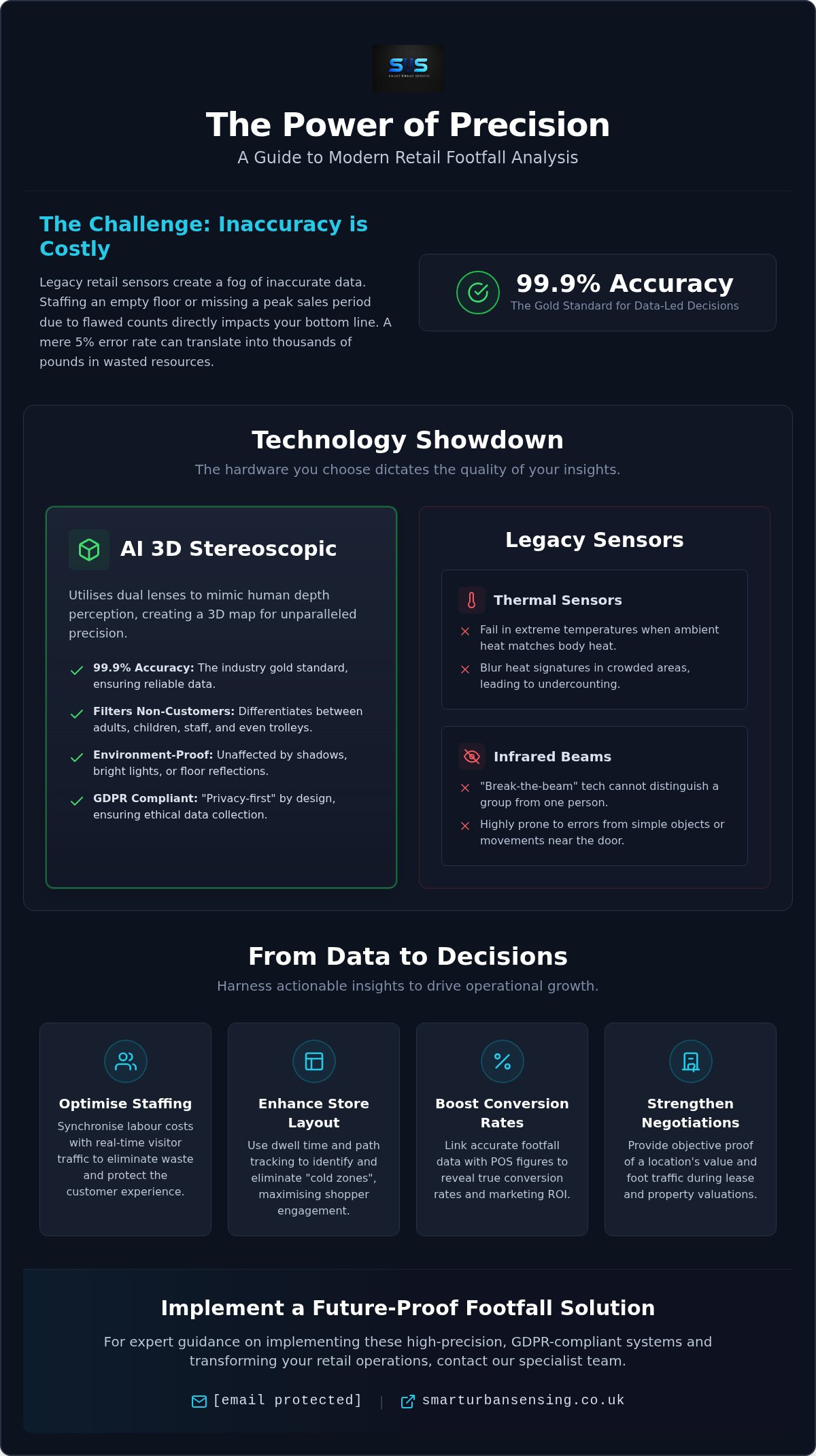
The hardware architecture you choose dictates the integrity of your data. Whilst legacy systems once relied on simple infrared beams, these “break-the-beam” counters lack the sophistication required for modern footfall analysis for retail stores. They don’t distinguish between a family of four and a single shopper; they simply register a pulse. In contrast, 3D stereoscopic sensors utilise dual lenses to mimic human depth perception. This allows the system to build a three-dimensional map of the entrance, ensuring that every individual is tracked with surgical precision regardless of how crowded the doorway becomes.
Thermal sensors represent a different approach, but they carry inherent operational limitations. They rely on detecting heat signatures, which often blur together in high-density areas or fail entirely during extreme summer temperatures when ambient heat matches human body temperature. Shadows, floor reflections, and sudden lighting changes also plague lesser technologies, leading to significant data drift. High-performance AI sensors bypass these environmental hurdles by using contrast and depth rather than heat or simple movement, maintaining a steady count in the most challenging retail conditions.
Why 3D Stereoscopic Sensors Lead the Market
The primary advantage of 3D technology lies in its ability to categorise what it sees. These sensors can distinguish between adults, children, and even shopping trolleys, ensuring your conversion rates aren’t diluted by non-buying visitors. For multi-entrance sites, integrating high precision 3d counters is the only way to maintain a consistent 99% accuracy rate across a complex footprint. This granular level of detail is vital for a Big Data Approach to Footfall Prediction, where precision at the source determines the quality of the eventual business forecast.
The AI Advantage in People Counting
Modern sensors don’t just record data; they process it. On-device AI ensures that data delivery happens in real-time without the lag associated with cloud-only processing. This intelligence allows the sensor to filter out non-human objects like swinging doors, promotional signage, or floor-cleaning robots. Because these systems use machine learning, their accuracy actually improves over their lifecycle as they adapt to the specific nuances of your store’s environment. This makes footfall analysis for retail stores a dynamic asset rather than a static measurement.
If you’re unsure which technology fits your specific store layout, you can speak with our technical consultants for a tailored assessment. For detailed specifications on our AI 3DPro2 range, please contact us at sales@smarturbansensing.co.uk.
Analysing Customer Behaviour Data to Improve Store Performance
Raw entrance data provides the volume, but behaviour analysis provides the value. Sophisticated footfall analysis for retail stores allows you to map the internal customer journey, transforming your floor plan from a static layout into a dynamic, responsive environment. By tracking dwell time, you can identify “hot spots” where products command sustained attention and “cold zones” that visitors consistently bypass. Path tracking reveals the invisible currents within your store; it shows whether customers naturally veer left or right and where they tend to stall. This data is essential for visual merchandising, as it ensures your high-margin displays are positioned exactly where the highest percentage of visitors will see them.
Operational efficiency also benefits from real-time occupancy data. By monitoring live traffic, your team can implement proactive queue management, opening additional tills before a bottleneck forms. This protects the customer experience and prevents walk-outs, ensuring your conversion rate remains stable. You can also measure the specific “draw rate” of window displays. This gives your marketing team concrete evidence of which promotions actually pull pedestrians into the store, allowing for rapid adjustments to your visual strategy based on genuine performance metrics.
Turning Raw Data into Actionable Insights
Our V9 Analytics Software organises these complex streams of information into digestible retail dashboards. A critical metric for any decision-maker is the “Power Hour”. This identifies the specific window when your store generates the highest revenue relative to visitor volume, which often differs from your busiest period. Understanding this distinction is vital for benchmarking performance across a national estate. It ensures that store managers are judged on their ability to convert existing traffic into sales, with 2026 industry standards typically targeting conversion rates between 20% and 40%.
Optimising Store Layout and Merchandising
Heatmap data provides the objective evidence needed to justify premium shelf-space pricing to suppliers. If you can prove that a specific end-cap receives 40% more eye-level traffic than a standard aisle, the value of that space increases. You can also use A/B testing for your aisles, measuring how layout changes impact dwell time and total basket value. Finally, identifying “dead ends” that cause customer frustration allows you to refine the flow of the store. By eliminating these friction points, you ensure that every square metre of your retail space contributes to the bottom line.
For a bespoke demonstration of how our V9 Analytics Software can refine your store performance, please visit our contact us page at smarturbansensing.co.uk or reach out to our specialist team at sales@smarturbansensing.co.uk.
Retail Staffing Optimisation: A Data-Led Guide
Labour represents the most significant variable expense in physical retail. Without accurate footfall analysis for retail stores, managers often rely on intuition or legacy rotas that fail to account for modern shopping patterns. Finding the “sweet spot” in your workforce management means ensuring you have enough specialists on the floor to drive conversion without incurring the financial drain of idle hours. By aligning your team’s presence with actual visitor demand, you transform labour from a fixed overhead into a strategic asset.
Under-staffing during unexpected surges doesn’t just lose immediate sales; it damages long-term brand loyalty through poor service. Conversely, over-staffing is a silent profit-killer that erodes margins. Predictive data empowers store managers to look ahead, creating schedules that anticipate the ramps and plateaus of the coming week. This methodical approach ensures that your most experienced staff are on the floor when they are needed most, protecting the customer experience whilst maintaining a lean operational profile.
Step-by-Step: Aligning Rotas with Footfall
To achieve operational synchronicity, follow this methodical framework:
- Step 1: Collect 4-6 weeks of high-accuracy baseline data using sensors like the AI 3DPro2 to establish a reliable traffic profile for each day of the week.
- Step 2: Identify the specific “Staff-to-Customer” ratio required for your service level. A luxury boutique will require a much tighter ratio than a high-volume convenience store.
- Step 3: Overlay your historical footfall peaks with current staff rotas. This visual comparison quickly reveals periods of waste and vulnerability.
- Step 4: Adjust shift start and end times by 30-60 minutes. Matching these precisely to traffic ramps ensures your team is in position before the rush begins.
Measuring the ROI of Staffing Adjustments
The impact of data-led scheduling is immediately visible in your performance metrics. By tracking the correlation between increased staff presence and higher conversion rates, you can prove the value of your labour investment. This approach also addresses the human element of retail. Ensuring adequate support during peak periods significantly reduces employee burnout, leading to better retention and more engaged service. Using V9 Analytics, these insights are easily reported to head office, providing a transparent view of labour efficiency across the entire estate.
If you’re ready to eliminate staffing waste through precision data, contact our consultancy team today for a tailored workforce audit. For technical support or integration queries, reach out to our specialists at sales@smarturbansensing.co.uk.
Implementing a Future-Proof Footfall Solution with Smart Urban Sensing
Selecting the right partner is as critical as the hardware itself. Smart Urban Sensing specialises in bridging the gap between raw data and high-level strategy, ensuring that your investment in footfall analysis for retail stores delivers measurable returns from day one. Whether you’re a single boutique utilising one of our Retail Starter Kits or a national chain coordinating a complex rollout across the United Kingdom, our solutions are designed to scale with your ambitions. We provide a consultative approach that begins with site planning and continues through to comprehensive training on our V9 Analytics Software.
The AI 3DPro2 Advantage
The AI 3DPro2 stands as the industry benchmark for precision. Its stereoscopic technology delivers 99% accuracy by creating a three-dimensional view of the entrance, which remains consistent in all lighting conditions. This reliability is matched by a non-intrusive design that blends seamlessly into high-end retail interiors, ensuring that the technology doesn’t detract from the aesthetic of your brand. For retailers managing multiple sites, the AI 3DPro2 provides the uniform data quality required for meaningful estate-wide comparisons.
Privacy by Design
Ethical data handling is a core pillar of our philosophy. In an era of heightened regulatory scrutiny, our “Privacy First” sensors ensure 100% GDPR compliance by design. Unlike traditional CCTV-based analytics, our sensors don’t use facial recognition or capture personally identifiable information. Instead, they process data at the edge, converting physical movement into anonymous coordinates. This approach protects customer privacy whilst providing the deep behavioural insights necessary for modern retail operations, allowing you to innovate without legal compromise.
Secure Data Management with V9 Analytics
Data is only valuable if it’s accessible and understandable. Our V9 Analytics Software provides cloud-based monitoring from any device, allowing stakeholders to view live traffic and historical trends from the office or on the move. The platform features customisable reporting, enabling you to focus on the specific KPIs, such as draw rates, conversion, or dwell time, that matter most to your business. V9 Software turns noise into clarity for retail stakeholders.
To begin your journey towards data-led growth, please visit our contact us page at smarturbansensing.co.uk or contact our technical team directly at sales@smarturbansensing.co.uk.
Strategic Precision for the Future of Retail
The landscape of physical retail in 2026 demands more than just presence; it requires a deep, data-driven understanding of every visitor who crosses your threshold. By moving away from legacy sensors and adopting high-precision 3D stereoscopic technology, you ensure your operational decisions are based on the highest quality insights. We’ve explored how sophisticated footfall analysis for retail stores can eliminate staffing waste, optimise your store layout, and provide a clear picture of customer behaviour whilst maintaining total GDPR compliance.
Implementing a future-proof solution with the AI 3DPro2 provides the 99% accuracy needed to transform raw visitor data into a reliable strategic lever. Whether you’re managing a single site or a national estate, our consultative approach ensures your technology integrates seamlessly with your business goals. Our team provides expert UK-wide support and training to help you master the V9 Analytics Software. Contact our expert team today to discuss your retail footfall requirements or reach out to us at sales@smarturbansensing.co.uk. Your path to optimised growth starts with the right data.
Frequently Asked Questions
Is footfall analysis GDPR-compliant for retail stores?
Yes, footfall analysis for retail stores is entirely GDPR-compliant when using “Privacy First” technology. Our AI 3DPro2 sensors process data at the edge, converting physical movement into anonymous mathematical coordinates. They don’t capture facial features or personally identifiable information. This ensures your data collection remains ethical and legally sound, allowing you to focus on operational growth without the risks associated with intrusive surveillance methods.
What is the difference between a people counter and footfall analysis?
A people counter is the physical hardware installed at your entrance, whilst footfall analysis is the broader strategic process of interpreting that data. Think of the counter as the source and the analysis as the solution. By using V9 Analytics Software, you transform simple counts into actionable insights regarding dwell time, path tracking, and conversion rates, moving from basic observation to sophisticated business intelligence.
How accurate are 3D stereoscopic sensors compared to infrared?
The difference in precision is significant. Legacy infrared sensors rely on simple beam-breaking, which often fails in crowded entrances or with groups. In contrast, 3D stereoscopic sensors like the AI 3DPro2 achieve 99% accuracy by mimicking human depth perception. This allows the system to distinguish between individuals walking side-by-side, providing a reliable baseline for calculating conversion rates and staffing requirements across your estate.
Can footfall data help me reduce my retail energy costs?
Yes, high-precision occupancy data can be integrated with building management systems to optimise energy consumption. If your sensors detect that specific zones are empty, you can automate lighting and HVAC adjustments to reduce waste. This data-led approach ensures you aren’t heating or lighting unoccupied spaces, directly lowering your utility bills whilst contributing to your company’s sustainability targets and overall operational efficiency.
Do I need a different sensor for outdoor retail spaces?
Specific environments require specialised hardware. Whilst indoor sensors are designed for controlled lighting, our outdoor counters are engineered to handle variable weather conditions and high-contrast sunlight. These IP-rated devices are essential for monitoring shopping centre precincts or open-air retail parks. For a bespoke recommendation on which sensor fits your specific layout, please visit our contact us page at smarturbansensing.co.uk.
How much does it cost to implement a footfall analysis system?
Implementation costs vary based on the scale of your project and the complexity of your site layout. A small boutique might start with one of our Retail Starter Kits, whilst a national chain will require a more comprehensive rollout of AI 3DPro2 units. We recommend a consultative audit to determine the most cost-effective hardware mix for your needs. For a detailed proposal, reach out to our specialists at sales@smarturbansensing.co.uk.
What is a “good” conversion rate for a retail store?
Industry benchmarks for 2026 suggest that a “good” conversion rate typically falls between 20% and 40%. However, this figure depends heavily on your retail sector and location. The value of footfall analysis for retail stores isn’t just in reaching a specific percentage, but in identifying the factors that cause those numbers to fluctuate. By benchmarking your top-performing stores, you can implement those success strategies across your entire estate.
Can the AI 3DPro2 distinguish between staff and customers?
The AI 3DPro2 uses advanced AI filtering to distinguish between genuine customers and “shadow traffic”. This includes the ability to exclude staff members, security personnel, and delivery drivers from your final counts. By filtering out these non-buying visitors, your V9 Analytics Software provides a much cleaner dataset. This ensures your conversion rates are calculated against actual potential buyers, leading to more accurate performance reporting and better strategic decisions.
Researching footfall analytics?
Get the supplier-neutral footfall & occupancy buyer checklist
Entrance survey sheet, 24 buyer checks, a simple ROI worksheet and the red flags to watch for. We will email it to you — and, if you like, a short monthly retail analytics briefing.


