
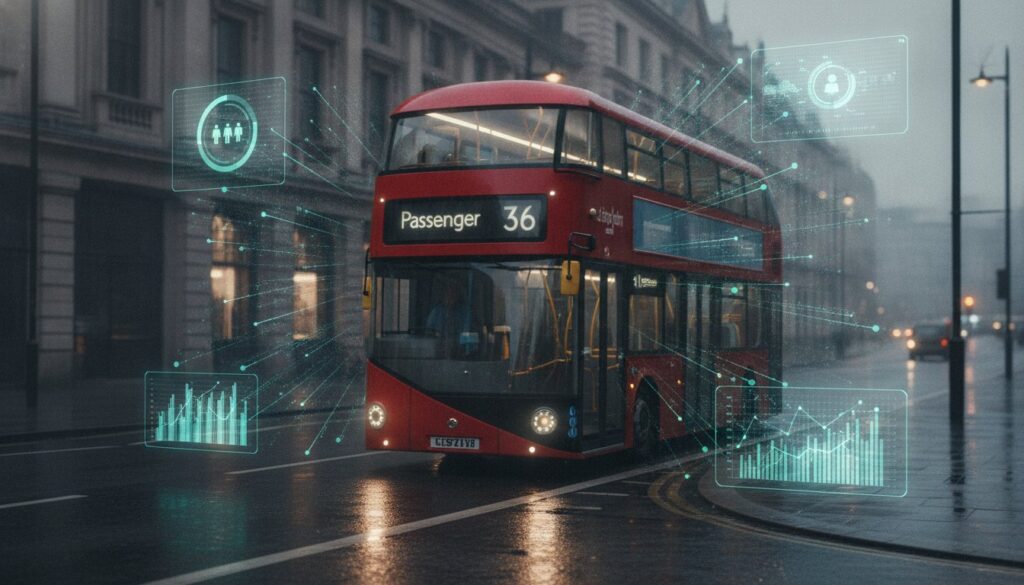
If the global market for automated passenger counting is projected to reach $10.53 billion by the end of 2026, it is because fleet operators can no longer afford the cost of being wrong. You likely recognise the daily frustration of relying on manual tallies that fail to capture the true rhythm of your network, leading to under-utilised routes and significant revenue leakage. Calculating the ROI of bus passenger counters is no longer a theoretical exercise; it is a commercial necessity for those seeking to optimise every mile of their operation.
This guide demonstrates how transitioning to 99% accurate data through systems like the AI 3D APC transforms raw transit figures into measurable financial returns. We will provide a clear framework for calculating your specific payback period, whilst exploring how the integration of V9 Analytics Software reduces fuel wastage and secures vital grant funding through precise, reliable reporting. You will discover how sophisticated mobility intelligence turns operational blind spots into strategic assets. To discuss your specific fleet requirements, you can contact our team at sales@smarturbansensing.co.uk or visit our contact us page at smarturbansensing.co.uk.
Key Takeaways
- Identify the hidden financial drain of manual counting and how inaccurate data leads to inefficient route scheduling and unnecessary fuel wastage.
- Understand how the AI 3D APC achieves 99% accuracy by using stereoscopic sensors to distinguish between passengers, luggage, and children.
- Learn a structured framework for calculating the ROI of bus passenger counters by categorising direct fuel savings and indirect operational gains.
- Ensure your fleet remains GDPR-compliant whilst gathering the high-fidelity data required for precise grant reporting and national funding applications.
- Discover how to integrate V9 Analytics Software for actionable insights, or contact our team at sales@smarturbansensing.co.uk and visit our contact us page at smarturbansensing.co.uk for a bespoke consultation.
The Financial Case for Automated Bus Passenger Counting Systems
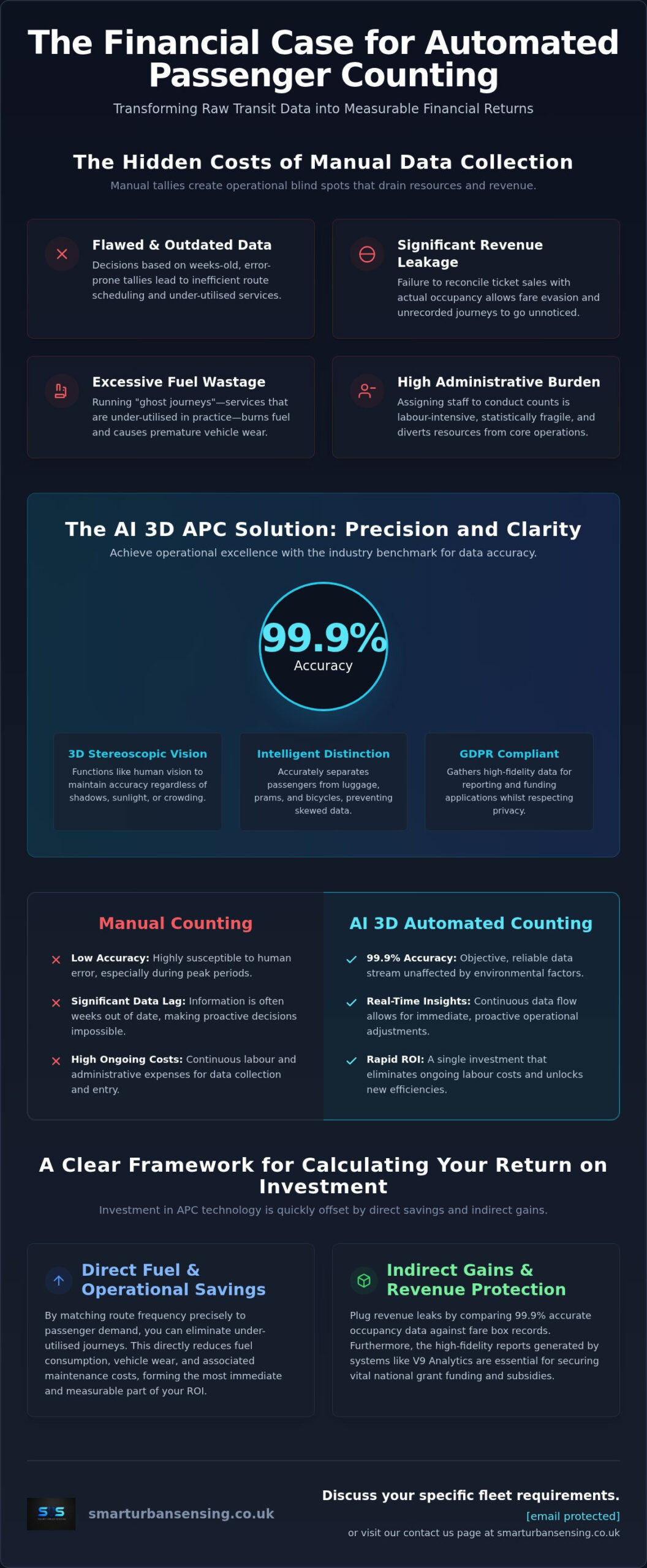
Financial transparency in fleet operations is often obscured by the limitations of manual observation. For many operators, the true cost of service delivery remains a moving target because the data used to inform scheduling is inherently flawed. Relying on paper-based tallies or occasional manual surveys introduces human error and significant data lag, where decisions are made based on information that is already weeks out of date. This inefficiency directly impacts the ROI of bus passenger counters, as the investment in technology is quickly offset by the elimination of these expensive operational blind spots.
The High Price of Manual Data Collection
Traditional methods of monitoring ridership are labour-intensive and statistically fragile. Assigning staff to conduct manual counts or requiring drivers to log every boarding event adds a significant administrative burden whilst increasing the likelihood of inaccuracies during peak periods. Automated Passenger Counters provide a continuous, objective stream of data that manual surveys simply cannot replicate. Without this automation, fleet managers often find themselves running “ghost” journeys. These are services that appear necessary on paper but are actually under-utilised in practice, leading to excessive fuel wastage and premature vehicle wear. The cost of paying staff to collect unreliable data is a double loss for the organisation.
Bridging the Gap Between Occupancy and Revenue
One of the most critical financial leaks in public transport is the discrepancy between ticket sales and actual occupancy. Manual systems often fail to identify unrecorded passengers or fare leakage during high-volume stops. By implementing the AI 3D APC, operators can compare real-time occupancy data against fare box records with 99% accuracy. This high-precision 3D technology distinguishes between passengers, luggage, and children, ensuring that the data used for revenue protection is beyond reproach. Identifying these leaks allows for targeted interventions, such as adjusting ticket inspection routes or refining fare collection methods at specific times. It’s about ensuring every journey is accounted for.
Transitioning from reactive adjustments to proactive fleet management requires a foundation of absolute data integrity. When you can see the exact occupancy of every vehicle at every stop, you can optimise route frequency to match demand, significantly reducing operational overheads. This strategic shift is the cornerstone of a modern, profitable transit network. To learn how our technology can clarify your financial performance and improve the ROI of bus passenger counters across your fleet, contact our team at sales@smarturbansensing.co.uk or visit our contact us page at smarturbansensing.co.uk.
Leveraging AI 3D APC Technology for Operational Clarity
The AI 3D APC represents a paradigm shift in how transit data is captured and utilised. Unlike older generations of counting technology, this system employs stereoscopic sensors that function similarly to human vision, using two distinct lenses to create a three-dimensional field of view. This depth perception allows the hardware to achieve 99% accuracy, even in the most challenging environments. The ROI of bus passenger counters is fundamentally dependent on this level of precision, as even a minor margin of error can lead to significant miscalculations in route demand over a fiscal year.
Beyond simple headcounts, these advanced sensors possess the intelligence to distinguish between passengers and inanimate objects. The system accurately identifies luggage, prams, and bicycles, ensuring they don’t skew ridership figures. It also differentiates between adults and children, providing a more granular look at passenger demographics. This clarity allows operators to monitor real-time occupancy levels, which is essential for maintaining passenger safety and enhancing the overall travel experience by preventing overcrowding. For a comprehensive overview of how intelligent analytics underpin these capabilities, our guide to transit occupancy monitoring explores how AI-powered sensing transforms raw data into actionable network insights.
Why 99% Accuracy is the Industry Benchmark
Standard infrared or thermal sensors often struggle with environmental variables such as shifting shadows, intense sunlight, or crowded doorways where passengers stand close together. In contrast, 3D stereoscopic technology maintains its integrity regardless of lighting conditions. This level of detail is explored further in our guide to High Precision 3D Counters, which explains how 99% accuracy becomes the foundation for reliable fleet planning and resource allocation. Without this benchmark, the data remains a series of estimates rather than a definitive record. For fleet operators evaluating their hardware options, our AI 3D APC 2026 passenger counting buying guide provides a comprehensive comparison of stereoscopic vision systems against legacy infrared sensors to help inform your procurement decision.
V9 Analytics: Turning Raw Data into Fleet Strategy
Maximising the ROI of bus passenger counters requires more than just counting passengers; it requires the ability to interpret that data through sophisticated software. V9 Analytics Software acts as the central intelligence hub, integrating directly with the AI 3D APC to provide a comprehensive visualisation of load factors across your entire network. This platform automates the reporting process for local authority requirements, saving hundreds of administrative hours whilst ensuring compliance with national standards.
- Load Factor Visualisation: Identify under-performing routes and peak-time bottlenecks at a glance.
- Resource Optimisation: Reallocate vehicles to high-demand corridors based on historical trends.
- Grant Reporting: Generate audit-ready data to secure and maintain essential funding.
By organising raw sensor data into actionable insights, transport planners can move away from guesswork and towards a data-driven strategy that reduces fuel consumption and operational overheads. To see how these tools integrate with your current infrastructure, speak with one of our technical consultants. You can also reach us directly at sales@smarturbansensing.co.uk or visit our contact us page at smarturbansensing.co.uk to explore bespoke solutions for your fleet.
Calculating the ROI of Bus Passenger Counters
Determining the ROI of bus passenger counters involves more than a simple comparison of hardware costs against fare increases. It requires a structured analysis of both immediate financial recoveries and long-term strategic advantages. By categorising these gains into hard and soft ROI, fleet operators can build a robust business case that justifies the initial capital expenditure through sustained operational efficiency and reduced waste.
Hard ROI: Tangible Financial Payback
Hard ROI focuses on the tangible, bottom-line savings that appear on a balance sheet. The most immediate impact is the reduction of “dead mileage”, which is the distance travelled by under-utilised vehicles. By matching vehicle capacity to the high-fidelity demand data provided by the AI 3D APC, operators can prune inefficient services and reallocate resources where they generate the most revenue. This precision directly reduces fuel consumption and vehicle wear. Additionally, verified occupancy data can lead to lower insurance premiums by providing objective evidence of safety compliance and overcrowding prevention. When calculating the payback period, operators should weigh the initial hardware and installation costs against the monthly reduction in fuel, maintenance, and manual survey labour.
Soft ROI: Strategic and Long-Term Value
Soft ROI covers the strategic value that, whilst harder to quantify initially, often leads to greater long-term profitability. A fleet that consistently avoids overcrowding and maintains punctuality through data-driven scheduling builds a reputation for reliability. This improved passenger experience is a primary driver for increased ridership amongst commuters who might otherwise choose private transport. Beyond immediate ridership, having a 99% accurate data stream future-proofs the fleet for integration into wider smart city footfall monitoring initiatives. This positions the operator as a technologically sophisticated partner for local authorities, making them a preferred choice for future service contracts.
Maximising the ROI of bus passenger counters also extends to grant and subsidy management. Many funding bodies now require rigorous, audit-ready data to justify transport subsidies. Using automated systems eliminates the risk of precision errors that can jeopardise grant eligibility, ensuring that every passenger mile is recorded to maximise financial support from national transport schemes. To receive a detailed breakdown of how our systems can streamline your financial reporting, contact our team at sales@smarturbansensing.co.uk or visit our contact us page at smarturbansensing.co.uk.
Privacy, Compliance, and Technical Implementation
The long-term viability of any technological investment depends heavily on its ability to meet stringent regulatory standards without compromising operational speed. For fleet operators, the ROI of bus passenger counters is inextricably linked to data integrity and legal compliance. A system that fails to meet privacy requirements or breaks down in the demanding environment of a public service vehicle quickly becomes a liability rather than an asset. Ensuring your counting solution is both ethically designed and physically resilient is a prerequisite for sustainable growth.
GDPR and the Ethics of Passenger Data
Public trust is a fragile commodity, particularly regarding data collection on public transport. Modern APC systems, such as the AI 3D APC, prioritise a privacy-first approach by processing data at the “edge”. This means the device itself analyses the visual information to generate a count and then immediately discards the raw imagery. No personal identifiers or facial recognition data are ever stored or transmitted. This non-intrusive method ensures full GDPR compliance, which is often a non-negotiable requirement for securing national transport tenders and local authority contracts. By removing the risk of data breaches, operators protect their reputation whilst maintaining the high-fidelity data needed for strategic planning. Operators seeking to understand how modern hardware meets these “Privacy by Design” standards in 2026 will find our AI 3D APC passenger counting buying guide an essential reference for evaluating compliant solutions.
Hardware Durability and Fleet Integration
On-vehicle hardware must endure a punishing range of conditions, from constant vibrations and engine heat to extreme external temperature fluctuations. Selecting high accuracy footfall sensors that are purpose-built for the transport sector is essential for maintaining a consistent ROI of bus passenger counters. Our hardware is engineered for durability, ensuring that the precision of the 3D stereoscopic sensors remains unaffected by the physical stresses of daily operation. These systems are designed for seamless integration with existing GPS and telematics platforms, allowing operators to correlate occupancy data with specific geographic coordinates and timestamps in real-time. This level of technical synergy enables a truly scalable solution, whether you are managing a small local shuttle service or a nationwide transit network.
Implementing a robust counting system requires a partner who understands the complexities of both hardware engineering and regulatory frameworks. To ensure your fleet is equipped with compliant, high-performance technology, contact our technical team for an implementation roadmap. You can also reach us at sales@smarturbansensing.co.uk or visit our contact us page at smarturbansensing.co.uk to learn more about our specialised hardware solutions.
Why Smart Urban Sensing is the Strategic Choice for APC
Smart Urban Sensing occupies a unique position at the intersection of high-precision engineering and urban logistical strategy. Our expertise in AI-powered people counting extends beyond simple hardware provision; we provide the analytical framework necessary to realise a genuine ROI of bus passenger counters. By choosing a partner that understands the nuances of transport infrastructure, fleet operators gain access to a consultative relationship that prioritises long-term operational stability over superficial metrics. We don’t just sell sensors; we deliver the clarity required to manage a modern transit network.
The AI 3D APC is not a generic sensor adapted for transport; it is a purpose-built solution designed to withstand the rigours of the road whilst maintaining a 99% accuracy benchmark. When paired with V9 Analytics Software, this hardware provides total fleet visibility, allowing planners to move from fragmented data points to a unified network strategy. This synergy ensures that every boarding event is captured, categorised, and converted into actionable intelligence that drives profitability across your entire operation.
A Partner in Smart City Evolution
Our vision for urban mobility encompasses the entire journey, from Smart Junctions and Cycle Lane Monitoring to the interior of the vehicle. This multi-modal perspective provides a context that standalone vendors cannot match. For instance, understanding the broader landscape through Store Traffic Analysis helps transport planners correlate retail footfall with transit demand, creating a more integrated urban experience. This comprehensive approach allows us to support deployments ranging from local shuttle trials to national-scale infrastructure projects with equal precision.
Get Started with a Custom ROI Analysis
Building a compelling business case for automated counting requires specific data tailored to your fleet’s unique profile. Our team of specialists works alongside you to quantify the ROI of bus passenger counters, identifying the exact areas where fuel savings, labour reductions, and grant maximisation will occur. We provide end-to-end support, ensuring that technical implementation is as smooth as the data it produces. This methodical approach guarantees that your investment is protected by both technical excellence and ethical data handling.
We invite fleet managers to request a pilot programme to experience the precision of our systems first-hand. For technical enquiries, bespoke quotes, or to discuss your network’s specific challenges, please contact our team at sales@smarturbansensing.co.uk or visit our contact us page at smarturbansensing.co.uk.
Modernising Your Fleet with Data-Driven Precision
Operational excellence begins with absolute data integrity. Transitioning from manual observation to automated intelligence allows fleet operators to finally capture the true rhythm of their network by eliminating the inaccuracies of human error. This clarity ensures that capacity always meets demand whilst reducing unnecessary fuel consumption and vehicle wear. A robust ROI of bus passenger counters is achieved through this intersection of technical precision and strategic application. We don’t just provide hardware; we provide the clarity required for sustainable growth.
Our AI 3D APC technology provides a 99% accuracy benchmark, ensuring your data is beyond reproach for both internal planning and external grant reporting. This privacy-first approach remains fully GDPR-compliant, protecting passenger trust whilst delivering high-fidelity insights through V9 Analytics Software. To discuss your specific fleet requirements and calculate your potential ROI, contact our expert team today. You can also reach our dedicated support desk at sales@smarturbansensing.co.uk or visit our contact us page at smarturbansensing.co.uk. We look forward to helping you transform your transit data into a strategic asset.
Frequently Asked Questions
What is the typical payback period for bus passenger counting systems?
The payback period is most measurable for fleets with 15 or more vehicles, where the data significantly informs scheduling and budgeting. Smaller fleets also benefit, but the return is accelerated when the system identifies large-scale route inefficiencies. By eliminating the labour costs of manual surveys and reducing fuel wastage, operators can justify the investment through immediate operational savings that contribute to the overall ROI of bus passenger counters.
How does 99% counting accuracy impact my ROI compared to cheaper sensors?
High accuracy is the industry benchmark for reliable transport planning. Cheaper infrared or thermal sensors often have error margins that lead to significant miscalculations in route demand. The 99% accuracy of the AI 3D APC ensures that every boarding is recorded correctly, preventing the financial loss associated with ghost journeys. This level of precision is essential for securing and maintaining grant funding through audit-ready reporting.
Are bus passenger counters GDPR compliant for UK transport operators?
Yes, our systems are designed with a privacy-first architecture to ensure full GDPR compliance for UK transport operators. The AI 3D APC processes data at the edge, meaning it generates a count and discards raw imagery immediately without storing personal identifiers or facial data. This non-intrusive method is essential for meeting national transport tender requirements whilst maintaining the public trust necessary for widespread fleet deployments.
Can APC systems integrate with my existing fleet management software?
Our systems are engineered for seamless integration with existing GPS, telematics, and fleet management platforms. The data captured by our sensors can be fed directly into your current infrastructure or visualised through our V9 Analytics Software. This technical synergy allows operators to correlate passenger numbers with specific coordinates and timestamps, providing a unified view of fleet performance and helping to optimise resource allocation across the network.
What is the difference between manual counting and AI 3D APC?
Manual counting is labour-intensive, prone to human error, and often provides delayed insights that are weeks out of date. In contrast, the AI 3D APC offers real-time, objective data that distinguishes between passengers, luggage, and prams. This automation removes the administrative burden on staff whilst providing the high-fidelity data needed for precise reporting. It’s the difference between guessing demand and knowing it with certainty.
How do passenger counters help in reducing fuel costs for bus fleets?
Passenger counters help reduce fuel costs by identifying routes with low load factors that don’t justify current service frequencies. By matching vehicle capacity to actual demand data, operators can prune inefficient journeys and reallocate resources to high-volume corridors. This data-driven approach to scheduling significantly reduces dead mileage, which is a primary driver for unnecessary fuel expenditure across national bus and coach fleets.
Do these sensors work in low-light or high-congestion environments?
Our 3D stereoscopic sensors are specifically designed to perform in challenging environments. Unlike standard video or infrared systems, 3D technology uses depth perception to maintain accuracy in low-light conditions or during high-congestion periods where passengers stand close together in the doorway. This resilience ensures that the data remains reliable regardless of the time of day, weather conditions, or the density of the crowd.
What maintenance is required for on-vehicle passenger counting hardware?
The hardware is designed for long-term durability in harsh transport environments with minimal maintenance required. The sensors are resistant to the constant vibrations and temperature fluctuations common in on-vehicle operations. Regular software updates are handled remotely to ensure the system continues to operate at peak performance, protecting the ROI of bus passenger counters by ensuring the equipment remains functional and accurate for the vehicle’s entire lifespan.
For more information on how our AI 3D APC systems can enhance your operational efficiency, contact our team at sales@smarturbansensing.co.uk or visit our contact us page at smarturbansensing.co.uk.


