
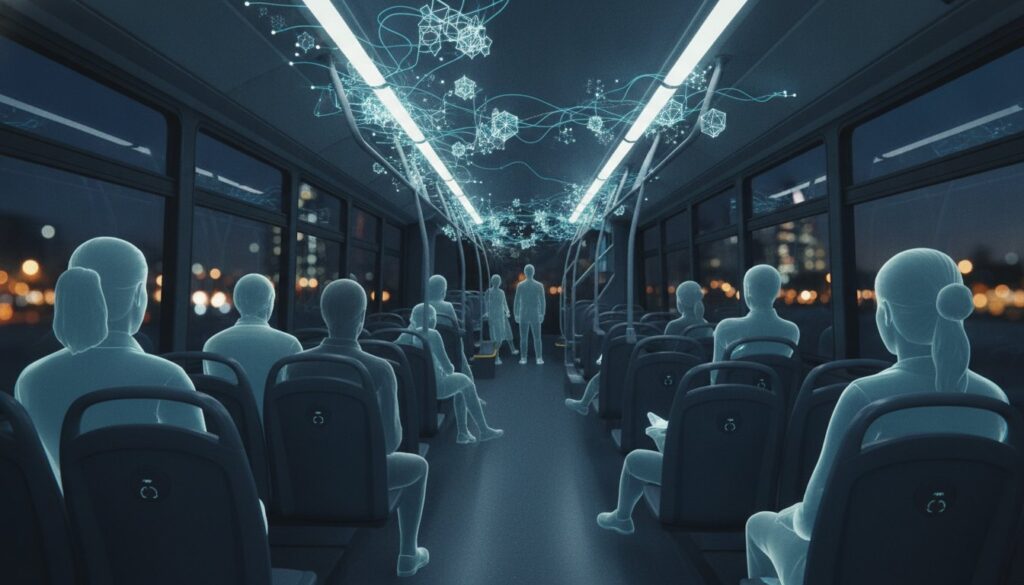
The era of estimating passenger numbers through guesswork and manual tallies is over. In an environment where every second of delay impacts city-wide mobility, modern transit occupancy monitoring has become an ethical and operational imperative. You likely recognise the struggle of managing peak-hour surges with inaccurate data, all whilst navigating the complexities of passenger privacy and GDPR compliance. It’s a delicate balance that traditional methods simply cannot maintain.
This 2026 guide promises to show you how advanced AI-powered sensing technology, such as the AI 3D APC, transforms raw transit data into actionable insights for safer, more efficient networks. By achieving 99% counting accuracy, you can reduce operational costs through data-led scheduling and provide real-time occupancy updates directly to passenger apps. We’ll explore the transition from reactive planning to proactive, intelligent analytics that respect anonymity. To discuss how these solutions fit your infrastructure, contact us at smarturbansensing.co.uk or email our team at sales@smarturbansensing.co.uk.
Key Takeaways
- Precision is Paramount. Learn how the AI 3DPro2 delivers 99% accuracy in challenging environments to eliminate the risks of manual counting errors.
- Safety through Visibility. Discover how transit occupancy monitoring provides the real-time data necessary to manage overcrowding and improve emergency response times.
- Optimised Fleet Management. Understand the role of V9 Analytics Software in aligning service frequency with actual demand to reduce fuel waste and operational overheads.
- Privacy as a Priority. Explore the technological safeguards that ensure passenger anonymity whilst maintaining total compliance with GDPR and regulatory standards.
- Strategic Growth. Find out how the AI 3D APC scales with your transport network; for expert consultation, contact us at smarturbansensing.co.uk or email sales@smarturbansensing.co.uk.
What is Transit Occupancy Monitoring and Why Does it Matter?
Accurate data is the foundation of every high-performing transport network. Transit occupancy monitoring involves the continuous, real-time tracking of passenger volumes across every node of a transport network. By 2026, smart city infrastructure goals demand a level of precision that older systems can’t provide. These objectives focus on creating carbon-neutral urban centres where public transport is the preferred choice for every citizen. This transition relies on the ability to demonstrate efficiency and reliability through transparent, data-driven management. We’re moving beyond vague estimates toward high-granularity data that identifies exactly how many passengers are in a specific carriage or at a particular bus stop. This level of detail is essential for balancing the load across a network, ensuring that no single asset is over-utilised whilst others remain empty.
The Shift Towards Automated Passenger Counting (APC)
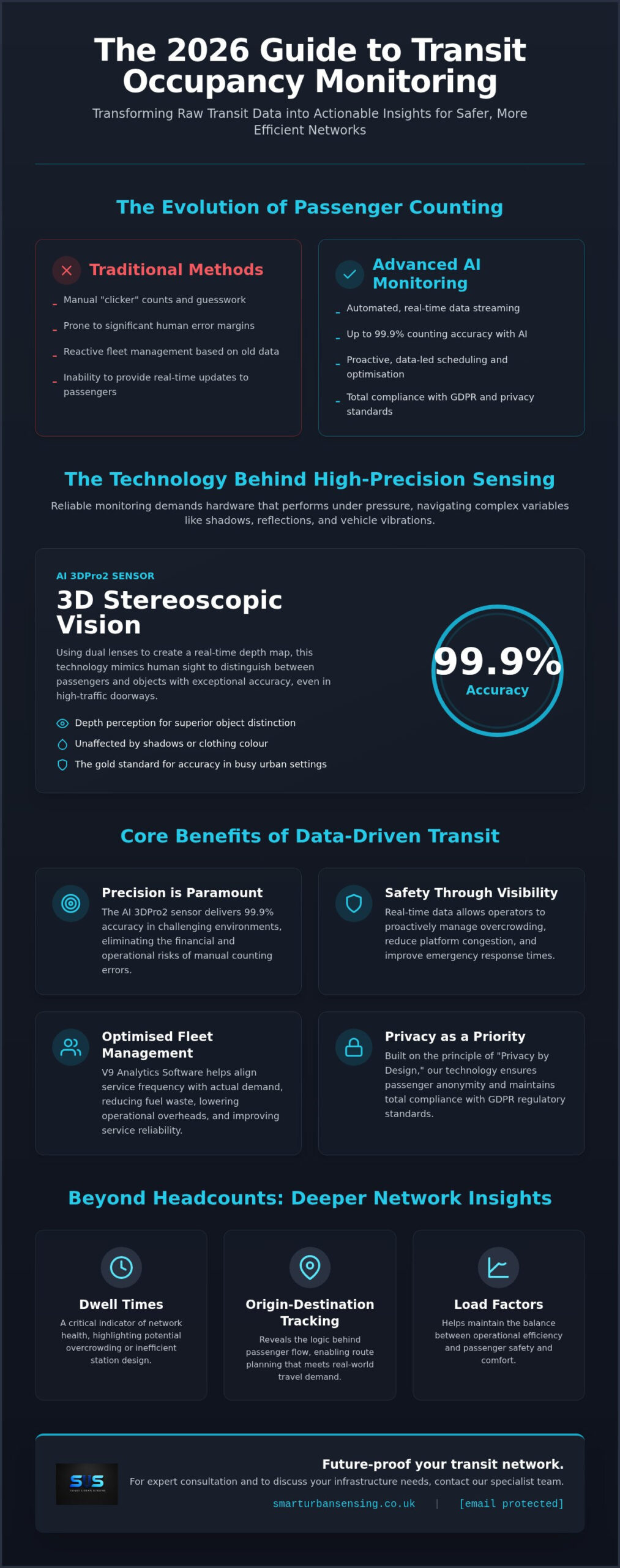
Precision is the only viable alternative to the unreliability of manual counting. Manual “clicker” counts are a strategy of the past. Human-led data collection is prone to significant error margins, often making fleet management a guessing game. Automated systems provide the cold precision needed for complex logistics. Modern APC solutions allow for real-time data streaming. This isn’t just for back-office planning; it’s for the passengers too. When commuters can see exactly how busy the next train is via an app, they can choose to wait for a less crowded service. This improves the overall travel experience and naturally distributes the load across the fleet.
Key Metrics: Beyond Simple Headcounts
True network optimisation requires a perspective that extends beyond simple headcounts. To truly optimise a network, operators must look at the nuances of passenger flow. Dwell times, for example, are a critical indicator of network health. If a bus is consistently stuck at a stop for longer than scheduled, it’s often a sign of overcrowding or poor station design. Origin-Destination (OD) tracking provides the logic behind the numbers, showing where people are actually going so you can plan routes that meet real demand. Integrating these metrics into a centralised platform like V9 Analytics Software allows for a holistic view of the entire network. Load factors help you maintain that balance where vehicles are full enough to be efficient but not so crowded that passenger safety is compromised. By monitoring these factors in real time, operators can deploy additional services or adjust frequencies on the fly to prevent bottlenecks. For a comprehensive look at how to optimise these processes, our passenger flow management guide for 2026 explores predictive strategies and real-time analytics in greater depth.
To learn more about implementing advanced transit occupancy monitoring in your own network, visit smarturbansensing.co.uk or contact our specialist team at sales@smarturbansensing.co.uk.
The Technology Behind High-Precision Occupancy Sensing
Reliable transit occupancy monitoring demands hardware that performs under pressure. Achieving 99% accuracy isn’t just a technical milestone; it’s a prerequisite for the high-level logistical decisions required in 2026. The sensors must navigate complex variables like shadows, reflections, and the physical vibrations of a moving vehicle whilst delivering data that operators can trust implicitly. This level of precision is what separates a strategic asset from a mere gadget.
3D Stereoscopic vs Thermal Sensors
Depth perception is the defining advantage of 3D stereoscopic sensors. By using dual lenses to create a real-time depth map, these devices mimic human sight to distinguish between passengers and inanimate objects. This is particularly vital in high-traffic doorways where people board and alight simultaneously. Whilst thermal sensors are often preferred in total darkness or areas with extreme glare, stereoscopic vision remains the gold standard for accuracy in busy urban environments. The AI 3DPro2 excels here, maintaining its performance regardless of clothing colour or ambient lighting. For those evaluating specific hardware for their fleet, the AI 3D APC: 2026 Passenger Counting Buying Guide provides a comprehensive breakdown of these technical trade-offs. Fleet operators looking to move beyond legacy infrared systems should also review the latest bus occupancy sensor technology options for 2026, which compares 3D Time-of-Flight and AI stereoscopic solutions in detail.
Privacy by Design and GDPR Compliance
Anonymisation is a core feature, not an optional extra. Our technology is built on the principle of “Privacy by Design,” ensuring that passenger trust is never compromised. We achieve this through edge computing. Instead of streaming video to a central server, the AI 3D APC processes all visual data locally on the device. It converts the visual input into a simple numerical count and then discards the image immediately. There’s a fundamental distinction between counting and surveillance. Counting identifies a shape as a human to provide a tally; surveillance seeks to identify who that human is. By focusing purely on anonymous volumes, we ensure absolute GDPR compliance. If you’re ready to implement privacy-compliant sensing, our team is available to discuss your specific regulatory needs. You can also reach us directly at sales@smarturbansensing.co.uk.
Durability is the final pillar of effective transport sensing. Hardware mounted on buses or trains faces constant mechanical stress. The AI 3DPro2 is engineered to withstand these rigorous conditions, featuring housing that protects the internal AI processors from vibration and temperature spikes. This ensures that your data remains consistent over the entire lifecycle of the vehicle, preventing the costly maintenance cycles associated with less robust equipment. It’s this combination of AI intelligence and physical resilience that defines modern transit analytics.
Enhancing Passenger Safety and Experience through Data
Data is the silent guardian of the modern passenger experience. Whilst infrastructure and fleet quality are vital, the way a passenger feels during their journey often depends on the invisible management of space and safety. Effective transit occupancy monitoring isn’t just a logistical tool; it’s a safety essential that allows operators to respond to the pulse of the network in real time. When you have an accurate view of every carriage and platform, you can prevent the dangerous overcrowding that leads to accidents and passenger distress.
Accurate data directly correlates with higher passenger satisfaction scores. By feeding real-time occupancy levels into public-facing apps, you empower commuters to make informed choices. Instead of boarding a “crush load” train, a passenger might choose to wait five minutes for a service with guaranteed seating. This transparency builds trust and transforms the perception of public transport from a necessary chore into a reliable, high-quality service. Beyond daily comfort, these sensors play a pivotal role in emergency evacuation planning and incident management, providing first responders with the exact number of individuals on board a vehicle at any given second.
Managing Overcrowding in Real-Time
V9 Analytics Software acts as the central nervous system for capacity management. It doesn’t just record numbers; it provides the logic needed to handle surges during major events like festivals or sports fixtures. When a platform reaches a pre-defined safety threshold, the software triggers immediate alerts, allowing staff to implement crowd control measures before a situation becomes critical. This proactive approach alleviates the psychological strain on passengers, who feel safer when they see that their environment is being actively managed. It ensures that even during peak demand, the network remains fluid and secure.
Accessibility and Inclusive Transport
Inclusivity relies on the ability to see the specific needs of every passenger. Our AI 3D APC sensors are sophisticated enough to distinguish between adults, children, and wheelchair users, providing a granular level of data that traditional counters miss. This capability is essential for monitoring the availability of dedicated spaces for pushchairs, bicycles, and mobility aids. If these areas are consistently full, operators can use this evidence to justify fleet modifications or service increases on specific routes. Precise occupancy data ensures that transport networks remain truly equitable by guaranteeing that accessibility requirements are met in real-time. If you’re looking to improve the inclusivity of your network, contact our team at smarturbansensing.co.uk or reach out via email at sales@smarturbansensing.co.uk.
Operational Efficiency: Optimising Fleet Management
Efficiency in transit is no longer about following a fixed timetable; it’s about responding to the living flow of the city. Implementing transit occupancy monitoring allows operators to move beyond static models and embrace dynamic scheduling. When you understand exactly how many people are using a specific route at any given hour, you can align your fleet capacity with actual demand. This precision ensures that you aren’t running empty vehicles during off-peak times whilst leaving passengers stranded during unexpected surges. Effective passenger flow management is central to this shift, enabling operators to move from reactive crowd control toward predictive, data-driven resource allocation.
The environmental impact of these insights is substantial. By reducing the number of unnecessary journeys, operators can significantly lower their fuel consumption and overall carbon footprint. There are also clear maintenance benefits to this approach. Instead of servicing vehicles based on arbitrary time intervals, data allows you to prioritise cleaning and repairs for the most-used assets. This extends the lifecycle of the fleet and ensures that resources are directed where they’re needed most. For a deeper analysis of these financial gains, explore our ROI of Bus Passenger Counters: Guide for Fleet Operators.
Data-Led Scheduling and Route Planning
Eliminating “ghost buses” is a primary goal for modern fleet managers. These low-occupancy routes drain resources without providing a meaningful service to the community. By analysing historical data from V9 Analytics Software, you can identify these inefficiencies and reallocate those vehicles to high-demand corridors. Integrating this passenger data with existing GPS and telematics systems creates a comprehensive view of network performance. This allows you to predict seasonal trends and peak shifts, ensuring your route planning is always one step ahead of public behaviour.
Revenue Protection and Subsidy Reporting
Integrity in reporting is essential for securing the future of public transport. Accurate APC data allows operators to verify ticket sales against the actual number of passengers on board, identifying potential revenue leakage. This transparency is also a requirement for securing government subsidies and grants, where precise ridership figures are mandatory for compliance. Automated reporting through our AI systems reduces the administrative overhead for fleet managers, allowing them to focus on strategy rather than manual spreadsheet entry. If you’re ready to optimise your fleet operations, contact our specialists at sales@smarturbansensing.co.uk.
Future-Proofing Your Transit Network with SUS
Building a resilient transport network requires a foundation of adaptable, high-precision technology. Future-proofing isn’t just about selecting the latest hardware; it’s about choosing an architecture that evolves alongside urban growth and changing commuter behaviours. Investing in advanced transit occupancy monitoring today ensures that your infrastructure remains relevant as smart city initiatives accelerate toward 2026. The scalability of the AI 3D APC system allows transit authorities to start with critical routes and expand network-wide without the need for a total system overhaul. This modular approach provides a sustainable path for digital transformation, ensuring long-term strategic value for every pound invested.
Smart Urban Sensing Ltd acts as a strategic partner rather than a mere vendor. We understand that every transport network has unique challenges, from high-vibration rail environments to the varied lighting conditions of bus interchanges. Our consultative approach means we work closely with your team to assess specific fleet needs, providing the technical expertise required to solve complex mobility problems. This partnership ensures that your sensing solution is perfectly aligned with your operational goals and regulatory requirements.
Integrating Analytics with V9 Software
A centralised view of your network is the key to informed decision-making. V9 Analytics Software provides a powerful dashboard that brings network-wide visibility into a single interface. This cloud-based management is particularly effective for multi-modal transport hubs, where data from buses, trains, and trams must be synthesised to create a cohesive passenger flow strategy. The software’s ability to integrate SUS hardware with existing third-party fleet management systems means you don’t have to replace your current software to benefit from high-precision data. This interoperability allows for a smoother transition, letting you layer intelligent analytics over your established workflows to enhance efficiency without disruption.
Get Started with Smart Urban Sensing
The journey toward an intelligent, data-led transport network begins with a technical consultation. We recommend a thorough assessment of your fleet to identify the specific sensor configurations and software integrations that will deliver the most immediate impact. Whether you’re looking to improve passenger safety, optimise scheduling, or ensure total GDPR compliance through edge computing, our team provides a clear roadmap for implementation. We specialise in bespoke project requirements, ensuring that your transit occupancy monitoring system is tailored to the exact demands of your infrastructure.
To begin your digital transformation and explore how our AI-powered solutions can enhance your fleet management, contact us on our website or email our specialist team at sales@smarturbansensing.co.uk. We’re ready to help you build a safer, more efficient transport network for the future.
Transforming Urban Mobility with Intelligent Data
Adopting advanced transit occupancy monitoring is no longer a luxury for forward-thinking operators; it’s the standard for modern urban mobility. By replacing outdated manual methods with AI 3DPro2 technology, you secure 99% accuracy whilst ensuring full GDPR compliance via edge-based processing. This precision provides the necessary foundation for dynamic fleet scheduling, improved passenger safety, and significant reductions in your network’s carbon footprint.
As a UK-based expert, Smart Urban Sensing Ltd offers the consultative support and technical reliability needed to manage these complex infrastructure transitions. We’re dedicated to helping you turn raw data into a strategic asset that improves the daily lives of every commuter. Our team bridges the gap between high-level engineering and everyday fleet management to ensure your network remains resilient in an ever-changing urban environment.
Ready to redefine your network’s efficiency? Request a technical consultation for your transit network or contact our specialist team at sales@smarturbansensing.co.uk. Together, we can build a more resilient and passenger-centric transport network for the future.
Frequently Asked Questions
How accurate is transit occupancy monitoring technology in 2026?
Modern transit occupancy monitoring technology, specifically the AI 3DPro2, delivers up to 99% accuracy. This precision is maintained even in high-vibration environments or challenging lighting conditions found on buses and trains. By using AI-powered 3D stereoscopic vision, the system filters out shadows and reflections that typically confuse older sensors. This ensures that fleet operators have reliable data for critical scheduling and safety decisions across their entire network.
Is automated passenger counting (APC) compliant with UK GDPR?
Yes, our automated passenger counting systems are fully compliant with UK GDPR through a “Privacy by Design” approach. The AI 3D APC processes all visual data locally on the device using edge computing. It converts movements into numerical counts and discards the images immediately, ensuring no personally identifiable information (PII) is ever stored or transmitted. This methodology maintains passenger anonymity whilst providing the high-granularity data required for network optimisation.
Can transit sensors distinguish between passengers and luggage or pets?
Advanced AI sensors, such as the AI 3DPro series, are specifically designed to distinguish between humans and inanimate objects. By creating a real-time depth map, the system recognises the physical proportions of a person compared to luggage, pushchairs, or pets. This capability prevents inflated headcounts and provides a more accurate reflection of actual vehicle load, which is essential for managing passenger comfort and safety during peak travel times.
What is the difference between 3D stereoscopic and infrared sensors for buses?
3D stereoscopic sensors use dual lenses to create a three-dimensional view, offering superior accuracy in crowded doorways by perceiving depth. Infrared sensors often rely on beam interruption or heat signatures, which can be less reliable in extreme temperatures or high-density boarding scenarios. Whilst infrared can be a cost-effective entry point, 3D stereoscopic technology like the AI 3D APC is the preferred choice for operators requiring 99% counting precision and complex flow analysis. For a detailed comparison of how modern bus occupancy sensor technology has advanced beyond legacy infrared systems, our dedicated 2026 fleet operator guide provides an in-depth evaluation.
How does real-time occupancy data improve passenger safety?
Real-time data allows operators to prevent dangerous overcrowding by monitoring carriage and platform volumes as they happen. If a vehicle reaches its safe capacity, V9 Analytics Software triggers immediate alerts for staff intervention. Additionally, these systems provide first responders with precise passenger counts during emergency incidents, facilitating more effective evacuation planning. This visibility reduces the risk of “crush loads” and ensures a safer environment for all commuters across the network.
What is the typical ROI for installing bus passenger counting systems?
The return on investment (ROI) for transit occupancy monitoring is realised through multiple channels. Operators reduce fuel costs by eliminating “ghost buses” and reallocating resources to high-demand routes. Accurate data ensures total compliance for government subsidy reporting, protecting vital revenue streams. By automating these processes, fleet managers also reduce administrative overheads, leading to long-term operational savings. For a bespoke ROI assessment, contact our team at sales@smarturbansensing.co.uk.
Does transit occupancy monitoring require a constant internet connection?
A constant connection isn’t strictly necessary for the counting process itself, as AI 3D APC units perform all calculations at the edge. The system can cache data locally and transmit it to the V9 Analytics Software whenever a connection is established, such as via 4G, 5G, or depot Wi-Fi. However, a stable connection is recommended if you intend to provide real-time occupancy updates to public-facing passenger apps or emergency monitoring centres.
Can the AI 3D APC system be retrofitted to older vehicle models?
Yes, the AI 3D APC is designed for both new builds and retrofitting into existing fleets. Its compact housing and flexible mounting options make it compatible with a wide variety of older bus and train models. This allows transit authorities to modernise their networks without the immediate expense of replacing entire vehicles. To discuss the specific requirements for your current fleet, please visit smarturbansensing.co.uk or email us at sales@smarturbansensing.co.uk.


