
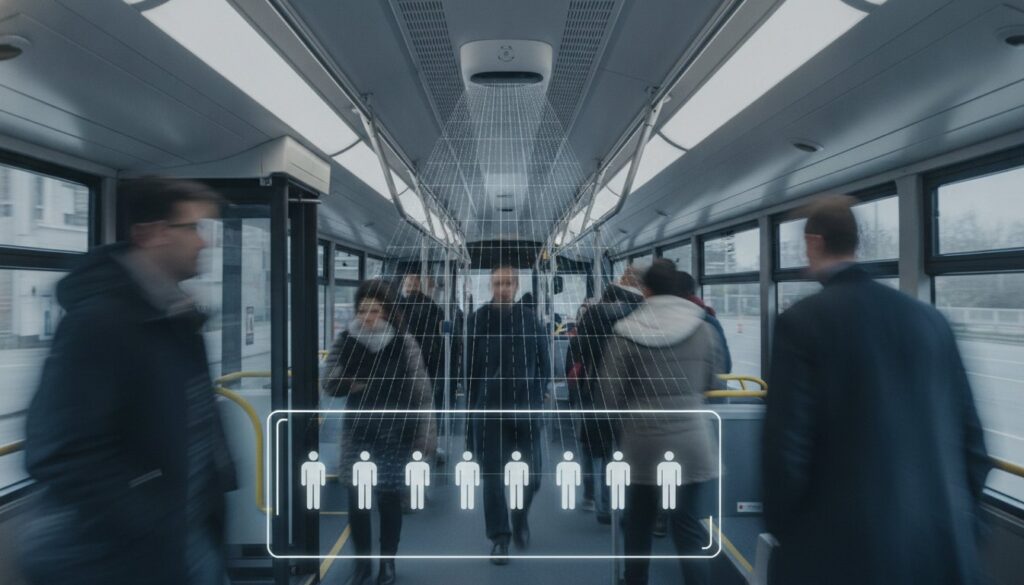
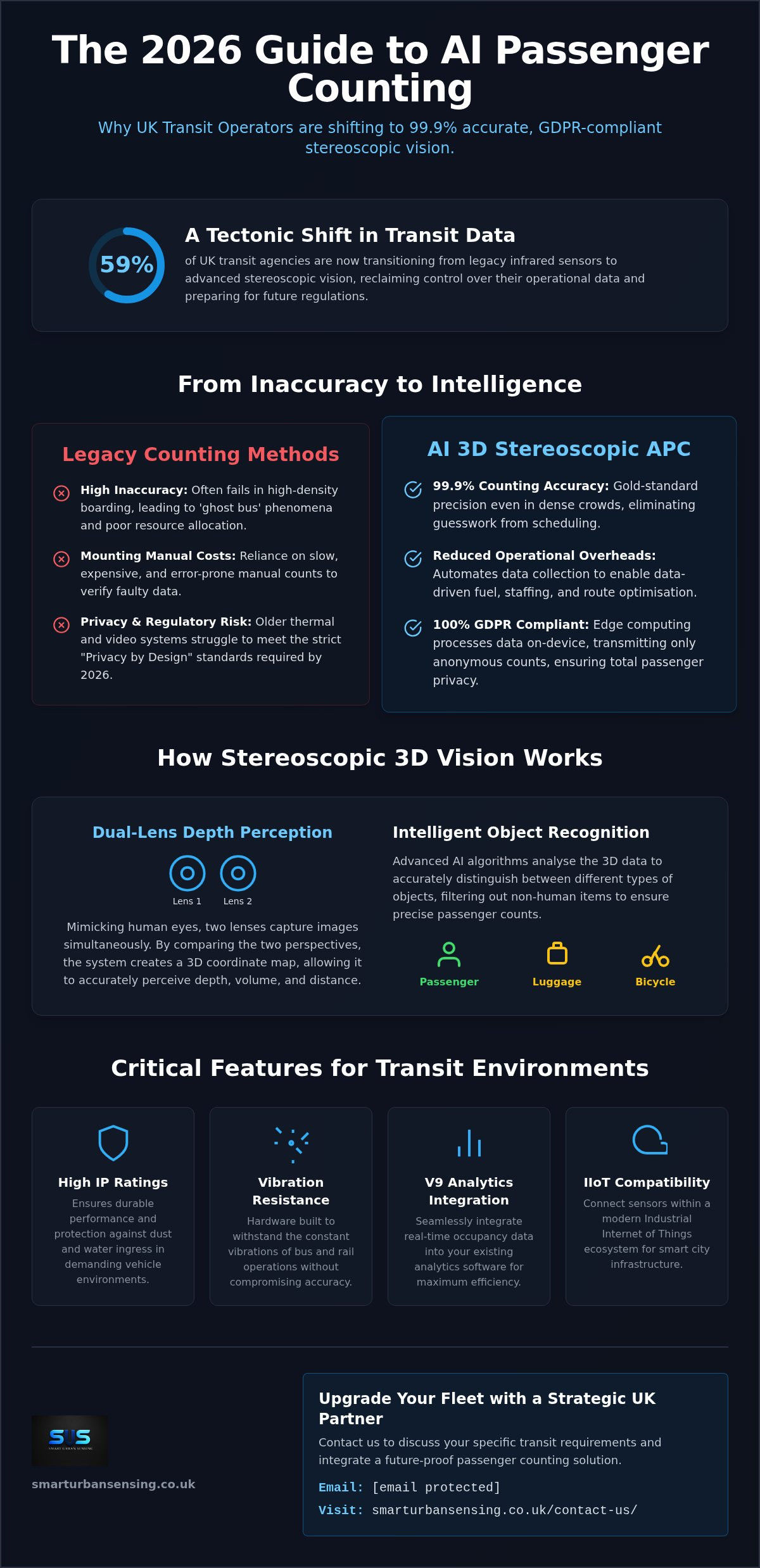
Did you know that 59% of transit agencies are now transitioning from infrared sensors to stereoscopic vision to reclaim control over their operational data? For many UK fleet operators, the reliance on legacy hardware has led to a cycle of inaccurate reporting and mounting manual costs. You’ve likely experienced the limitations of systems that struggle with high-density boarding or fail to meet the rigorous “Privacy by Design” standards required in 2026. Integrating a robust AI 3D APC solution is no longer just an upgrade; it’s a strategic necessity following the recent discontinuation of major thermal sensor lines across the industry.
We understand that precision shouldn’t come at the cost of privacy or regulatory risk. This 2026 buying guide demonstrates how AI-powered stereoscopic sensors achieve a remarkable 99% accuracy rate whilst maintaining absolute GDPR compliance for your entire transit fleet. By adopting these advanced solutions, you can finally move beyond guesswork to data-driven route scheduling and reduced operational overheads. We’ll examine the technical shift towards IIoT compatibility, the implications of the latest UK Automated Vehicles regulations, and the strategic steps to integrate real-time occupancy data into your V9 Analytics software for maximum efficiency.
Key Takeaways
- Understand why the industry is moving away from legacy infrared sensors towards stereoscopic 3D vision to achieve a gold-standard 99% counting accuracy.
- Learn how modern AI 3D APC systems achieve precision whilst ensuring 100% GDPR compliance through “Privacy by Design” protocols that protect passenger anonymity.
- Discover the methodology for integrating real-time sensor data with V9 Analytics Software to optimise fleet scheduling and reduce operational overheads.
- Identify the critical hardware specifications, such as IP ratings and vibration resistance, required for durable performance in demanding bus and rail environments.
- Connect with a strategic UK partner at sales@smarturbansensing.co.uk or visit smarturbansensing.co.uk/contact-us/ to discuss your specific transit requirements.
The Shift to AI 3D APC: Why Traditional Counting Methods Fail
The transition toward sophisticated data collection is accelerating across the UK transport sector. For years, operators relied on traditional counting methods such as infrared beam-break sensors and thermal imaging to monitor patronage. These legacy systems often struggle in the high-density environments of modern transit networks. Infrared beams are easily blocked by groups of passengers entering simultaneously, whilst thermal sensors frequently fail to distinguish between human heat signatures and other environmental heat sources. Manual counting, once a standard practice, is now entirely insufficient. It’s too slow, prone to human error, and far too expensive for the scale of data required for modern fleet management.
The Hidden Costs of Inaccurate Passenger Data
Inaccuracy isn’t just a technical glitch; it’s a financial drain. Even a 5% error rate in passenger counts can lead to significant inefficiencies in fuel consumption and staffing allocations. When data suggests a bus is empty when it’s actually at capacity, operators face the ‘ghost bus’ phenomenon. This occurs when services are cut based on false low-occupancy reports, leaving passengers stranded and damaging public trust. Conversely, overcrowding at peak times goes unaddressed without real-time metrics, leading to safety concerns and lost revenue from missed boardings. Precise monitoring ensures that every vehicle in the fleet is utilised to its full potential, protecting both the bottom line and the passenger experience.
Defining AI 3D APC in a Smart City Context
A modern AI 3D APC system represents a fundamental shift from simple detection to intelligent recognition. Unlike older technologies, these systems use dual-lens stereoscopic vision to mimic human depth perception. This allows the hardware to distinguish between an adult passenger, a child, a bicycle, or a piece of luggage with 99% accuracy. By utilising edge computing, the AI 3D APC processes this data directly on the vehicle, ensuring that only anonymous, numerical data is transmitted. This approach supports strict privacy standards whilst providing the granular insights needed for smart city infrastructure. To learn more about upgrading your fleet, contact us at smarturbansensing.co.uk/contact-us/ or email sales@smarturbansensing.co.uk.
Technical Deep-Dive: How Stereoscopic 3D APC Technology Works
The shift to high-precision monitoring requires a fundamental understanding of spatial awareness. Unlike traditional monocular cameras that see the world as a flat, two-dimensional image, an AI 3D APC system utilises dual-lens technology to capture volume and depth. This stereoscopic approach mimics the way human eyes perceive the world, allowing the sensor to calculate the exact distance of objects from the lens. By processing these images locally on the device, often referred to as edge computing, the system ensures rapid response times and superior data security. This means that sensitive video data never leaves the vehicle; only anonymous, numerical counts are transmitted to your central management platform.
Stereoscopic Vision vs. Monocular Cameras
Depth perception is the primary differentiator when counting passengers in high-traffic transit environments. Monocular systems often fail when people walk closely together, as they cannot distinguish where one person ends and another begins. Stereoscopic sensing is the use of two lenses to create a three-dimensional coordinate map. This map allows the system to accurately separate individual passengers, even when they are boarding in dense groups. It also effectively eliminates false positives caused by shifting shadows, floor patterns, or reflections that often confuse standard camera-based systems. If you’re looking to optimise your fleet’s data accuracy, understanding these technical nuances is the first step.
Distinguishing Passenger Types with AI
The intelligence within an AI 3D APC device goes beyond simple movement detection. Advanced algorithms are trained to identify specific shapes and behaviours, allowing the system to filter out non-human objects such as wheelchairs, pushchairs, or bicycles. This level of granularity is vital for transport authorities who need to understand the true composition of their patronage. The technology can even distinguish between adults and children based on height and spatial volume, providing more accurate data for fare revenue analysis. Additionally, the system is designed to handle complex ‘dwell’ behaviour, where passengers might linger near the doors without actually alighting. By tracking the trajectory of each individual in a 3D space, the sensor ensures that only valid boardings and alightings are recorded. This maintains a 99% accuracy rate even in challenging lighting or poor weather conditions. For technical specifications on our hardware, you can reach our team at sales@smarturbansensing.co.uk.
Critical Features to Evaluate When Selecting an APC System
Choosing an AI 3D APC system requires a strategic focus on three specific pillars: accuracy, durability, and ethical compliance. Whilst many vendors claim high precision, the 99% benchmark remains the industry gold standard for a reason. This level of reliability ensures that the data driving your fleet management decisions is beyond reproach. It effectively eliminates the need for expensive manual audits and provides a solid foundation for revenue protection strategies. When accuracy drops even slightly, the cumulative error over a single month can lead to thousands of pounds in misallocated resources.
Durability and Longevity in Transit Environments
Transit hardware must withstand conditions that would cause standard consumer electronics to fail within weeks. When evaluating sensors for bus and rail, look for high IP ratings to ensure protection against dust and moisture ingress during cleaning or inclement weather. Vibration resistance is equally critical; the constant movement of a vehicle over uneven road surfaces or rail tracks can loosen internal components over time. Investing in robust hardware significantly reduces your total cost of ownership by minimising maintenance cycles and extending the lifespan of the installation. You can learn more about high precision 3D counters for industrial and transit applications to see how these benchmarks are met in practice.
The Privacy Framework: GDPR and Anonymisation
Public trust is a fragile asset. In an era of heightened surveillance concerns, transport authorities must demonstrate a commitment to “Privacy by Design.” The most effective AI 3D APC solutions use vector-based counting rather than traditional video recording. This technology treats passengers as anonymous 3D coordinates rather than identifiable faces. There is a fundamental difference between video surveillance and data sensing; the former captures personal information, whilst the latter focuses purely on spatial metrics. By ensuring that no identifiable images are ever stored or transmitted, you can achieve 100% GDPR compliance without the complexities of facial recognition.
Low-profile aesthetics also play a role in this trust. A discreet, ceiling-mounted sensor is less intrusive than a bulky camera housing, reducing the psychological impact on passengers whilst protecting the hardware from accidental damage. For a consultation on how to balance these technical requirements with your fleet’s specific needs, please reach out to our team at sales@smarturbansensing.co.uk or visit our contact page at smarturbansensing.co.uk/contact-us/.
Integration and Analytics: Maximising the Value of Your Data
Data is only as valuable as the insights it generates. Whilst the precision of the hardware provides the necessary foundation, the true transformation occurs when you bridge the gap between raw numbers and operational intelligence. An AI 3D APC system shouldn’t exist in a vacuum. It must serve as a primary node within your broader digital infrastructure. By connecting high-precision sensors to the V9 Analytics Software suite, you can move beyond simple counting to a sophisticated understanding of passenger behaviour and fleet performance. This integration allows for a seamless flow of information, ensuring that every boarding event is recorded, analysed, and made available for decision-making in real time. For a comprehensive overview of how these principles apply across your network, our guide to transit occupancy monitoring explores the full spectrum of intelligent passenger analytics for 2026.
Visualising Flow with V9 Analytics
The V9 platform provides a centralised dashboard that turns complex datasets into intuitive visualisations. Operators can generate detailed heatmaps to identify boarding hotspots or set up automated alerts that trigger when occupancy levels approach safety limits. This proactive approach is essential for maintaining service standards during unexpected peaks. The granular data collected serves as the perfect evidence base for financial planning. By using these metrics, you can accurately calculate the ROI of bus passenger counters, justifying the investment through documented improvements in efficiency and revenue protection.
Operational Efficiency Through Data-Driven Scheduling
Reliable data allows you to challenge the assumptions of traditional timetabling. Instead of relying on static estimates, you can adjust service frequency based on actual passenger load. This flexibility is vital for modern transit networks aiming to reduce fuel consumption and staffing costs. Effective passenger flow management enables operators to move from reactive crowd control to predictive staff allocation, ensuring resources are deployed precisely where and when they are needed. If the AI 3D APC data reveals that specific evening services are consistently under-utilised, those resources can be reallocated to high-demand morning routes. This level of precision doesn’t just save money; it significantly improves the passenger experience by reducing wait times and congestion on the busiest parts of the network.
Modern fleet management also requires robust reporting to satisfy regulatory bodies and local authorities. Our systems offer full API compatibility, allowing for the automated generation of National Transit Database (NTD) reports and other essential compliance documents. This automation removes the administrative burden from your team, ensuring that your reporting is always accurate and submitted on time. To see how V9 Analytics can transform your fleet’s data into a strategic asset, book a demonstration with our technical team or contact us directly at sales@smarturbansensing.co.uk.
Choosing Your Partner: Why Smart Urban Sensing Leads the UK Market
Selecting a technology partner for national transit projects requires more than just a hardware vendor; it demands a strategic ally who understands the specific nuances of the UK market. From strict GDPR compliance to the rigours of local transport regulations, the requirements are exacting. Smart Urban Sensing Ltd leads the sector by offering a unique combination of technological sophistication and local expertise. Whilst global competitors often provide generic support, our focus remains on the practical challenges faced by UK fleet operators. We’ve built a proven track record with the AI 3DPro series, deploying these systems in diverse urban environments where precision is non-negotiable. Whether you manage a small independent fleet or a massive transport hub, our scalable solutions are designed to deliver long-term stability and data integrity.
A Consultative Approach to Transit Innovation
We organise our project delivery to ensure minimal disruption to your operations. A successful implementation begins with a comprehensive site survey, followed by a methodical rollout that respects your fleet’s availability. This consultative approach extends far beyond the initial installation. Your AI 3D APC units receive regular firmware updates to ensure they remain at the cutting edge of sensing technology. Additionally, you have direct access to our UK-based technical support team. Having engineering expertise in the same time zone means that technical queries are resolved promptly, ensuring your data flow remains uninterrupted. This reliability is vital for maintaining the 99% accuracy rate that our clients expect from the AI 3DPro series.
Next Steps for Fleet Modernisation
Modernising your fleet is a significant step, but it doesn’t have to be a leap into the unknown. We recommend starting with a technical demonstration of the AI 3D APC system to see the V9 Analytics software in action. From there, we can facilitate a pilot programme to validate accuracy on your specific routes and vehicle types. This evidence-based approach ensures that the technology meets your exact requirements before a full-scale deployment. By validating the system in real-world conditions, you can move forward with total confidence in your data. To begin your journey toward 99% counting accuracy, Contact Smart Urban Sensing Ltd or email sales@smarturbansensing.co.uk to discuss your requirements.
Future-Proofing Your Transit Network with Precision Data
Adopting 2026 standards for passenger monitoring requires a decisive move away from legacy infrared systems towards sophisticated stereoscopic vision. The seamless integration of AI 3D APC hardware with V9 Analytics ensures that fleet operators can optimise routes and resource allocation with absolute confidence. By prioritising our 99% accuracy guarantee and GDPR-compliant “Privacy by Design” protocols, you protect both your operational revenue and the privacy of the public you serve. These systems are built to endure the rigours of the UK transit environment, providing long-term reliability and actionable intelligence. It’s a transformation that empowers your network to meet modern demands with surgical precision.
Smart Urban Sensing Ltd stands as your strategic partner, offering dedicated UK-based technical support to guide you through every stage of implementation. Whether you are managing a local bus fleet or a national rail network, our methodical approach ensures that your data remains a strategic asset. Ready to modernise your infrastructure? Request a Technical Consultation and Quote today. For further information, please contact our engineering team at sales@smarturbansensing.co.uk. We look forward to helping you lead the way in transit innovation.
Frequently Asked Questions
What is the difference between AI 3D APC and standard IR counters?
AI 3D APC uses dual-lens stereoscopic vision to create a 3D depth map, whereas standard IR counters rely on simple beam-breaks. This allows the AI system to distinguish between individuals and objects, even in dense crowds. IR counters often fail when multiple people cross at once or when shadows interfere. The 3D approach ensures a 99% accuracy rate that legacy infrared hardware simply cannot match.
Is the AI 3D APC system fully GDPR compliant for use in the UK?
Yes, the system is fully GDPR compliant and adheres to “Privacy by Design” principles. It uses vector-based sensing to track anonymous 3D coordinates rather than capturing facial features or identifiable images. Sensitive video data is processed locally on the edge, meaning no personal information is ever stored or transmitted. This ensures total passenger anonymity whilst providing the granular data required for modern fleet management.
Can the passenger counter distinguish between children and adults?
The AI algorithms can accurately distinguish between adults and children by calculating the height and spatial volume of each passenger. This capability is vital for transport authorities who need to reconcile patronage data with fare revenue. By filtering counts based on height thresholds, the system provides a more detailed breakdown of passenger demographics, allowing for more precise financial auditing and resource planning.
How does the system perform in low-light or night-time conditions?
The system performs reliably in low-light and night-time conditions by utilising advanced image sensors and, where necessary, infrared illumination. Unlike standard cameras that require high ambient light, stereoscopic 3D technology can maintain its 99% accuracy in the variable lighting found within bus and rail interiors. This ensures consistent data collection during early morning commutes or late-night services without requiring additional cabin lighting.
What is the typical installation time for an APC sensor on a standard bus?
A typical installation for an APC sensor on a standard bus takes approximately two to four hours per vehicle. This timeframe includes the physical mounting of the low-profile hardware and the initial calibration to the door environment. We organise our project delivery to minimise fleet downtime, often working during scheduled maintenance windows to ensure your vehicles return to service as quickly as possible.
Does the AI 3D APC integrate with my existing fleet management software?
The AI 3D APC is designed for seamless integration with existing fleet management and telematics software. It features full API compatibility and integrates directly with our V9 Analytics Software suite. This allows you to combine real-time occupancy data with GPS location and scheduling information. For specific integration queries, please visit our contact us page or email sales@smarturbansensing.co.uk.
How does the system handle passengers carrying large items like luggage or prams?
The system uses sophisticated AI algorithms to identify and filter out non-human objects such as luggage, bicycles, and prams. By analysing the 3D shape and movement patterns of an object, the sensor can distinguish a passenger from the items they are carrying. This ensures that your patronage data remains accurate and isn’t inflated by the presence of large bags or mobility aids in the boarding area.
What level of accuracy can I expect from the AI 3D APC in crowded environments?
You can expect a 99% accuracy rate even in highly crowded environments. The dual-lens stereoscopic vision allows the system to separate individual passengers who are boarding in close proximity, a task where monocular cameras or IR sensors typically fail. By tracking each person as a distinct 3D entity, the system maintains its precision during peak-time surges, ensuring your occupancy data is always reliable.


