
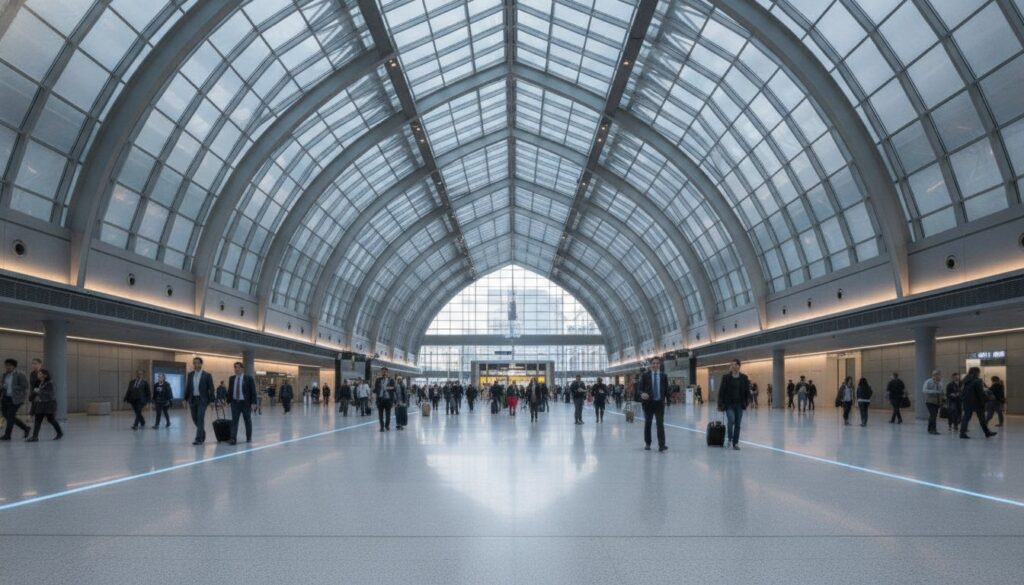
With global airports processing a record 9.8 billion passengers annually, the margin for operational error in transit hubs has effectively vanished. You likely recognise the mounting pressure of peak-time bottlenecks that compromise both safety and the passenger experience. Inaccurate manual counting and the fear of GDPR non-compliance with older camera-based systems often stall progress. Mastering passenger flow management is now a necessity for any hub seeking to balance operational efficiency with strict privacy standards.
This guide demonstrates how to optimise your spaces using high-precision AI sensing and real-time analytics to achieve 99% accurate data. We’ll examine the shift from reactive crowd control to predictive staff allocation and reduced waiting times. By integrating tools like the AI 3DPro2 and V9 Analytics Software, you can secure your infrastructure’s future whilst remaining fully compliant. To discuss your specific requirements, visit smarturbansensing.co.uk or contact our specialist team at sales@smarturbansensing.co.uk.
Key Takeaways
- Understand why strategic passenger flow management is the foundation of modern transit safety and operational efficiency whilst reducing peak-time bottlenecks.
- Learn how 3D stereoscopic sensors such as the AI 3DPro2 achieve 99% accuracy in high-density environments and complex lighting conditions.
- Discover how to maintain strict GDPR compliance by utilising non-intrusive people counting that tracks movement without capturing identifiable personal data.
- Identify the essential steps for auditing infrastructure bottlenecks and establishing clear KPIs to improve boarding efficiency and staff allocation.
- For bespoke advice on optimising your transit hub, contact our expert team at smarturbansensing.co.uk or email sales@smarturbansensing.co.uk.
What is Passenger Flow Management and Why Does It Matter?
Passenger flow management represents the strategic organisation of movement within a physical environment to prioritise safety, comfort, and operational throughput. In the context of 2026 transit hubs, it’s the difference between a seamless journey and a chaotic bottleneck. Historically, transport authorities relied on manual observation or basic infrared beams, but these methods lacked the precision required for modern volumes. The industry has since transitioned to sophisticated, AI-driven automated people counting technologies that provide granular, real-time insights into how individuals navigate complex spaces.
When flow is poorly managed, the consequences are immediate. Congestion leads to heightened passenger stress and significant safety risks, particularly during peak hours or emergency evacuations. Beyond safety, inefficient movement directly erodes commercial revenue; passengers stuck in security queues or crowded corridors have less time to engage with retail and dining facilities. High-precision data allows managers to predict these bottlenecks before they manifest, transforming a reactive struggle into a proactive strategy.
To better understand how design and flow interact in high-stakes environments, watch this helpful video:
The Core Components of Modern Flow Analytics
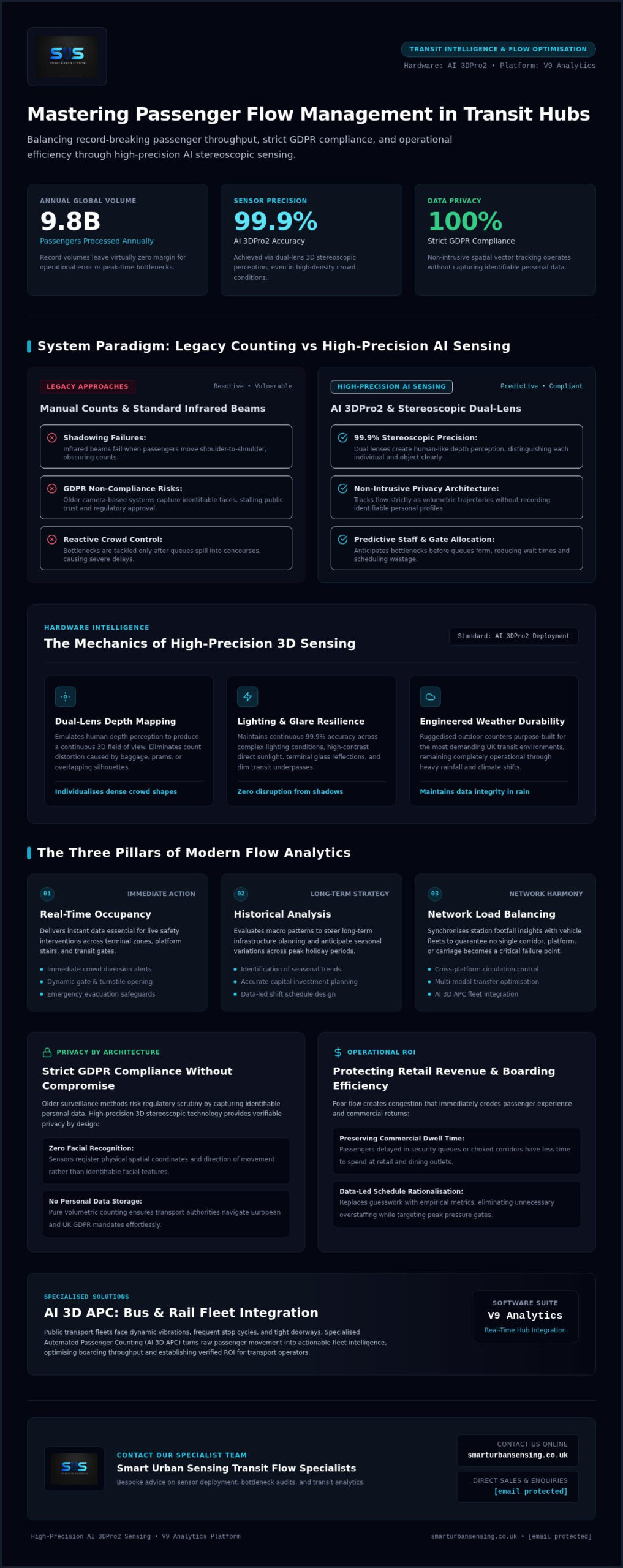
Effective analytics systems rely on three distinct pillars to maintain order. Real-time occupancy monitoring provides the immediate data necessary for safety interventions, such as diverting footfall or opening additional gates. Historical data analysis serves a different purpose, allowing for long-term infrastructure planning and the identification of seasonal trends. By integrating these insights with transit occupancy monitoring, operators can balance network loads across multiple platforms or vehicle fleets, ensuring that no single point becomes a failure.
Benefits for Fleet Operators and Hub Managers
The primary advantage of automated systems is the ability to reduce operational costs through data-led scheduling. Rather than overstaffing based on guesswork, managers can allocate resources precisely where and when they’re needed. This efficiency naturally improves passenger satisfaction by minimising wait times and creating a more intuitive travel experience. For those managing vehicle assets, understanding the ROI of Bus Passenger Counters is essential for justifying the shift toward AI-powered sensing. It’s about turning raw movement into actionable intelligence.
If you’re ready to enhance your facility’s efficiency, visit our contact page at smarturbansensing.co.uk or reach out via email at sales@smarturbansensing.co.uk.
The Mechanics of High-Precision Sensing Technology
3D stereoscopic sensors have emerged as the gold standard for passenger flow management. Unlike legacy systems, these devices utilise dual lenses to create a three-dimensional field of view, mimicking human depth perception to distinguish between individuals and objects with extreme clarity. This spatial awareness allows the AI 3DPro2 to achieve 99% accuracy, even when managing high-density crowds where people are walking shoulder-to-shoulder. While traditional infrared people counting systems often fail due to “shadowing” or environmental interference, stereoscopic technology maintains its precision by individualising every shape within the sensing zone.
For transport hubs across the UK, hardware durability is just as critical as software intelligence. Our outdoor counters are engineered to remain operational in the most demanding climates, ensuring that heavy rain or low-contrast lighting doesn’t compromise data integrity. Reliable sensing is the backbone of efficient infrastructure, a fact supported by research such as the U.S. DOT study on station passenger flows, which highlights how accurate movement data is essential for identifying and resolving circulation bottlenecks.
AI 3D APC: Specialised Solutions for Bus and Rail
Public transport environments introduce unique challenges that stationary sensors rarely face. The AI 3D APC is purpose-built for moving vehicles, designed to filter out the constant vibrations and fluctuating light levels that occur during transit. These automatic passenger counting units ensure that every boarding and alighting event is recorded accurately, regardless of how crowded the doorway becomes. Fleet operators seeking to upgrade from legacy infrared systems should explore the latest advances in bus occupancy sensor technology to understand how AI-powered 3D optical solutions deliver over 99% count accuracy under VDV 457 protocols. Managers looking for a deeper dive into the technical requirements for fleet integration can refer to our AI 3D APC buying guide for comprehensive specifications.
Thermal vs Stereoscopic: Choosing the Right Sensor
Selecting the appropriate sensor depends entirely on the operational environment. Thermal sensors are highly effective in total darkness or for applications requiring an additional layer of privacy, as they track heat signatures rather than visual outlines. However, stereoscopic sensors are generally superior for complex passenger flow management because they can accurately identify children, groups, and precise directions of travel. When this hardware is paired with our V9 Analytics Software, it creates a powerful ecosystem that turns raw counts into strategic insights. If you’re evaluating which sensor type best suits your facility, get in touch with our consultants for a tailored recommendation. You can also reach us directly at sales@smarturbansensing.co.uk.
Ensuring Privacy and GDPR Compliance in Public Spaces
Privacy is frequently the primary hurdle when implementing sophisticated passenger flow management systems. In an era of heightened public awareness, the fear of invasive surveillance and unauthorised facial identification can stall essential infrastructure projects. However, modern sensing technology operates on a fundamental principle of anonymity. Smart Urban Sensing Ltd prioritises a “privacy by design” philosophy, ensuring that our AI 3DPro series sensors provide the data required for efficiency without ever compromising the individual’s right to privacy. These systems are engineered to measure movement dynamics rather than personal identity, aligning perfectly with the evolving regulatory landscape.
Adhering to the EDPB guidelines on video surveillance in public spaces is a core component of our ethical framework. Whilst traditional CCTV-based analytics often struggle with data minimisation, our 3D stereoscopic sensors process information at the edge. This means raw imagery is never transmitted or stored; instead, the hardware only outputs anonymous coordinate vectors. By removing the human element from the data stream at the point of capture, transport authorities can mitigate the risks associated with data breaches and regulatory non-compliance.
Counting People Without Facial Recognition
The technical distinction between tracking and identifying is critical for public trust. Our sensors convert human shapes into anonymous data points within a three-dimensional grid, focusing on the spatial volume an individual occupies rather than their facial features. Tracking involves following the trajectory of a specific shape through a concourse to understand dwell times and pathing. Identifying, by contrast, requires matching biometric data against a database, a process our hardware is physically incapable of performing. In the context of anonymous sensing, GDPR compliance is achieved when the system processes only mathematical representations of spatial movement, ensuring that no personally identifiable information (PII) is ever generated or stored.
Building Public Trust Through Ethical Data Use
Transparency is the most effective tool for improving passenger cooperation. When travellers understand that data collection is dedicated solely to reducing queue lengths and improving safety, they’re far more likely to support the technology. Our V9 Analytics Software facilitates this by providing secure, cloud-based footfall analytics that are accessible only to authorised personnel. This high-level oversight allows hub managers to implement the strategies found in our Transit Occupancy Monitoring guide whilst maintaining a verifiable audit trail of ethical data handling. Strategic planning doesn’t have to come at the cost of civil liberties.
To learn more about our privacy-first approach to urban sensing, visit smarturbansensing.co.uk or contact our compliance specialists at sales@smarturbansensing.co.uk for a detailed technical consultation.
How to Implement a Passenger Flow Management Strategy
Implementing a robust passenger flow management strategy requires a transition from intuitive guesswork to methodical, data-led planning. The process begins with a comprehensive audit of your facility’s existing bottlenecks and “blind spots”. These are often areas where security queues converge or where signage fails to direct travellers efficiently. By identifying these friction points early, you can establish clear Key Performance Indicators (KPIs) such as average wait times, dwell times in retail zones, or boarding efficiency at gates.
Step 1: Mapping the Passenger Journey
Understanding how people move through high-traffic junctions is essential for optimising the entire transit hub. You need to determine where dwell time analytics provide the most value, such as concession areas or ticket halls. Consulting with stakeholders across safety, operations, and commercial departments ensures that the final strategy aligns with both security protocols and revenue targets. This collaborative approach turns a logistical problem into a strategic opportunity for growth.
Step 2: Deploying High-Precision Hardware
Once the journey is mapped, selecting the correct hardware is the next priority. For wide concourses and terminal entrances, the AI 3DPro2 offers the required coverage, whilst the AI 3D APC is specifically designed for the unique constraints of moving vehicles. Maximising accuracy depends heavily on mounting heights and angles; sensors must be positioned to avoid obstructions and ensure a clear field of view. Ensuring reliable network connectivity is equally vital for real-time data transmission. For detailed technical specifications on sensor placement, refer to our High Precision 3D Counters guide.
Data is only as useful as its accessibility. Integrating these sensors with V9 Analytics Software creates a centralised view of your entire network, from curbside to platform. This real-time visibility allows you to iterate based on live insights, refining staff allocation and digital signage to prevent congestion before it escalates. If you’re ready to begin your audit, contact our engineering team to schedule a site survey. You can also reach us via email at sales@smarturbansensing.co.uk.
Optimising Transit Hubs with Smart Urban Sensing
The integration of the AI 3DPro2 hardware with V9 Analytics Software represents a paradigm shift in how infrastructure managers approach passenger flow management. This synergy provides a comprehensive ecosystem that bridges the gap between raw data collection and strategic decision-making. Smart Urban Sensing Ltd supports national transit networks by providing the high-precision tools necessary to manage complex environments, from busy rail terminals to smart junctions and cycle lane monitoring. Our commitment to 99% accuracy ensures that your long-term planning is based on a foundation of absolute reliability and ethical data handling.
From Data to Actionable Intelligence
V9 Analytics transforms anonymous counts into sophisticated visualisations, including heatmaps and flow diagrams that illustrate exactly how travellers navigate your space. This level of detail allows safety teams to identify congestion before it occurs, whilst marketing departments can evaluate the effectiveness of retail placements. Predictive AI capabilities go even further, alerting staff 15 to 45 minutes before a queue reaches critical mass. By customising reports for specific departments, you ensure that every stakeholder has the intelligence they need to improve operational performance. The future of urban mobility depends on this granular understanding of movement, extending from station concourses to the monitoring of cycle lanes and pedestrian crossings.
Get Started with a Custom Flow Analysis
Every transit hub and vehicle fleet faces unique logistical challenges. We take a consultative approach to every project, moving beyond simple product delivery to act as a strategic partner in your infrastructure’s evolution. Whether you are managing a bus fleet requiring specialised AI 3D APC units or a city centre junction needing advanced monitoring, our team provides the technical expertise to deliver results. We invite you to contact Smart Urban Sensing to organise a consultation and discover how high-precision data can transform your operations.
Our methodology ensures that every sensor deployment is optimised for its specific environment, maintaining the highest standards of GDPR compliance. You can reach our specialist team directly via email at sales@smarturbansensing.co.uk or visit our main site at smarturbansensing.co.uk to explore our full range of indoor and outdoor counters. Strategic passenger flow management is no longer a luxury; it is the essential foundation for the efficient transport networks of 2026 and beyond.
Securing the Future of Urban Mobility
The evolution of transport infrastructure depends on the transition from reactive observation to proactive, data-led intelligence. By implementing the AI 3DPro2, you can achieve 99% accuracy in even the most congested environments whilst maintaining a fully GDPR-compliant sensing architecture. We’ve explored how high-precision hardware and V9 Analytics Software work in tandem to eliminate bottlenecks and enhance the traveller experience. Effective passenger flow management isn’t just about counting heads; it’s about building a strategic framework that prioritises both safety and operational growth.
As urban spaces become increasingly complex, having a strategic partner who understands the intersection of technology and ethics is essential. Our team is ready to help you navigate these challenges with bespoke solutions tailored to your specific hub or fleet requirements. Contact our expert team to optimise your passenger flow or email us at sales@smarturbansensing.co.uk for a bespoke quote. Let’s work together to create a more efficient and intuitive journey for every traveller.
Frequently Asked Questions
What is the most accurate way to measure passenger flow?
3D stereoscopic sensors, particularly the AI 3DPro2, represent the most accurate method for passenger flow management. These devices use dual lenses to create a three-dimensional field of view, achieving up to 99% accuracy even in dense crowds. This technology outperforms infrared and standard video by filtering out shadows and non-human objects. For a technical consultation on your specific hub, contact us at smarturbansensing.co.uk.
Is passenger counting technology GDPR compliant?
Yes, our technology is fully GDPR compliant through a privacy-first, anonymous approach. The sensors process data at the edge, converting human shapes into mathematical coordinate vectors without capturing or storing identifiable facial features. This ensures that personal privacy is protected whilst providing high-quality movement data. For specific compliance documentation, please reach out to our team at sales@smarturbansensing.co.uk to discuss your requirements.
How does 3D stereoscopic sensing differ from standard CCTV?
3D stereoscopic sensing uses depth perception to distinguish individual passengers, whereas standard CCTV relies on two-dimensional imagery. This spatial awareness allows the AI 3DPro series to maintain 99% accuracy in high-traffic environments where people walk closely together. Unlike CCTV, these sensors don’t require facial recognition to track flow, making them a more ethical choice for public spaces. They are purpose-built for data precision rather than just visual surveillance.
Can passenger flow management systems work on buses and trains?
Yes, our specialised AI 3D APC system is designed specifically for the unique environment of buses and rail. These units are engineered to handle the constant vibration and fluctuating light levels found in moving vehicles. They provide precise boarding and alighting data, helping fleet operators manage occupancy levels in real time. To discuss a bespoke integration for your fleet, visit our contact page at smarturbansensing.co.uk.
What is the difference between real-time occupancy and historical analytics?
Real-time occupancy monitoring provides immediate data for safety interventions, such as managing station overcrowding or vehicle capacity. Historical analytics, powered by V9 Analytics Software, examine long-term trends to inform infrastructure planning and staffing schedules. Both are essential components of modern passenger flow management. Real-time data keeps passengers moving safely today, whilst historical insights ensure your facility is prepared for the demand of tomorrow.
How does weather affect outdoor people counting sensors?
Our outdoor counters are specifically engineered to withstand the demanding UK climate without losing accuracy. These sensors are housed in IP-rated enclosures that protect the internal AI components from heavy rain, snow, and extreme temperature fluctuations. The sensors maintain high precision in low-contrast or high-glare lighting conditions that would typically disable standard optical systems. This reliability ensures that your urban sensing data remains consistent regardless of the seasonal weather patterns.
Is it possible to track passenger dwell times accurately?
Yes, it’s possible to track dwell times with extreme precision using the AI 3DPro series paired with V9 Analytics Software. The system monitors how long individuals remain in specific zones, such as retail concourses or ticket halls. This data helps hub managers understand passenger behaviour and optimise the layout of commercial spaces. By identifying where travellers linger, you can improve both operational efficiency and non-aeronautical revenue streams.
How much does it cost to implement a passenger flow system?
Implementation costs are determined by the specific requirements of your facility or fleet. Factors such as the number of entry points, the type of environment, and the depth of analytics required all influence the final investment. Smart Urban Sensing Ltd provides bespoke quotes to ensure you receive a solution that fits your operational goals perfectly. For a detailed breakdown and a professional quote, email our sales team at sales@smarturbansensing.co.uk.
Researching passenger counting?
Get the supplier-neutral APC specification checklist
Scoreable requirement lines for APC tenders, with the evidence to demand from every bidder. We will email it to you — and, if you like, a short transport data briefing.


