

AI-powered 3D optical sensors now deliver over 99% count accuracy under VDV 457 protocols, yet many fleet operators still rely on legacy infrared systems that miss nearly one in five passengers during peak boarding times. When evaluating modern bus occupancy sensor technology, you likely recognise the frustration of attempting route optimisation with “best-guess” data or the persistent worry that camera-based systems might inadvertently breach stringent GDPR requirements. Relying on outdated hardware doesn’t just skew your analytics; it actively erodes passenger trust and increases maintenance overheads as older components fail under the rigours of daily service.
This 2026 guide ensures you can discover the most accurate and GDPR-compliant solutions to transform your fleet efficiency and passenger experience. We will explore the shift from basic entry counters to sophisticated volumetric spatial occupancy, comparing 3D Time-of-Flight (ToF) and AI stereoscopic solutions. By the end of this article, you’ll understand how to leverage real-time data for smarter scheduling, improved safety, and a significant reduction in operational costs whilst positioning your organisation as a leader in smart urban mobility.
Key Takeaways
- Understand the evolution from manual counting to sophisticated bus occupancy sensor technology that provides real-time, actionable insights for fleet management.
- Compare the precision of various hardware types, including how the AI 3D APC achieves 99% accuracy whilst overcoming common issues like shadowing.
- Ensure full GDPR compliance by adopting a “Privacy by Design” approach that utilises non-intrusive sensing to protect passenger anonymity.
- Drive operational ROI by using occupancy data to optimise route scheduling, right-size vehicle frequency, and reduce overall fuel consumption.
- For bespoke advice on integrating these systems into your fleet, visit the contact us page at smarturbansensing.co.uk or email sales@smarturbansensing.co.uk.
What is Bus Occupancy Sensor Technology in 2026?
Modern bus occupancy sensing represents the precise, automated tracking of passenger numbers as they board and alight. It’s a fundamental shift from the era of manual ‘clicker’ counting to IoT-integrated automated people and passenger counting systems. By 2026, bus occupancy sensor technology has matured into a vital component of the ‘Integrated Transport’ model; ensuring that fleet operators can synchronise their services with real-time demand rather than relying on outdated static schedules.
This technology doesn’t just count heads; it provides a granular view of passenger behaviour and safety. Modern sensors distinguish between a wheelchair user, a cyclist with a folding bike, and a passenger with heavy luggage. This level of detail is essential for maintaining safety standards and ensuring that priority spaces are managed effectively whilst providing passengers with live capacity updates via mobile apps.
To better understand how computer vision identifies and tracks movement in real-time, watch this helpful video:
The Evolution of Passenger Counting
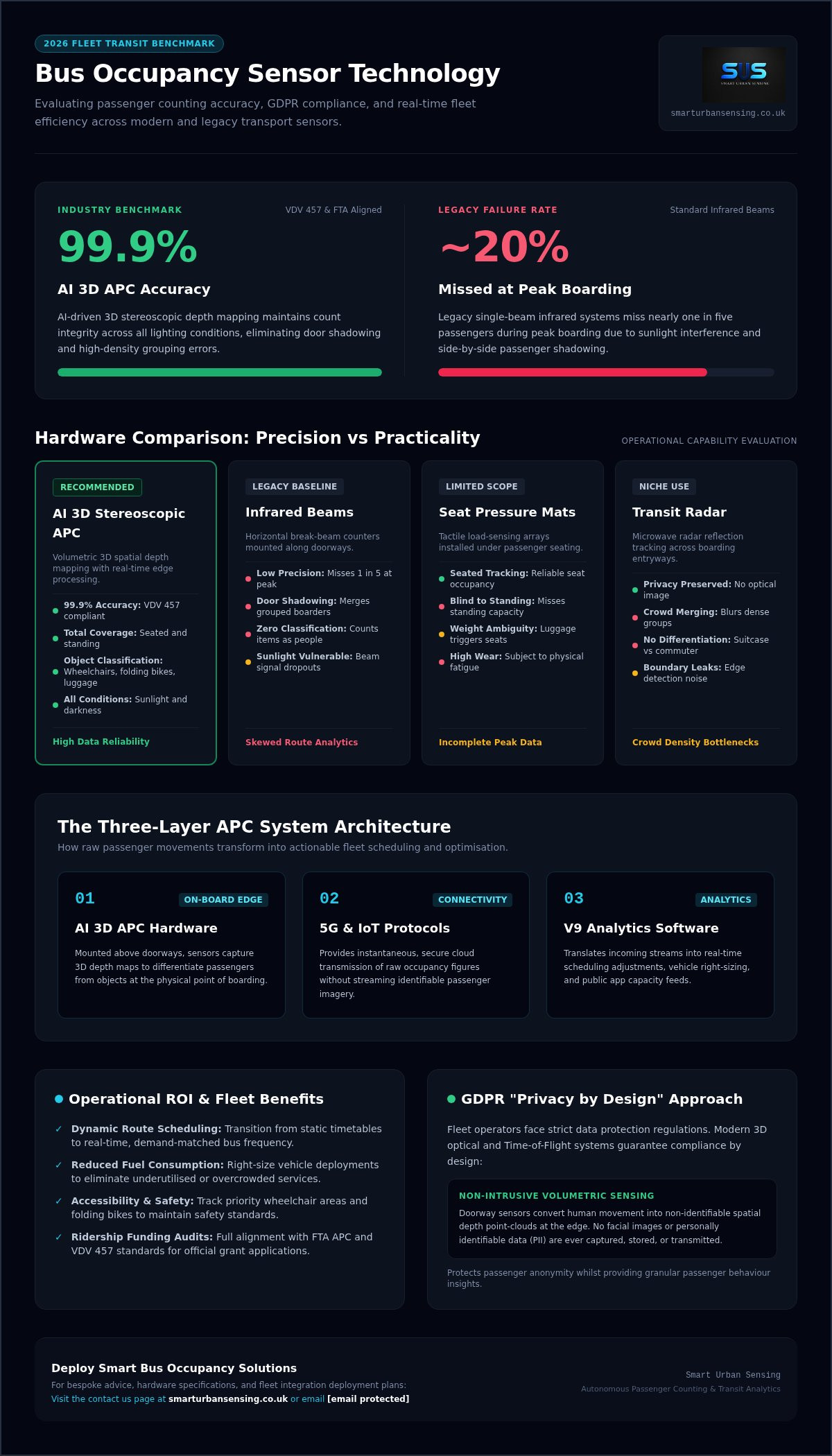
Legacy systems relied on simple infrared beams that often failed when passengers bunched together at a doorway or when sunlight interfered with the signal. Intermediate solutions like ultrasonic or basic 2D video improved accuracy but struggled with varied lighting and privacy concerns. The 2026 industry standard is defined by AI-driven 3D stereoscopic sensing. Unlike pressure mats that ignore standing passengers or radar that cannot differentiate between a person and a suitcase, the AI 3D APC provides 99% accuracy by creating a three-dimensional depth map of the doorway in any lighting condition.
Key Components of a Modern APC System
A robust bus occupancy sensor technology ecosystem consists of three distinct layers. First, the on-board hardware, such as the AI 3D APC, manages the initial data capture at the edge. Second, 5G and IoT protocols facilitate instantaneous data transmission to the cloud. Finally, the analytics layer, powered by V9 Analytics Software, processes these raw counts into actionable insights. This allows operators to right-size their fleet in real-time, reducing fuel consumption and operational strain. For customised hardware specifications or deployment plans, contact our team at smarturbansensing.co.uk or get in touch directly via sales@smarturbansensing.co.uk.
Comparing Sensor Technologies: Accuracy vs Practicality
Choosing the right bus occupancy sensor technology requires balancing initial capital expenditure against the long-term reliability of the data produced. Whilst many operators initially consider low-cost solutions, the operational cost of inaccurate data often exceeds the price of premium hardware. Precision is the foundation of effective fleet management; without it, route optimisation becomes mere guesswork.
Infrared (IR) beams remain a common entry-point for many fleets. They’re inexpensive and simple to install, but they suffer from ‘shadowing’ where two passengers boarding side-by-side are counted as a single individual. Pressure mapping via seat sensors provides excellent data for seated capacity, yet it completely ignores standing passengers. This is a critical oversight during peak urban transit hours when standing capacity is at its highest. Radar technology offers a high degree of privacy, but it frequently struggles to separate individuals within high-density crowds, often merging groups into a single mass.
In contrast, 3D stereoscopic AI systems are now widely regarded as the industry benchmark for modern transit. These systems align with FTA Automatic Passenger Counter standards by providing the granular, high-fidelity reporting required for national ridership audits and funding applications. Selecting bus occupancy sensor technology that meets these benchmarks ensures that your data is robust enough for both operational and regulatory requirements.
Why 3D Stereoscopic Sensing Wins on Accuracy
Depth perception is the defining advantage of modern stereoscopic hardware. By identifying the height and volume of a moving object, these sensors accurately distinguish between adults, children, and inanimate objects like prams or bicycles. 3D stereoscopic sensors use dual-lens technology to create a depth map for 99% accuracy.
This precision is maintained even in complex boarding scenarios. When passengers hover in the doorway whilst deciding whether to board, or when they carry large rucksacks that might trip a basic 2D sensor, the AI 3D APC correctly identifies the physical presence of the passenger without double-counting. This ensures your data remains clean and actionable without the need for manual intervention.
The Limitations of Legacy Hardware
Legacy hardware often carries hidden burdens that impact the bottom line. Pressure pads, for instance, are prone to mechanical wear and tear under the constant stress of heavy footfall. This leads to frequent maintenance visits and expensive vehicle downtime that far outweighs any initial savings. Environmental factors also plague older 2D and IR sensors. Direct sunlight or rapidly shifting shadows can ‘blind’ these devices, resulting in significant data gaps during the most critical times of the day.
The true cost of ‘cheap’ sensors isn’t the purchase price; it’s the subsequent need for extensive data cleaning and the inability to trust your scheduling decisions. If you’re looking to upgrade your fleet and move beyond these limitations, consulting with experts can help you avoid common pitfalls. You can also reach our technical team at sales@smarturbansensing.co.uk for a detailed hardware comparison.
Privacy and Compliance: The GDPR-First Approach
Fleet operators face a delicate balance between operational intelligence and passenger privacy. In 2026, the regulatory environment demands a “Privacy by Design” framework for all public infrastructure. Choosing the right bus occupancy sensor technology isn’t just about counting heads; it’s about ensuring your data collection methods don’t inadvertently create a surveillance risk. Modern fleet managers must prioritise non-intrusive counting to avoid the legal and reputational pitfalls associated with facial recognition or identifiable video storage.
The distinction between traditional video surveillance and anonymous depth sensing is critical. Whilst standard CCTV records identifiable features, 3D stereoscopic sensors convert physical presence into mathematical coordinates. This approach aligns with the EDPB guidelines on video processing and data protection, which advocate for data minimisation. By processing information as depth maps rather than high-resolution images, operators extract vital occupancy data whilst remaining entirely blind to a passenger’s identity.
Anonymisation at the Edge
True GDPR compliance begins at the hardware level. Advanced sensors, such as the AI 3D APC, perform all computational inference on the device itself. This “edge processing” means that raw imagery never leaves the sensor; only anonymous metadata is transmitted to the central server. This metadata provides the numerical counts needed for passenger flow management without ever creating a record of personal data. For a deeper look at how this data integrates into broader city-wide systems, see our comprehensive transit occupancy monitoring guide.
Building Public Trust with Ethical Data
Ethical data collection is a powerful tool for building brand reputation. Passengers are increasingly aware of their digital footprint; therefore, communicating your privacy standards through transparent reporting can significantly improve public trust. When bidding for national transport contracts, having a documented, GDPR-compliant data pipeline is often a mandatory requirement. It demonstrates a commitment to integrity that goes beyond simple logistics. It’s about being a strategic partner in a smart city ecosystem. If you need assistance in preparing for a data audit or want to ensure your current bus occupancy sensor technology meets these ethical standards, visit our contact us page or email sales@smarturbansensing.co.uk for a professional consultation.
Operational ROI: From Raw Data to Fleet Efficiency
Transforming raw data into operational excellence is the primary challenge for modern fleet managers. Bus occupancy sensor technology serves as the sensory nervous system of a transit network; providing the clarity needed to make high-stakes scheduling decisions with confidence. When you move beyond simple counting to real-time analytics, the potential for cost reduction and service improvement becomes tangible. Precision data allows you to move from reactive fixes to proactive fleet management.
Optimising route scheduling based on real-time and historical occupancy peaks ensures that resources are deployed where they are most needed. By right-sizing vehicle frequency, operators can significantly reduce fuel consumption and mechanical wear and tear. For instance, replacing an underutilised double-decker with a smaller vehicle during off-peak hours cuts dead mileage and operational overheads. This data also bridges the gap to a wider Smart City framework. Integrating occupancy feeds with Smart Junctions & Cycle Lane Monitoring allows cities to prioritise delayed, high-occupancy buses at traffic lights; ensuring the most efficient movement of people across the urban landscape.
Integration with V9 Analytics and Third-Party Software
Modern APC hardware is only as effective as the software that interprets its output. Connecting on-board sensors to a centralised management platform like V9 Analytics Software allows for a unified view of your entire fleet’s performance. Fleet operators often use the ROI of bus passenger counters to justify initial capital expenditure by demonstrating clear savings in resource allocation and staff hours. API flexibility is essential in this IoT ecosystem; ensuring that your occupancy data flows seamlessly into existing telematics, payroll, and scheduling tools without vendor lock-in.
Maintenance and Long-Term Scalability
Scalability requires a system that is as durable as it is intelligent. Remote monitoring of sensor health allows technical teams to identify issues before they impact data quality; drastically reducing the need for physical inspections and vehicle downtime. This future-proof approach means that as your requirements grow, your hardware remains relevant. AI software updates can refine detection algorithms over time; improving accuracy and object classification without the need for expensive hardware swaps. Whether you are launching a single pilot or managing a national fleet, the ability to scale whilst maintaining 99% accuracy is what defines a successful deployment.
If you are ready to transition from raw data to measurable fleet efficiency, our consultants can help you design a scalable, data-driven strategy. Request an APC technical scoping call to discuss your requirements, or reach out directly via sales@smarturbansensing.co.uk.
Selecting the Right AI 3D APC Solution for Your Fleet
Selecting bus occupancy sensor technology is a strategic decision that defines your fleet’s operational intelligence for years to come. National transport providers require solutions that withstand the unique rigours of the road whilst delivering the precision needed for complex ridership reporting. Accuracy, durability, and seamless integration are the three pillars of any successful APC deployment. When you choose a system, you aren’t just buying hardware; you’re investing in the reliability of the data that drives your business decisions.
Smart Urban Sensing Ltd acts as a strategic partner, providing end-to-end support for national transport providers. We understand that fleet management involves diverse vehicle types and complex doorway configurations. Our approach focuses on delivering high-accuracy monitoring that fits your specific operational constraints; ensuring that every boarding and alighting event is captured with precision. This level of detail is essential for meeting modern performance targets and securing long-term funding.
Specialised Transport Hardware
Buses present a challenging environment for sensitive electronics. Constant vibrations, fluctuating power supplies, and varied doorway widths require hardware like the AI 3D APC, which is specifically engineered for these constraints. For single-decker vehicles, a single sensor often suffices, whereas double-decker fleets might utilise the AI 3DPro series to monitor both lower and upper deck flow effectively. Ensuring sensor placement is optimised for every doorway configuration is a critical step in our implementation process; it eliminates blind spots and ensures data integrity.
Next Steps: Consultation and Implementation
Beginning your transition to data-driven management starts with a comprehensive fleet-wide technology audit. This process identifies the specific hardware needs of your diverse vehicle types and establishes a baseline for your ROI goals. We recommend organising a proof-of-concept trial to see the impact of our bespoke transport analytics in a live environment. This hands-on approach allows your team to experience the reliability of the system before committing to a wider rollout across your entire operation.
Our technical experts are available to guide you through the hardware selection and software integration process. For a detailed technical consultation or to request a pilot programme, contact our team at sales@smarturbansensing.co.uk. If you’re ready to upgrade your fleet’s intelligence and improve the passenger experience, Request an APC technical scoping call to begin your journey toward a more efficient, data-centric future.
Empowering the Future of Urban Mobility
The transition to data-driven fleet management is no longer a luxury; it’s a necessity for operators aiming to thrive in an increasingly complex landscape. By prioritising high-precision bus occupancy sensor technology, you gain the ability to right-size your services whilst maintaining a 99% accuracy guarantee. This methodical approach ensures your operations remain fully GDPR-compliant, protecting passenger privacy through non-intrusive, edge-processed sensing that never stores personal imagery.
Implementing these sophisticated systems allows you to transform raw data into measurable growth, reducing fuel consumption and dwell times through intelligent route optimisation. As a strategic partner, Smart Urban Sensing provides expert UK-based technical support to guide you from the initial technology audit to national deployment. Whether you’re managing a single route or a complex urban network, the path to efficiency starts with reliable, ethical data.
Request a technical consultation for your fleet today or reach out to our team at sales@smarturbansensing.co.uk to explore how we can support your journey toward smarter urban mobility.
Frequently Asked Questions
Is bus occupancy sensor technology GDPR compliant?
Yes, modern bus occupancy sensor technology is fully GDPR compliant when using a “Privacy by Design” framework. Systems like the AI 3D APC process data at the edge, meaning raw imagery is never stored or transmitted. Instead, the sensor outputs anonymous metadata that tracks movement without identifying individuals. This non-intrusive approach ensures your fleet meets stringent data protection standards whilst providing the high-fidelity analytics required for national transport contracts.
How accurate are automatic passenger counters (APC) compared to manual counting?
Automatic passenger counters are significantly more reliable than manual logs. Whilst manual “clicker” counting often suffers from a 10% to 15% error rate due to human fatigue or crowding, the AI 3D APC delivers a 99% accuracy rate. This precision is vital for route optimisation and funding claims. For a detailed technology audit of your current fleet, please contact our team at smarturbansensing.co.uk or email sales@smarturbansensing.co.uk.
Can these sensors distinguish between children, adults, and wheelchairs?
Yes, advanced stereoscopic sensors can accurately distinguish between different passenger types. By creating a three-dimensional depth map, the system identifies the height and volume of objects boarding the vehicle. This allows the AI 3D APC to differentiate between adults, children, and wheelchairs. Fleet operators use this granular data to monitor the occupancy of priority spaces and ensure that accessibility requirements are consistently met across their entire network.
How do occupancy sensors handle passengers standing near the doors?
These sensors use sophisticated vector tracking to handle passengers who linger in doorways. Unlike basic infrared beams that might double-count a stationary person, the AI 3D APC tracks the specific path of each individual. If a passenger stands near the door without alighting, the system recognises they haven’t crossed the exit threshold. This logic maintains count integrity even during peak urban transit hours when buses are frequently crowded.
What happens to the sensor accuracy in low-light or night-time conditions?
Accuracy remains consistent regardless of ambient lighting conditions. The AI 3D APC utilises active sensing technology that functions perfectly in total darkness or under the glare of bright streetlights. This ensures that your bus occupancy sensor technology provides reliable data during night-time services and through varying weather conditions. Maintaining a 99% accuracy rate around the clock is essential for operators who manage 24-hour urban transport networks and demand high-performance hardware.
Do bus occupancy sensors require a constant internet connection?
A constant internet connection isn’t necessary for the sensors to function. All passenger counting and data processing occur on the device itself at the edge. The resulting occupancy data is stored locally and can be transmitted to the cloud via 5G or Wi-Fi when a signal is available. This ensures that no data is lost when vehicles travel through rural areas or cellular dead zones, providing a continuous record of ridership.
How difficult is it to install APC sensors on an existing fleet?
Retrofitting automatic passenger counters to an existing fleet is a highly efficient process. The hardware is designed for discreet mounting above doorways and can be integrated with existing on-board power and telematics systems. Smart Urban Sensing provides expert UK-based technical support to ensure that your implementation is seamless and causes minimal vehicle downtime. To discuss a pilot programme for your fleet, get in touch via our contact page.
How much maintenance does an AI 3D APC system require?
AI-powered 3D systems require significantly less maintenance than legacy pressure mats or infrared beams. With no moving parts or mechanical components under the floor, the hardware is highly durable against the vibrations of daily service. Remote health monitoring through V9 Analytics Software allows your technical team to check sensor status off-site. This proactive approach reduces the need for physical inspections and ensures long-term stability for national transport providers.
Bus, rail and fleet operators
Scope automatic passenger counting for your fleet
A technical call with our APC team covering vehicle types, door configurations, gateways, data integration and validation — so you know what a pilot involves before you commit.


