
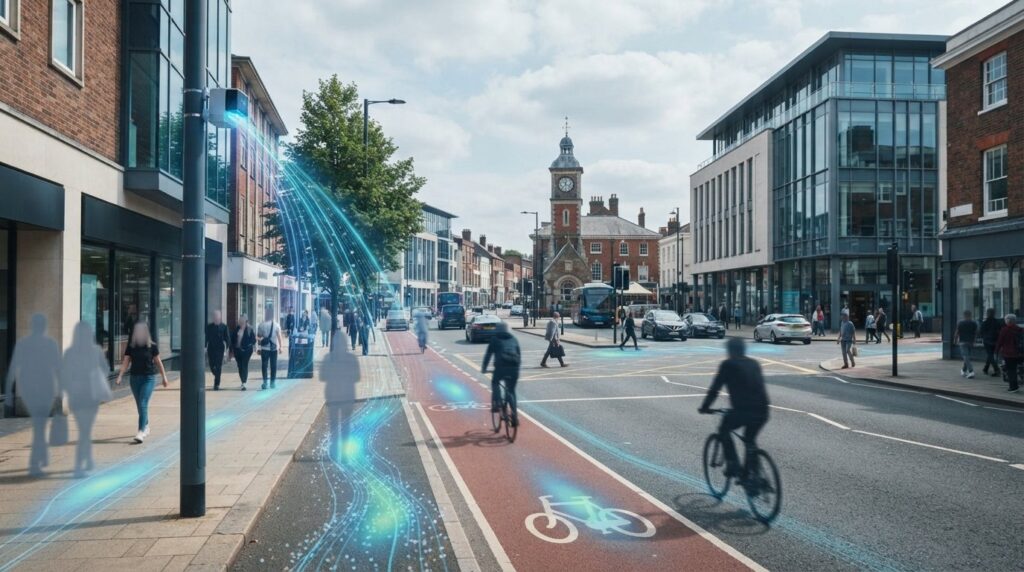
Did you know that every pound invested in UK walking and cycling infrastructure generates up to four pounds in economic and societal returns? For local authorities and urban planners, the challenge isn’t recognising the value of these investments, it’s proving they work with smart city footfall monitoring data that the public actually trusts. Traditional, manual counting methods and invasive surveillance are no longer viable for modern councils tasked with meeting ambitious national mode-shift targets.
This 2026 guide explores how urban analytics are being revolutionised through high-precision AI sensing and privacy-first data. We’ll show you how to achieve 99% counting accuracy whilst maintaining strict GDPR compliance through edge-processing technology. You’ll discover how these actionable insights are optimising cycle lanes and smart junctions across the country, turning disparate data sets into a coherent strategy for urban growth. To discuss how these analytics can transform your next infrastructure project, reach out to the team at Smart Urban Sensing or email sales@smarturbansensing.co.uk.
Key Takeaways
- Discover how AI 3DPro2 hardware delivers 99% accuracy, providing the empirical baseline needed to justify significant infrastructure investments.
- Navigate the complexities of GDPR compliance with a “privacy by design” approach that processes data at the edge without capturing identifiable personal images.
- Learn how to integrate smart city footfall monitoring with V9 Analytics to create a unified view of urban mobility across junctions and cycle lanes.
- Identify the specific KPIs required to measure the success of high street regeneration and carbon reduction initiatives within your local authority.
- Establish a scalable urban monitoring strategy by consulting our experts at Smart Urban Sensing or emailing sales@smarturbansensing.co.uk for bespoke advice.
What is Smart City Footfall Monitoring and Why Does it Matter?
Smart city footfall monitoring is the essential baseline for what we now define as “Smart Mobility”. It represents a shift from viewing urban spaces as static environments to understanding them as dynamic, breathing ecosystems. By capturing the precise flow of pedestrians and cyclists, local authorities can move beyond guesswork to evidence-based decision making. This data is the foundation for creating sustainable, resilient urban centres that adapt to the needs of the people who use them.
Effective urban planning no longer relies on manual “snapshot” counts that offer limited perspective. Modern infrastructure management requires continuous, high-fidelity data streams. These insights justify public expenditure by providing empirical proof of how new schemes perform, ensuring every pound spent on the public realm delivers measurable value. It’s about using technology to humanise the city, prioritising the safety and comfort of its residents.
To better understand the impact of pedestrian-centric data in urban development, watch this helpful video:
The Evolution of Urban Data Collection
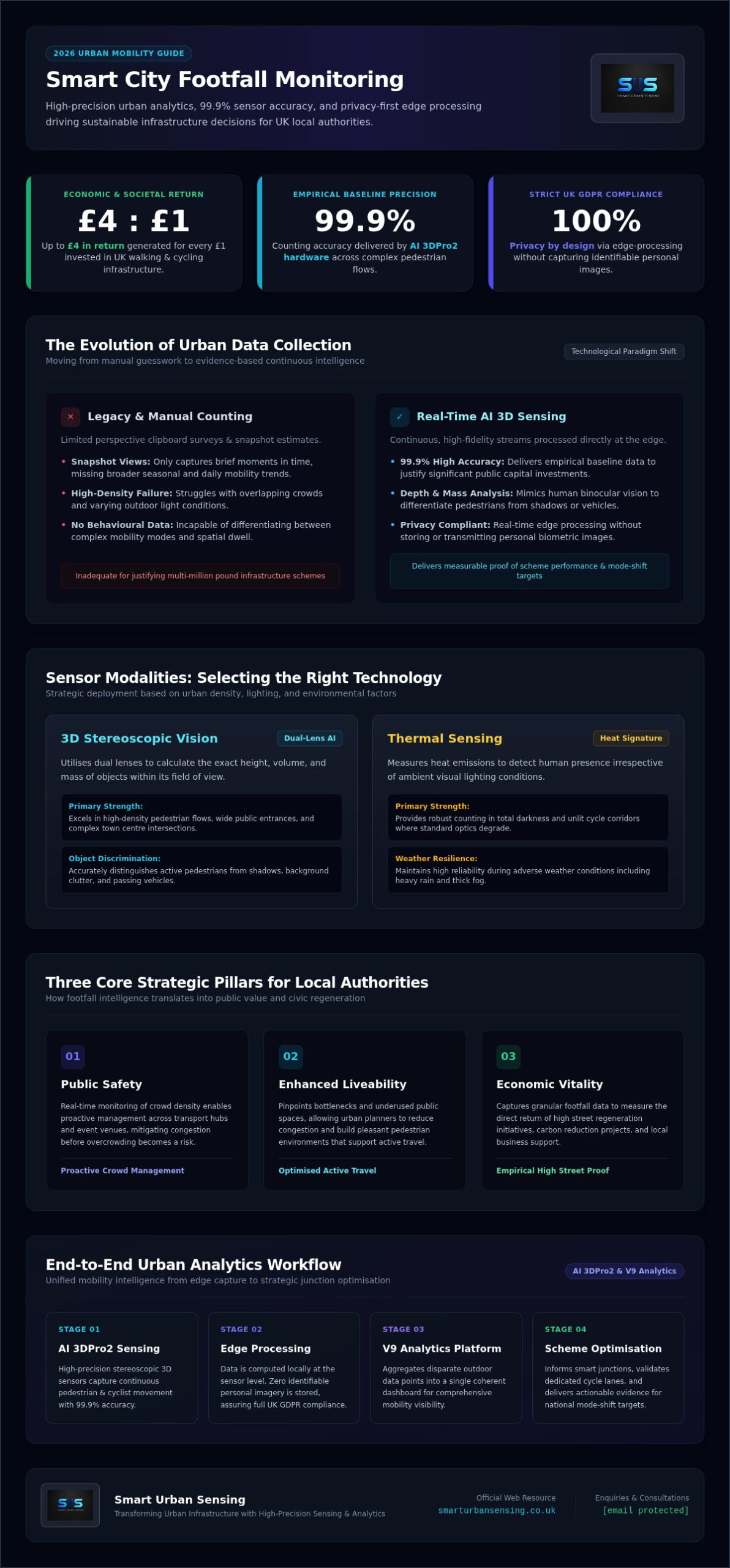
The journey from clipboard-based surveys to real-time sensing marks a significant technological leap. Legacy systems often struggle in high-density outdoor environments, where overlapping crowds and varying light conditions lead to inaccuracies. Today, automated people counter technologies have matured into sophisticated AI-driven solutions. These stereoscopic 3D sensors mimic human depth perception to provide granular insights. They don’t just count heads; they interpret complex behaviours, distinguishing between different mobility modes whilst maintaining a 99% accuracy rate.
Strategic Benefits for Public Stakeholders
Data-driven urban management offers tangible advantages for both the council and the citizen. When authorities understand movement patterns, they can proactively enhance the quality of life in our towns. This strategic approach focuses on three core pillars:
- Public Safety: Monitoring crowd density in real-time allows for better management of transport hubs and event spaces, preventing overcrowding before it becomes a risk.
- Enhanced Liveability: By identifying bottlenecks and underused spaces, planners can reduce congestion and create more pleasant pedestrian environments that encourage walking and cycling.
- Economic Vitality: Understanding high street footfall helps stakeholders quantify the impact of regeneration projects and support local businesses with reliable trend data.
Creating a smarter, more responsive city starts with accurate measurement. To explore how our consultative approach can support your authority’s smart city footfall monitoring strategy, contact the experts at Smart Urban Sensing or get in touch via sales@smarturbansensing.co.uk.
The Technology Behind High-Precision Urban Analytics
High-precision smart city footfall monitoring depends on the synergy between advanced optics and artificial intelligence. While legacy sensors often struggle with depth, modern 3D stereoscopic sensors utilise dual lenses to mimic human binocular vision. This allows the system to calculate the exact height and mass of objects within its field of view, ensuring it distinguishes a pedestrian from a shadow or a passing vehicle. This level of clarity is vital for urban planners who require more than just a raw count; they need a reliable understanding of how people occupy space.
3D Stereoscopic vs Thermal Sensors
Choosing the right sensor modality is a strategic decision based on the specific urban environment. 3D stereoscopic vision excels in complex pedestrian flows and wide entrances where high-density counting is required. In contrast, thermal sensing provides a robust alternative for total darkness or adverse weather conditions like heavy fog or rain. Both technologies align with ICO video surveillance and data protection guidance by focusing on telemetry rather than facial recognition.
Hardware durability remains a non-negotiable factor for national-scale outdoor deployments. Our outdoor counters are engineered to withstand the British climate, maintaining peak performance despite temperature fluctuations and moisture. Selecting the correct sensor also involves considering mounting heights; a sensor placed too low may lose its depth perspective, whilst one placed too high might miss granular movement details. Matching the hardware to the physical constraints of the site is essential for long-term stability.
AI and Edge Processing
The true intelligence of the AI 3DPro2 series lies in its “Edge” processing capabilities. Rather than sending raw video frames to a central server, the device processes all data locally on the sensor itself. This approach drastically reduces bandwidth requirements and enhances data security. The AI algorithms are trained to filter out environmental noise such as moving shadows, swaying foliage, or abandoned shopping trolleys, ensuring that only relevant movements are recorded.
The AI 3DPro2 sensors achieve a 99% accuracy rate by employing deep-learning algorithms that verify human characteristics in real-time across diverse lighting and weather conditions.
This precision allows for the exclusion of non-human objects like prams, bicycles, or pets, providing a clean data set for analysis. If you’re unsure which hardware configuration best suits your specific infrastructure, it’s helpful to consult with a technical specialist at sales@smarturbansensing.co.uk who understands the nuances of urban analytics.
Strategic Applications: From Smart Junctions to Cycle Lanes
The deployment of smart city footfall monitoring extends far beyond simple volume counting; it’s a vital tool for dynamic urban management. By integrating sensors into smart junction monitoring systems, local authorities can balance pedestrian safety with vehicular flow in real-time. This aligns with the NIST Smart Cities and Communities Framework, which provides a standardised approach for measuring the performance of urban cyber-physical systems. When crowds reach a specific density at an intersection, the system can automatically adjust traffic light phasing to prioritise pedestrian clearance, significantly reducing the risk of accidents during peak hours. The data is clear. Empirical evidence allows planners to move from reactive maintenance to proactive optimisation.
Optimising Smart Junctions and Pedestrian Crossings
Real-time alerts allow traffic managers to respond instantly to unexpected crowd build-up at major urban intersections. This proactive approach prevents the dangerous “spill-over” effect where pedestrians are forced off the pavement due to a lack of standing space. For a deeper look at the hardware required for these critical environments, see our guide on High Precision 3D Counters: The Strategic Guide to 99% Accuracy. These systems provide the high-fidelity telemetry needed to support automated traffic control algorithms, ensuring that safety and efficiency are never compromised.
Cycle Lane and Sustainable Transport Monitoring
Validating the ROI of new active travel infrastructure requires granular data that distinguishes between different mobility modes. Our AI-powered sensors can differentiate between pedestrians, cyclists, and e-scooters with high precision, providing the evidence needed to support long-term decarbonisation strategies. For transport teams seeking to build defensible funding bids and optimise active travel schemes, cycle lane usage tracking with AI-powered analytics provides the multi-modal detail needed to prove scheme effectiveness over time. This level of detail allows planners to track usage trends over time, proving the effectiveness of cycle lane investments and identifying where further network expansion is required. It’s about building confidence in sustainable transport through transparent, data-driven results.
In busy transport hubs, managing passenger flow is essential to prevent bottlenecking at ticket barriers or platform entrances. By utilising V9 Analytics, operators can also identify “dwell zones” in public squares and parks, understanding how residents interact with urban green spaces. This insight helps in designing more intuitive layouts that enhance the user experience whilst maintaining public safety. If you’re looking to implement a tailored monitoring solution for your local authority, contact the specialists at Smart Urban Sensing or get in touch directly via sales@smarturbansensing.co.uk.
Ensuring Privacy and GDPR Compliance in Public Spaces
Public anxiety regarding surveillance is a significant hurdle for urban innovation. It’s essential to distinguish between intrusive facial recognition and ethical smart city footfall monitoring. Whilst the former seeks to identify individuals, the latter focuses solely on anonymised movement telemetry. By prioritising privacy from the outset, local authorities can gather the insights they need without compromising the civil liberties of the residents they serve. This ethical approach is not just a legal requirement; it’s the foundation of public trust.
Privacy-by-Design Architecture
The AI 3DPro sensor series is built on a “privacy-by-design” framework. This means that data anonymisation happens at the source, directly on the sensor hardware. Because the devices use edge processing, no raw video footage ever leaves the unit or crosses a network. The sensors translate human movement into numeric data points and mathematical coordinates, effectively stripping away any identifiable features before the information reaches the V9 Analytics platform. Key privacy features include:
- Zero Biometric Capture: The system is incapable of recording facial features or unique biometric signatures.
- On-Device Processing: Raw frames are discarded instantly after the count is registered, ensuring no personal data is stored.
- Secure Data Silos: Encrypted telemetry is managed within the V9 Analytics environment, providing a secure audit trail for compliance officers.
Legal and Ethical Considerations
Navigating the strict requirements of UK GDPR requires a methodical approach to data governance. For any city-wide project, conducting a thorough Data Protection Impact Assessment (DPIA) is a mandatory step. This process helps stakeholders identify and mitigate potential risks to individual privacy before deployment begins. Transparency remains the most effective tool for building community support. When councils clearly communicate that the data is being used to improve cycle lanes or reduce junction congestion, public perception shifts from fear of surveillance to appreciation for better services.
As UK data regulations continue to evolve, maintaining long-term compliance requires a strategic partner who understands the legal landscape. Our consultative approach ensures your project remains aligned with the latest Information Commissioner’s Office (ICO) guidelines. If you need assistance with your DPIA or wish to discuss privacy-compliant monitoring for your authority, get in touch with our specialists at Smart Urban Sensing or email sales@smarturbansensing.co.uk.
Implementing a National-Scale Monitoring Solution
Deploying a robust smart city footfall monitoring network across a wide geographic area requires a methodical, four-stage approach. It’s not merely a matter of hardware installation; it’s about establishing a strategic framework that ensures data remains accurate, secure, and actionable for years to come. By following a structured implementation path, local authorities can avoid the pitfalls of fragmented data sets and ensure a high return on infrastructure investment.
The first step involves defining clear Key Performance Indicators (KPIs). Whether the objective is reducing congestion at major intersections or measuring the success of high street regeneration, these goals dictate the sensor density and placement strategy. Once objectives are set, selecting the appropriate hardware is vital. The AI 3DPro2 is the preferred choice for areas requiring maximum precision, whilst our specialised outdoor counters provide the necessary durability for exposed national infrastructure. The third stage is professional installation and calibration. To achieve our signature 99% accuracy rate, sensors must be precisely configured to the specific geometry of the site. Finally, leveraging V9 Analytics Software allows planners to transform raw counts into sophisticated urban insights.
Hardware Selection and Placement
Achieving 99% precision depends heavily on correct mounting heights and field-of-view requirements. In wide urban streets, sensors must be positioned to avoid “blind spots” whilst maintaining a clear line of sight for the AI to classify movement modes correctly. Connectivity is another critical factor. We ensure resilience by offering diverse integration options, including 4G and 5G cellular modules for remote locations or Power over Ethernet (PoE) for new developments. For those managing mixed-use environments, our guide on Store Traffic Analysis: The 2026 Guide to Retail Behavioural Data provides deeper insights into granular consumer patterns that complement broader urban trends.
Data Integration and Action
Data shouldn’t exist in a silo. The true power of urban analytics is realised when footfall streams are integrated with other environmental sensors, such as air quality and noise monitors. This allows council departments to correlate pedestrian density with localised pollution levels, enabling more effective public health strategies. The V9 Analytics platform facilitates this by creating custom reports tailored to the needs of different stakeholders, from transport planners to economic development officers. This holistic view ensures that every decision is backed by empirical evidence rather than anecdotal observation.
Successful implementation requires a strategic partner who understands the complexities of municipal infrastructure. To begin your journey towards a data-driven urban environment, Contact Us for a professional consultation or get in touch directly at sales@smarturbansensing.co.uk.
Shaping the Future of Urban Mobility
Transforming our urban centres into resilient, pedestrian-friendly environments requires more than just vision; it demands empirical evidence. We’ve explored how smart city footfall monitoring provides the 99% accuracy guaranteed with the AI 3DPro2, offering the precision needed to justify infrastructure spend whilst ensuring full UK GDPR compliance. By moving from manual surveys to AI-driven insights, local authorities can create safer junctions and more effective cycle lanes that truly serve the community. Our national team is ready to help you navigate these technical and regulatory complexities with expert support. Whether you’re planning a single crossing or a city-wide rollout, the right data ensures long-term stability and success. It’s time to replace guesswork with clarity and build urban spaces that adapt to the people who use them every day.
Request a consultation for your smart city project today or reach out directly to our specialists via sales@smarturbansensing.co.uk. Let’s work together to build a smarter, more human-centric urban future that stands the test of time.
Frequently Asked Questions
Is smart city footfall monitoring the same as CCTV surveillance?
No, smart city footfall monitoring is fundamentally different from CCTV surveillance because it prioritises anonymity over identification. Whilst CCTV captures visual footage to identify individuals, our AI 3DPro2 sensors process data at the edge, converting movement into numeric telemetry. No personal images are stored or transmitted. This distinction is critical for maintaining public trust and ensuring that urban analytics remain a tool for planning rather than policing.
How accurate are AI people counters in outdoor environments?
Our AI 3DPro series sensors deliver a 99% accuracy rate, even in complex outdoor environments. This precision is achieved through 3D stereoscopic vision, which allows the device to calculate depth and filter out environmental noise. Unlike legacy infrared beams, these sensors can distinguish between separate individuals in a crowd. This level of reliability provides the empirical baseline necessary for high-level logistical decisions and infrastructure investment validation.
Do these sensors work in heavy rain or at night?
Yes, our specialised outdoor counters are engineered to maintain performance in adverse conditions. Thermal and infrared technologies allow the sensors to operate in total darkness or heavy rain where standard optical systems might struggle. The hardware is housed in durable, weather-resistant casings designed for the British climate. This ensures that data collection remains consistent throughout the year, providing a complete picture of urban mobility regardless of the season.
Is the data collected by footfall sensors GDPR compliant?
All data collected by our systems is fully GDPR compliant through a “privacy by design” architecture. Because the AI 3DPro2 processes data locally at the edge, raw video frames are discarded instantly and never enter the cloud. The output consists only of anonymous numeric counts and directional flow data. This approach minimises data risk and simplifies the process of completing mandatory Data Protection Impact Assessments for municipal projects.
Can the system distinguish between pedestrians, cyclists, and vehicles?
The system uses advanced AI to differentiate between various mobility modes, including pedestrians, cyclists, and e-scooters. By analysing the mass, speed, and trajectory of an object, the sensor can accurately classify movement type. This granularity is essential for multi-modal transport planning. It allows councils to measure the specific impact of new cycle lanes or pedestrianised zones without the data being skewed by vehicular traffic or non-human movement.
How is the data from multiple sensors across a city centralised?
Data from multiple sensors is centralised through our V9 Analytics Software, a secure cloud-based platform. Each sensor transmits its numeric telemetry via 4G, 5G, or PoE connections to a unified dashboard. This allows urban planners to view real-time data from across a national network in one place. The platform also offers API integration, enabling the seamless export of insights into existing council data warehouses or GIS mapping tools.
What is the typical lifespan of an outdoor footfall counter?
Our outdoor counters are designed for long-term stability in public infrastructure projects. With professional installation and regular remote health checks via the V9 platform, these units typically have an operational lifespan of five to seven years. The hardware is built to withstand environmental stressors, including temperature fluctuations and moisture. For specific advice on maintenance and lifecycle planning, contact Smart Urban Sensing or email our team at sales@smarturbansensing.co.uk.
How can footfall data help in urban planning for cycle lanes?
Footfall data provides the empirical evidence needed to justify and optimise cycle lane placement. By monitoring existing corridors, planners can identify high-demand routes and potential safety bottlenecks at junctions. This smart city footfall monitoring data allows for the calculation of ROI on new infrastructure by tracking usage trends over time. It ensures that active travel investments are targeted where they will have the greatest impact on decarbonisation and urban congestion reduction. For a comprehensive look at how modern sensors support this process, explore our dedicated guide to cycle lane usage tracking and AI-powered active travel analytics.


