
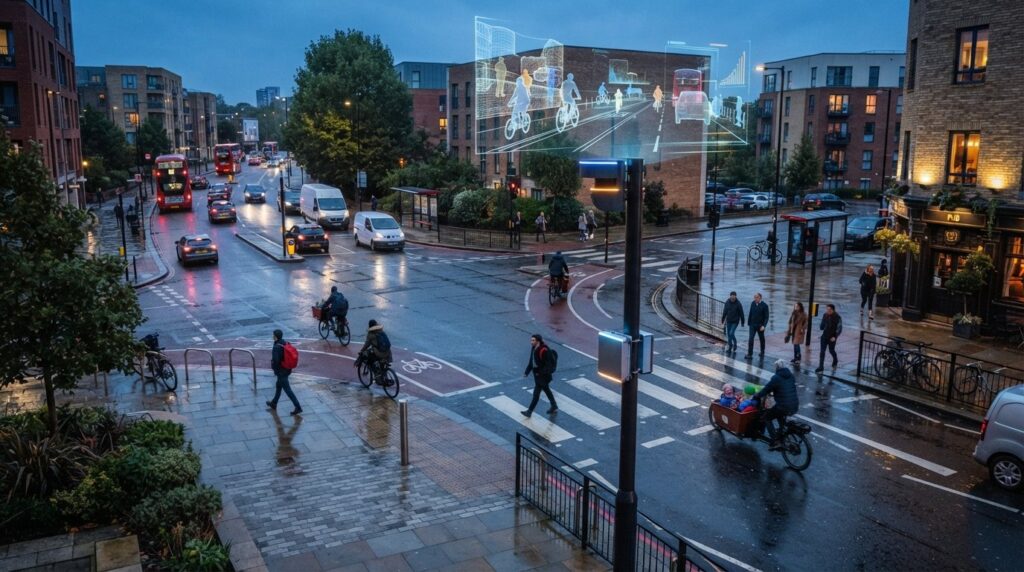
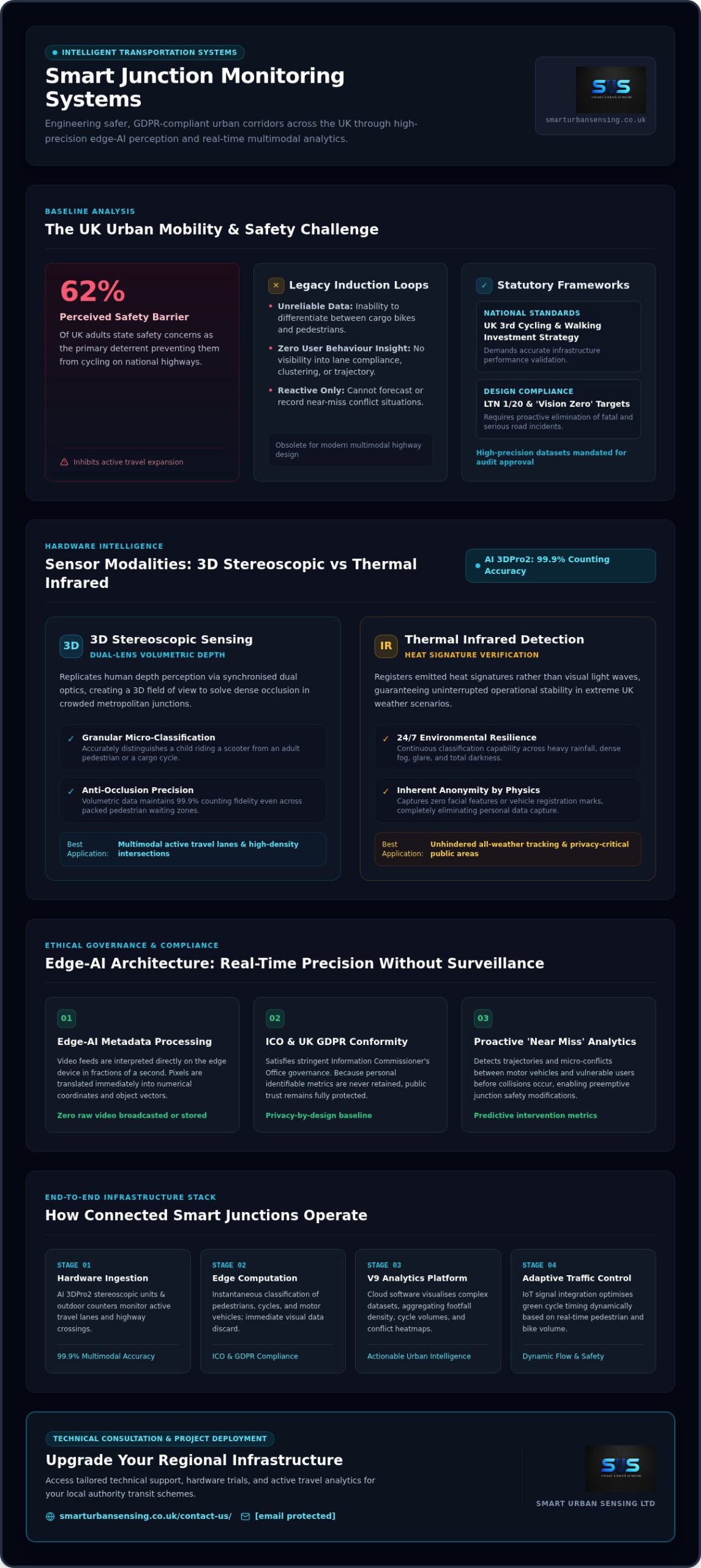
Approximately 62% of UK adults cite safety concerns as the primary barrier preventing them from cycling on highways. You’ve likely experienced the frustration of relying on legacy induction loops that fail to distinguish between a cargo bike and a pedestrian, leading to unreliable datasets. Implementing smart junction monitoring systems is now essential to meet the rigorous standards of the UK’s Third Cycling and Walking Investment Strategy and ensure the safety of all road users.
We’ll explore how AI-powered sensors deliver 99% counting accuracy whilst ensuring a privacy-first approach that satisfies strict ICO governance. It’s a sophisticated method of balancing data precision with ethical responsibility. This article previews the shift towards edge-AI compute and demonstrates how the V9 Analytics Software facilitates a seamless transition to smarter, safer, and more inclusive urban environments across the country. By moving away from central cloud storage to real-time metadata processing, local authorities can finally achieve the granular insights needed for high-level infrastructure planning without compromising public trust.
Key Takeaways
- Learn how AI-powered sensors achieve 99% accuracy by mimicking human depth perception to distinguish between pedestrians, cyclists, and motor vehicles.
- Understand why smart junction monitoring systems must utilise edge-AI processing to maintain strict GDPR compliance whilst delivering granular, real-time traffic insights.
- Evaluate the strategic benefits of 3D stereoscopic and thermal sensing for maintaining data reliability during adverse weather or in complete darkness.
- Discover how to leverage V9 Analytics Software to meet LTN 1/20 standards and enhance safety for vulnerable road users across UK transport networks.
- Access tailored technical support for your urban mobility projects by visiting smarturbansensing.co.uk or emailing our team at sales@smarturbansensing.co.uk.
What Are Smart Junction Monitoring Systems?
Modern urban planning requires more than just counting cars. Smart junction monitoring systems represent a fundamental shift in how we understand and manage city intersections. These systems utilise AI-driven sensing to track multimodal movements in real-time, providing a comprehensive view of how vehicles, cyclists, and pedestrians interact. Unlike traditional methods, these systems focus on inclusive urban mobility data, ensuring that every road user is visible to the infrastructure that guides them.
Legacy induction loops, once the industry standard, are no longer sufficient for the complexities of modern UK infrastructure. They often fail to distinguish between different types of road users and provide no insight into the behaviour of pedestrians or cyclists. High-precision sensors are now critical for achieving ‘Vision Zero’ safety targets, as they allow authorities to identify and mitigate risks before accidents occur. This technology is a cornerstone of intelligent transportation systems, creating a data-driven foundation for safer, more efficient transit networks.
To better understand the mechanics of these intelligent intersections, watch this helpful video:
The Evolution of Urban Traffic Sensing
The transition from simple vehicle counters to sophisticated AI-powered analytics has transformed urban management. We’ve moved beyond basic volume metrics to capturing ‘near miss’ data, which identifies dangerous conflict points at complex junctions without waiting for a collision to happen. This granular insight often integrates with broader smart city footfall monitoring initiatives, allowing planners to correlate pedestrian density with traffic signal cycles for better flow and safety.
Key Components of a Modern Smart Junction
A resilient system relies on a synergy of high-performance hardware and intelligent software. The AI 3DPro2 sensor provides the visual intelligence needed to classify road users with 99% accuracy, whilst outdoor counters monitor usage across dedicated cycle paths. This data is processed through V9 Analytics Software, a cloud-based platform that visualises complex datasets for actionable decision-making. Through IoT integration, these components allow for real-time traffic signal optimisation, ensuring that smart junction monitoring systems respond dynamically to the actual needs of the street.
If you’re looking to upgrade your local infrastructure with precision-engineered sensing technology, contact our expert team at smarturbansensing.co.uk or reach out via email at sales@smarturbansensing.co.uk.
The Technology: 3D Stereoscopic vs Thermal Sensors
High-precision data is the bedrock of modern urban planning. Selecting the right sensor technology determines whether a local authority achieves its safety objectives or struggles with flawed, inconsistent datasets. Smart junction monitoring systems typically utilise two primary sensing technologies: 3D stereoscopic vision and thermal infrared detection. Each offers unique advantages depending on the specific environmental challenges and the level of classification detail required for the site.
3D stereoscopic sensors mimic human depth perception by using dual lenses to create a three-dimensional field of view. This volumetric data allows the system to achieve 99% counting accuracy, even in dense urban crowds where occlusion is common. When comparing 3D stereoscopic vs thermal sensors for junction precision, stereoscopic systems excel at detailed classification. They ensure that a child on a scooter isn’t mistakenly logged as a pedestrian, providing the granular insights needed for active travel schemes.
Thermal sensors detect heat signatures rather than visual light, making them inherently privacy-centric. Because they don’t capture identifiable facial features or registration plates, they operate outside the standard definition of personal data processing. This design aligns perfectly with the latest ICO guidance on CCTV and video surveillance, significantly reducing the administrative burden of Data Protection Impact Assessments (DPIAs) for local councils.
AI 3DPro2: The Standard for Multimodal Accuracy
Achieving true multimodal precision requires the ability to distinguish between diverse road users at high speeds. The AI 3DPro2 excels at categorising pedestrians, cyclists, e-scooters, and HGVs with surgical precision, providing the clarity needed for complex junction management. It eliminates common errors like double-counting or inaccuracies caused by long shadows and pavement reflections. The AI 3DPro2 is a sophisticated stereoscopic sensor that processes all data at the edge for maximum speed and enhanced privacy.
Thermal and Infrared: Monitoring Beyond the Visible Spectrum
Reliability mustn’t falter when the sun goes down or the weather turns. Thermal sensing ensures 24/7 monitoring capability amongst the varied and often challenging UK environmental conditions, such as heavy rain, glare, or dense fog. By focusing on long-wave infrared radiation, these sensors maintain non-intrusive visitor and pedestrian counts without any reliance on ambient light. They provide a stable, reliable foundation for city-wide urban mobility data collection, ensuring that multi-million pound infrastructure decisions are based on continuous, year-round evidence.
For a detailed analysis of how these sensors can be integrated into your local transport network, contact our team at smarturbansensing.co.uk or email us at sales@smarturbansensing.co.uk for a technical consultation.
Balancing Data Accuracy with GDPR Compliance
Ethical responsibility is a non-negotiable pillar of modern infrastructure management. As local authorities seek to deploy smart junction monitoring systems, they often face a delicate tension between the need for granular data and the public’s right to privacy. Smart Urban Sensing Ltd addresses this challenge through a strict ‘Privacy by Design’ framework, ensuring that technological sophistication never comes at the cost of individual anonymity. By prioritising ethical data handling, we enable planners to gather essential urban mobility insights whilst maintaining absolute regulatory compliance.
High-precision counting doesn’t require the capture of facial identities or vehicle registration plates. Our stereoscopic sensors are engineered to perceive depth and volume, allowing them to classify road users with 99% accuracy based on physical dimensions and movement patterns rather than visual traits. This approach aligns with the Federal Highway Administration intersection safety guidelines, which emphasise the importance of data-driven safety interventions to protect vulnerable road users. Building public trust is essential for the long-term success of these projects, and transparent, non-intrusive monitoring is the most effective way to achieve it.
Anonymisation at the Edge
Traditional monitoring often relies on transmitting raw video feeds to central servers, creating significant security vulnerabilities. Our systems eliminate this risk by processing all visual data directly on the sensor hardware. This creates a clear distinction between ‘tracking’ an individual’s journey and ‘monitoring’ the overall flow patterns of a junction. Edge processing ensures that personal data never leaves the sensor unit. Because only anonymous metadata packets are transmitted, the system remains inherently secure and private from the moment of capture.
GDPR Standards for Smart City Sensors
Meeting the rigorous requirements of UK data protection laws is a legal necessity for any local authority infrastructure project. We ensure that every deployment adheres to the highest standards of the UK GDPR, providing a robust audit trail for Data Protection Impact Assessments. Beyond the hardware, our V9 Analytics Software employs advanced encryption to secure all stored data, ensuring that urban planning remains a transparent and safe process. Non-intrusive people counting allows for decades of longitudinal study without the liabilities associated with traditional CCTV surveillance.
If you’re planning a sensitive urban monitoring project and require a partner who values privacy as much as precision, contact us at smarturbansensing.co.uk. You can also reach our technical team directly at sales@smarturbansensing.co.uk to discuss your specific compliance requirements.
Implementing Smart Junction Systems for Cycle Lanes
Safety at intersections remains the primary concern for active travel advocates and urban planners alike. Identifying high-risk conflict points between motor vehicles and cyclists is the first step toward creating effective, life-saving interventions. By deploying smart junction monitoring systems, local authorities can move beyond anecdotal evidence and base their infrastructure decisions on empirical, real-time data. This evidence-based approach is essential for securing the funding required to transform UK streets into inclusive spaces for all road users.
Outdoor counters are strategically deployed to measure cycle lane usage tracking throughout the year, providing a continuous stream of data that accounts for seasonal variations and weather conditions. This level of visibility allows planners to justify infrastructure investment for active travel by demonstrating clear demand and identifying specific locations where current provisions fall short. Integrating these cycle lane analytics into the broader smart city network ensures that cycling isn’t treated as an isolated mode of transport, but as a core component of a cohesive urban mobility strategy.
Tracking Cycle Lane Usage and Behaviour
Understanding the volume of cyclists is only one part of the equation; understanding their behaviour is what drives safety improvements. Measuring peak usage times allows councils to optimise maintenance schedules and street lighting, ensuring that resources are directed where they’re most effective. Our technology provides the granular detail needed to analyse turning behaviours, helping to prevent accidents at busy junctions before they occur. A key advantage of the AI 3DPro2 is its ability to differentiate between traditional cyclists and e-scooters, allowing for more nuanced policy decisions and safety assessments.
Integration with V9 Analytics Software
Data loses its value if it remains siloed or difficult to interpret. Our V9 Analytics Software facilitates the visualisation of multimodal flow on a single, intuitive dashboard, bringing together insights from every sensor across the network. Council stakeholders and planners can generate automated reports at the click of a button, providing the clear evidence needed for public consultations or budget approvals. By using historic data to predict future urban mobility trends, authorities can design resilient infrastructure that anticipates the needs of 2026 and beyond. This foresight is critical for maintaining long-term stability in rapidly evolving urban environments.
To begin optimising your cycle infrastructure with high-precision data, reach out to our consultancy team or email us directly at sales@smarturbansensing.co.uk.
Choosing Smart Urban Sensing Ltd as Your Strategic Partner
Selecting a technology partner is a strategic decision that impacts urban safety for decades. As an independent UK digital technology provider, Smart Urban Sensing Ltd offers a unique combination of local expertise and world-class innovation. We don’t just supply hardware; we act as a consultative partner to ensure that smart junction monitoring systems are deployed with surgical precision, whilst maintaining a focus on ethical data handling. Our commitment to 99% accuracy is backed by long-term reliability, providing the stable data foundation required for high-stakes infrastructure planning.
Our range of customisable solutions caters to diverse operational needs, from initial Retail Starter Kits to expansive, city-wide junction networks. Planners can deploy the AI 3DPro series for high-precision people counting at busy intersections or integrate bus passenger counting systems to gain a holistic view of transit data. This integrated approach allows urban sensing projects to scale seamlessly, moving from a single pilot junction to a comprehensive transport network that captures every modal movement across the city with absolute clarity.
Comprehensive Solutions for Every Urban Space
Achieving a complete picture of urban mobility requires hardware that adapts to its environment. By utilising the AI 3DPro series, authorities can capture granular data on pedestrian and cyclist behaviour in high-density areas. These systems are designed to work in tandem with our broader suite of tools, ensuring that data from bus routes and cycle lanes flows into a centralised repository. This scalability ensures that as your city grows, your sensing capabilities grow with it, providing a future-proof solution for 2026 and beyond.
Get Started with Smart Urban Sensing
Success begins with a methodical approach to infrastructure planning and sensor placement. Our specialist team provides expert consultation and national support for on-street deployments, ensuring that each sensor is positioned for optimal coverage and performance. Beyond installation, we provide ongoing support and software updates for V9 Analytics Software users, ensuring your system remains at the forefront of technological capability. We don’t believe in superficial results; we value the long-term stability and precision that modern urban managers demand.
Contact our specialist team today at smarturbansensing.co.uk to organise a consultation for your next project. You can also reach us via email at sales@smarturbansensing.co.uk to discuss how our high-precision sensing can transform your local transport infrastructure.
Shaping the Future of UK Transport Infrastructure
The transition to multimodal urban mobility requires a foundation of absolute precision. We’ve explored how 3D stereoscopic and thermal sensors provide the 99% counting accuracy needed to protect vulnerable road users whilst adhering to a privacy-first design. By implementing smart junction monitoring systems, local authorities can move beyond legacy data limitations and embrace a more inclusive, data-driven approach to city planning.
As independent UK-based specialists, we ensure that every sensor deployment is GDPR-compliant and capable of distinguishing between cyclists, pedestrians, and vehicles directly at the edge. This methodical approach builds public trust and provides the long-term stability required for large-scale infrastructure projects. Integrating these insights with V9 Analytics Software allows for a sophisticated understanding of flow and safety across entire transport networks.
Contact our expert team at Smart Urban Sensing Ltd or email us at sales@smarturbansensing.co.uk to discuss your smart junction requirements. We look forward to helping you create safer, smarter urban environments that meet the challenges of 2026 and beyond.
Frequently Asked Questions
How accurate are smart junction monitoring systems compared to manual counts?
Smart junction monitoring systems provide up to 99% accuracy, significantly outperforming traditional manual counts. Human observers are prone to fatigue and distraction, leading to errors in high-volume or complex environments. Our AI-driven sensors maintain consistent precision 24/7 without the need for breaks or shifts. This high-level reliability ensures that urban planners have access to a continuous, error-free dataset for making critical infrastructure decisions across the UK transport network.
Are smart junction sensors GDPR compliant?
Our sensors are designed with a privacy-first approach that ensures full GDPR compliance. By processing data at the edge, identifiable information like faces or registration plates is never stored or transmitted. Only anonymous metadata is sent to the V9 Analytics Software, meaning individual privacy is protected by default. This non-intrusive method allows local authorities to gather essential urban mobility data without the legal risks associated with traditional surveillance.
Can these systems distinguish between different types of vehicles and pedestrians?
The AI 3DPro2 uses advanced neural networks to classify road users with surgical precision. It effectively distinguishes between pedestrians, cyclists, e-scooters, HGVs, and standard motor vehicles based on their volumetric and movement signatures. This granular classification is essential for monitoring cycle lanes and identifying how different groups interact at complex junctions. Understanding these specific modal shifts helps planners design safer, more efficient intersections for every type of road user.
What are the maintenance requirements for outdoor AI sensors?
Maintenance requirements for our outdoor AI sensors are minimal due to their robust, industrial-grade design. We recommend periodic visual inspections and lens cleaning to ensure optimal performance, especially in areas with high pollution or dust levels. The hardware is built to withstand varied UK weather conditions, featuring weather-resistant housings that protect sensitive electronics. Remote diagnostics via the V9 Analytics platform allow for proactive monitoring of sensor health, reducing the need for on-site visits.
How does V9 Analytics Software handle real-time data from multiple junctions?
V9 Analytics Software acts as a centralised hub, aggregating real-time metadata from numerous sensors across a city-wide network. The platform visualises this multimodal flow on an intuitive dashboard, allowing managers to monitor traffic patterns and city center pedestrian counts simultaneously. It uses secure, encrypted connections to ensure data integrity whilst providing automated reports for stakeholders. This scalable architecture supports long-term stability, whether you’re monitoring a single intersection or an entire national transport infrastructure.
Do smart junction systems work in heavy rain or fog?
Our systems maintain high reliability even in adverse weather conditions like heavy rain, dense fog, or sun glare. Whilst optical sensors are highly effective, we often integrate thermal sensing for environments where visibility is frequently compromised. Thermal sensors detect heat signatures rather than light, allowing them to see through environmental obstructions that would blind traditional cameras. This ensures that smart junction monitoring systems provide consistent, 24/7 data regardless of the UK’s unpredictable climate.
Can existing CCTV infrastructure be upgraded to smart monitoring?
Upgrading existing CCTV is technically possible, but it often lacks the precision of dedicated 3D stereoscopic hardware. Standard cameras capture 2D images, which struggle with depth perception and classification accuracy compared to our AI 3DPro series. We recommend deploying purpose-built sensors to achieve the 99% accuracy required for modern infrastructure planning. For a technical assessment of your current assets, contact us at smarturbansensing.co.uk or email sales@smarturbansensing.co.uk.
What is the typical lifespan of an AI 3DPro2 sensor?
The AI 3DPro2 is engineered for longevity in demanding outdoor environments, typically offering a service life of five to seven years. Its solid-state components and durable housing are designed to resist the wear and tear of constant urban exposure. Regular software updates via our cloud platform ensure the sensor stays compatible with evolving data standards and security protocols. This long-term reliability makes it a cost-effective investment for local authorities focused on sustainable urban development.


