

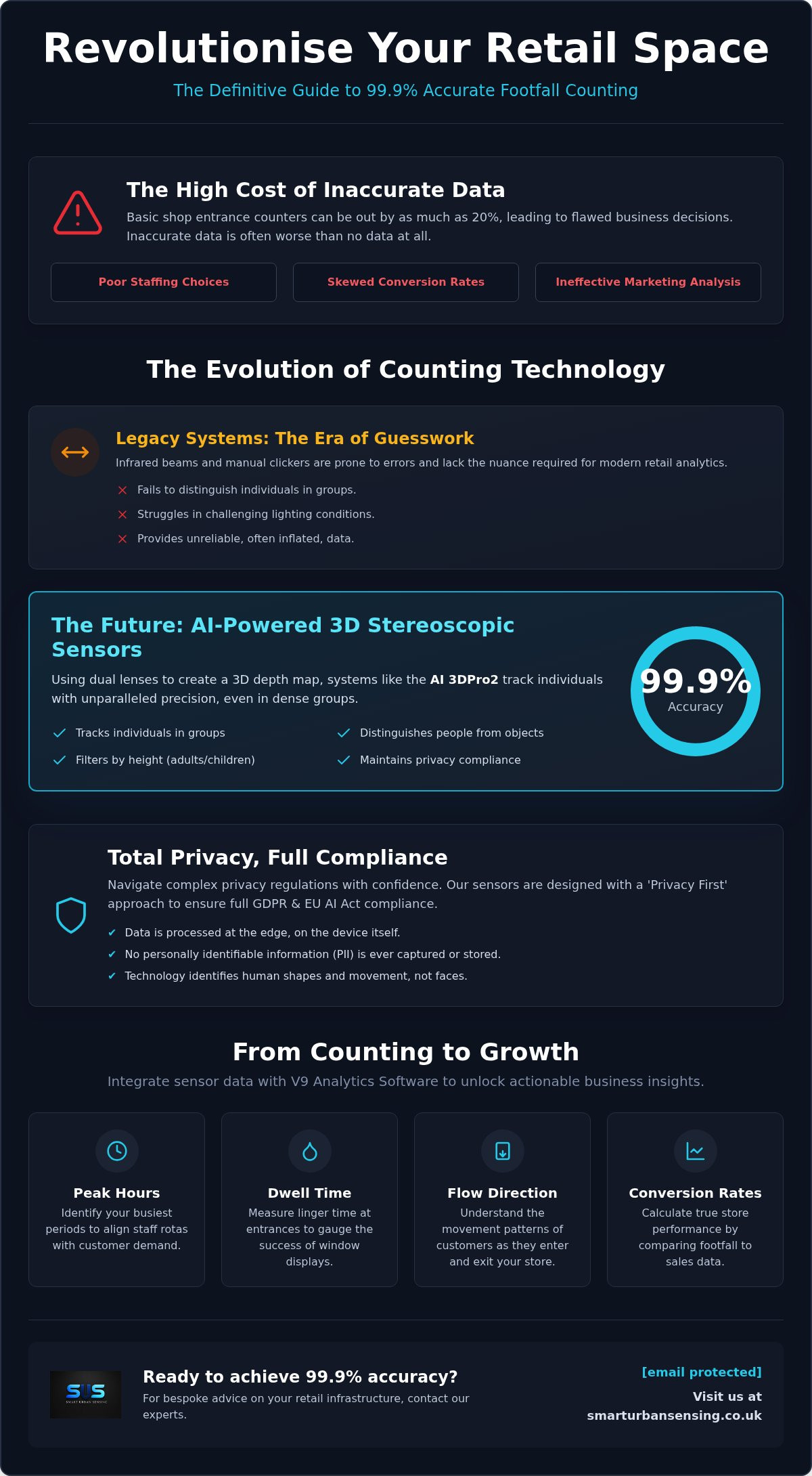
What if the data driving your most critical retail decisions was out by as much as 20 percent? It’s a common frustration for managers who rely on a basic shop entrance footfall counter only to find it double-counts groups or fails whilst operating in challenging lighting. You’ve likely felt the tension between wanting granular insights and worrying about the legalities of GDPR or the 2026 EU AI Act. We agree that inaccurate data is often worse than no data at all; it leads to poor staffing choices and skewed conversion rates.
This article provides a definitive path to achieving 99.9 percent accuracy whilst maintaining total privacy compliance. We’ll explore the technical superiority of 3D stereoscopic technology, such as the AI 3DPro2, and provide clear instructions on optimising your installation for long-term stability. You’ll also see how V9 Analytics Software transforms raw numbers into actionable growth strategies. For bespoke advice on your retail infrastructure, contact us at sales@smarturbansensing.co.uk or visit our contact us page at smarturbansensing.co.uk.
Key Takeaways
- Discover why 3D stereoscopic sensors like the AI 3DPro2 have become the industry benchmark, delivering 99% accuracy whilst eliminating the errors common in legacy systems.
- Learn the technical requirements for a professional installation, including how to conduct a site survey to identify the perfect mounting height for your shop entrance footfall counter.
- Navigate complex privacy regulations with confidence by utilising non-intrusive sensors that process data at the edge to ensure full GDPR compliance.
- Unlock deeper business insights by integrating your sensor data with V9 Analytics Software to calculate conversion rates and optimise your retail performance.
- For expert guidance on selecting the right hardware for your facility, email sales@smarturbansensing.co.uk or visit our contact us page at smarturbansensing.co.uk.
What are Entrance Counting Sensors and Why Do Retailers Need Them?
Entrance counting sensors are automated hardware devices installed at store ingress points to monitor and record visitor traffic with high precision. In a competitive retail landscape, a shop entrance footfall counter acts as the foundational tool for understanding store performance. These systems have evolved from simple “people counters” into intelligent analytical hubs that help managers calculate conversion rates, optimise staffing rotas, and measure the success of marketing campaigns. By providing an objective count of every individual who crosses the threshold, retailers can move away from guesswork and toward data-driven strategy.
The landscape of People counter technologies has expanded significantly, moving away from simple light-interruption beams toward advanced AI-driven stereoscopic vision. A key pillar of this technology is the “Privacy First” approach. Modern sensors identify human shapes and movement patterns to ensure accuracy whilst never capturing or storing personally identifiable information. This ensures your store remains compliant with evolving data laws whilst gathering the insights needed to thrive. To better understand how these systems are implemented in a real-world retail environment, watch this helpful video:
The Evolution from Tally Counters to AI Sensors
Manual clickers and mechanical palm counters are relics of a previous era. They’re prone to human fatigue and offer no temporal context; they can’t tell you exactly when your footfall peaked. Similarly, basic infrared beam counters often struggle in modern retail settings. These legacy devices cannot distinguish between a single customer and a family of four entering together, leading to inflated and unreliable data. The introduction of the AI 3DPro series has revolutionised this field. By using dual lenses to create a 3D depth map, these sensors can track individual movements with 99.9 percent accuracy, even in high-traffic scenarios where people enter in dense groups.
Key Metrics Captured at the Shop Entrance
Total footfall is the baseline metric, but it’s only the beginning of the story. Using V9 Analytics Software, retailers can break down this data into specific, actionable categories:
- Peak Hours: Identify exactly when your shop centre is busiest to align staff rotas with demand.
- Dwell Time: Measure how long customers linger at the entrance, indicating the success of window displays.
- Flow Direction: Understand the movement patterns of customers whilst they enter and exit.
These insights allow for a more nuanced understanding of customer behaviour. For bespoke advice on your retail infrastructure, email sales@smarturbansensing.co.uk or visit our contact us page at smarturbansensing.co.uk.
Selecting the Right Sensor Technology for Your Entrance
Choosing the right hardware is the most critical step in building a reliable analytics framework. Whilst many vendors suggest a “one size fits all” approach, the reality of retail architecture requires a more nuanced selection process. Most modern installations rely on three primary technologies: infrared beams, thermal imaging, and 3D stereoscopic vision. Infrared is largely obsolete for high-traffic environments because it fails to distinguish between individuals in a group. 3D stereoscopic sensors, particularly the AI 3DPro2, have emerged as the industry benchmark because they mimic human binocular vision to perceive depth with absolute clarity.
3D Stereoscopic vs Thermal Sensors
3D sensors utilise dual lenses to create a sophisticated depth map of the entrance area. This allows the system to distinguish between human beings and inanimate objects like shopping trolleys or swinging doors. It also enables the device to differentiate between adults and children based on height, providing a cleaner data set for conversion analysis. This distinction is vital for retailers who want to understand their true customer base rather than just raw movement.
There are specific scenarios where you might opt for thermal people counting sensors instead. Thermal technology detects heat signatures rather than light, making it the preferred choice for areas with extremely low lighting or where environmental conditions, such as high steam or fog, might obscure an optical lens. However, for the majority of standard retail entrances, 3D remains the superior choice for sheer precision and detail.
Why Accuracy Matters: The 99% Benchmark
Precision isn’t just a technical vanity metric; it has real financial implications. A mere 5 percent error rate in your footfall data can lead to thousands of pounds in lost revenue through misallocated staffing or misunderstood conversion rates. Using high precision 3D counters ensures you eliminate “ghost counts” caused by shadows, reflections, or floor patterns that confuse lesser systems.
The AI 3DPro series uses advanced AI filtering to detect groups and exclude staff members from the final tally. This level of granularity is essential for maintaining integrity in your reporting. All our hardware adheres to the latest UK GDPR guidance for IoT products, ensuring that data is processed at the edge without ever storing personal images or facial data. When selecting your shop entrance footfall counter, consider the mounting height and entrance width. A standard AI 3DPro2 can cover wide ingress points whilst maintaining its 99.9 percent accuracy rating. If you aren’t sure which technology fits your specific floor plan, you can speak with our technical team for a detailed site assessment. For further assistance, contact us at sales@smarturbansensing.co.uk.
How to Install Entrance Counting Sensors for Maximum Accuracy
Achieving a 99.9 percent accuracy rating requires more than just high-quality hardware; it demands a precise and methodical installation process. A shop entrance footfall counter is only as effective as its placement and configuration. To ensure your data remains a reliable asset for your business, follow these four essential steps during the setup phase.
First, conduct a comprehensive site survey to identify the central mounting point directly above the entrance threshold. Second, determine the optimal mounting height. For the AI 3DPro2, this height is critical to balancing a wide field of view with the granular detail needed for AI person detection. Third, establish a stable infrastructure. We recommend Power over Ethernet (PoE) for its reliability, as it provides both power and high-speed data through a single cable. Finally, use our AI software to calibrate the sensor, defining digital “in” and “out” lines to ensure every crossing is recorded correctly.
Positioning and Mounting Best Practices
Top-down mounting is the industry standard for high-precision analytics. Unlike side-mounted sensors, which suffer from “occlusion” where one person blocks the view of another, a ceiling-mounted position provides a clear, unobstructed view of every visitor. You must also account for the physical architecture of your shop centre. Hanging signs, decorative lighting, or large seasonal displays can create blind spots if not managed correctly. Ensure the sensor is positioned to cover the entire width of the ingress point; if the entrance is particularly wide, you may need to daisy-chain multiple AI 3DPro units to prevent missed counts at the edges of the frame.
Environmental Considerations for Setup
Retail environments are rarely static. Natural light levels can shift dramatically throughout the day, especially if your store has large glass frontages. High-contrast shadows or sudden bursts of bright sunlight can confuse basic sensors, leading to data drift. However, AI people counting sensors UK retailers use are specifically engineered to handle these challenging conditions. These devices use sophisticated algorithms to filter out environmental noise, ensuring that a shadow is never mistaken for a customer.
Once the physical installation is complete, it’s vital to test the system during peak traffic periods. This allows you to verify real-world performance when the entrance is at its busiest and people are entering in dense groups. If you require technical support during your deployment, our team is available to assist. You can reach us at sales@smarturbansensing.co.uk or visit our contact us page at smarturbansensing.co.uk for detailed installation guides and hardware specifications.
Organising Your Data: GDPR Compliance and Privacy
Maintaining public trust is as vital as maintaining data accuracy. For many retailers, the installation of a shop entrance footfall counter raises immediate questions about surveillance and customer privacy. It’s essential to distinguish between these two concepts. Surveillance aims to identify and track specific individuals; people counting aims to understand anonymous movement patterns. Our AI 3DPro series is built on a foundation of privacy-by-design, ensuring that your business remains fully compliant with UK GDPR whilst gathering high-precision insights.
The technical secret to this compliance is edge processing. Unlike traditional CCTV systems that stream video to a central server, these sensors analyse the visual feed locally on the hardware. The device converts the image into anonymous numerical data before any information is transmitted to your network. No facial images or personally identifiable features are ever stored or uploaded. This non-intrusive approach allows you to communicate your data practices to customers with total transparency, reassuring them that their anonymity is protected at every threshold.
The Ethics of Non-Intrusive Sensing
Modern 3D sensors use dual-lens technology to create a depth map of the entrance area. This map consists of anonymous silhouettes rather than identifiable video frames. Because the system only needs to recognise the “human shape” to count effectively, facial recognition is entirely unnecessary for accurate footfall analytics. We prioritise non-intrusive people counting by using high-level data encryption at the source. This ensures that even the anonymous data remains secure from the moment of capture until it reaches your dashboard.
V9 Analytics: Secure Cloud-Based Management
Gathering data is only the first step; managing it securely is what builds long-term operational stability. V9 Analytics Software allows you to centralise data from multiple entrances and locations into a single, secure cloud-based dashboard. This platform provides granular control over user permissions, ensuring that sensitive footfall trends are only accessible to authorised personnel within your organisation.
By automating your reporting through V9, you eliminate the risks associated with manual data handling and spreadsheet sharing. This systematic approach reduces the chance of data leaks and ensures your reporting remains consistent and audit-ready. If you need to review your privacy framework for footfall sensing or require a compliance certificate for your hardware, our team can help. For more information, contact us at sales@smarturbansensing.co.uk or visit our contact us page at smarturbansensing.co.uk.
From Counting to Growth: Integrating Your Entrance Sensors
Raw data provides a snapshot, but integrated intelligence drives long-term profitability. Once your shop entrance footfall counter is operational, the next logical step is to bridge the gap between visitor numbers and financial performance. By synchronising your sensor data with your Point of Sale (POS) system, you transform simple tallies into a comprehensive view of store health. This integration allows you to move beyond basic monitoring and begin the process of genuine retail optimisation.
V9 Analytics Software serves as the central engine for this transformation. It allows decision-makers to visualise complex trends across days, weeks, and even years, providing the clarity needed to identify seasonal patterns or the impact of local events. Whether you’re managing a single boutique or scaling to a national multi-site network, the platform remains robust and responsive. To maintain this level of precision, we provide ongoing remote monitoring and technical support, ensuring every sensor in your estate remains healthy and accurate.
Calculating and Improving Conversion Rates
The conversion rate is the most vital metric for any physical retailer. It’s calculated using a simple yet powerful formula: (Total Transactions divided by Total Footfall) multiplied by 100. This percentage reveals exactly how effective your store is at turning browsers into buyers. High footfall with low conversion often indicates “missed opportunities,” perhaps due to long queues or insufficient floor staff during peak hours. By identifying these gaps, you can justify strategic changes to window displays, entrance layouts, or staffing levels with confidence.
Next Steps for Your Retail Analytics Strategy
Successful retailers don’t stop at the entrance. Whilst the threshold provides the baseline, monitoring internal “hot spots” and aisle performance offers a deeper understanding of customer behaviour. Utilising a 3D stereoscopic sensor for retail allows you to track the entire customer journey, from the moment they enter until they reach the checkout. This data is indispensable for long-term strategic planning and store redesigns.
Before upgrading your shop entrance footfall counter technology, ensure your infrastructure supports high-precision AI and that your data management is fully centralised. For a comprehensive audit of your current sensing capabilities or to discuss a national rollout, contact our consultancy team. You can reach us at sales@smarturbansensing.co.uk or visit our contact us page at smarturbansensing.co.uk to explore our range of AI-powered solutions.
Transforming Footfall into Strategic Growth
Precision in retail analytics is no longer a luxury; it’s the foundation of operational excellence. By selecting a high-specification shop entrance footfall counter and adhering to methodical installation standards, you secure data that is both actionable and reliable. We’ve explored how 3D stereoscopic technology eliminates legacy errors whilst ensuring your business remains at the forefront of ethical data handling through GDPR-compliant AI technology. Whether you’re optimising staff rotas or measuring the ROI of a new window display, the clarity provided by 99.9 percent accuracy allows you to lead with confidence.
Smart Urban Sensing is your strategic partner in this evolution. We combine a 99% Accuracy Guarantee with dedicated UK-Based Technical Support to ensure your infrastructure performs in all conditions. Ready to achieve 99% accuracy? Book a free 20-minute footfall review or email our experts at sales@smarturbansensing.co.uk. We look forward to helping you unlock the full potential of your retail space and turning every visitor insight into a measurable business advantage.
Frequently Asked Questions
Are entrance counting sensors the same as CCTV cameras?
No, these sensors are fundamentally different from security cameras. Whilst CCTV records video for identification, a shop entrance footfall counter like the AI 3DPro2 uses stereoscopic lenses to create anonymous depth maps. The device processes data at the edge, meaning it only transmits numerical counts rather than identifiable images. This distinction ensures that your system remains a tool for business intelligence rather than intrusive surveillance, protecting customer privacy whilst delivering high-precision analytics.
How many sensors do I need if I have a wide double-door entrance?
The number of sensors required depends on the width of your ingress point and the mounting height of the hardware. A single AI 3DPro2 typically covers a standard double-door entrance, but for wider openings, multiple units can be daisy-chained together. This configuration allows the sensors to share a single field of view, preventing double-counting at the overlap. Our team can provide a bespoke site survey to determine the exact requirements for your specific floor plan.
Do these sensors work in complete darkness or very bright sunlight?
Yes, our sensors are engineered to maintain 99.9 percent accuracy in challenging environmental conditions. The AI 3DPro series uses advanced algorithms to filter out high-contrast shadows and glare from bright sunlight, which often confuse lesser systems. In environments with zero light, we provide thermal people counting sensors that detect heat signatures rather than light. This ensures your data remains consistent regardless of the time of day or the British weather outside your threshold.
Can the AI distinguish between a customer and a staff member?
Yes, advanced AI algorithms allow the system to differentiate between various types of movement. The AI 3DPro series can be configured to exclude staff members based on their entry patterns or by using staff exclusion tags. This prevents your internal team’s movements from skewing your conversion rates. By filtering out non-customer traffic, you ensure that your footfall data reflects genuine sales opportunities rather than just general store activity.
Is it difficult to integrate the sensor data with my existing POS system?
Integration is a straightforward process designed for modern retail environments. Our V9 Analytics Software provides robust API options that allow for seamless data sharing with most leading Point of Sale (POS) systems. This connection enables you to automatically calculate conversion rates by comparing transactions against total visitor numbers. If you require assistance with the technical setup, our UK-based support team is available to guide your IT department through the integration phase.
What happens if my shop’s internet connection goes down?
Your data remains safe even during a network outage. Our sensors feature internal memory that stores counting data locally until the internet connection is restored. Once the device is back online, it automatically synchronises the stored figures with the V9 Analytics dashboard. This ensures that you never lose valuable insights due to temporary connectivity issues, providing a reliable record of your store’s performance throughout the entire trading day.
Are there wireless or battery-powered options for entrance counting?
Whilst some basic beam counters use batteries, we prioritise Power over Ethernet (PoE) for professional retail installations. PoE provides a stable, high-speed data connection and a constant power supply, which is essential for maintaining our 99.9 percent accuracy rating. Battery-powered devices often suffer from data drift and require frequent maintenance. For outdoor or temporary locations, we offer specialised hardware that balances portability with the reliability required for high-level business decisions.
How do I ensure my footfall counting is 100% GDPR compliant?
Compliance is achieved by using non-intrusive technology that avoids capturing personally identifiable information. By deploying a shop entrance footfall counter that processes data at the edge, you ensure that no facial images are ever recorded. We provide full documentation to support your privacy impact assessments, making it easy to demonstrate compliance to regulatory bodies. For bespoke advice, email sales@smarturbansensing.co.uk or visit our contact us page at smarturbansensing.co.uk.
Retail and shopping centres
Find out what your entrance data should be telling you
In 20 minutes we review your entrances, current counting setup and conversion questions, then tell you what accurate footfall data would change. No obligation, no hard sell.


