

In an era where facial recognition is under intense scrutiny, the most powerful tool for understanding footfall is one that cannot see a face at all. For many facility managers and retailers, the struggle to gather accurate data whilst respecting strict UK GDPR standards feels like a constant compromise. Traditional infrared beam counters often fail in crowded spaces, yet the alternative of camera-based tracking frequently sparks privacy concerns amongst visitors. Implementing a thermal people counting sensor resolves this tension by detecting heat signatures rather than visual identities, ensuring your data remains precise without ever capturing personally identifiable information.
We recognise that you need reliable insights to optimise your space effectively. This guide explains the technical mechanics of thermal sensing and confirms why it’s the premier choice for privacy-first design. You’ll learn how heat-based detection achieves exceptional accuracy even in complex environments and see how this data integrates with our V9 Analytics Software. By the end of this reference, you’ll have the clarity needed to determine if this technology aligns with your operational requirements and provides the strategic oversight your venue demands.
Key Takeaways
- Understand why thermal technology is inherently anonymous, providing a robust solution for UK GDPR compliance without the need for facial recognition.
- Discover how a thermal people counting sensor distinguishes human heat signatures from environmental background noise to deliver reliable footfall data.
- Compare thermal sensing with stereoscopic 3D technology to determine which hardware best suits your specific lighting conditions and privacy requirements.
- Learn to integrate high-precision heat data with V9 Analytics Software to effectively organise staff levels and manage passenger flow.
- Identify the critical environmental factors, such as HVAC placement, that you must consider to maintain sensor accuracy in your venue.
What is a Thermal People Counting Sensor?
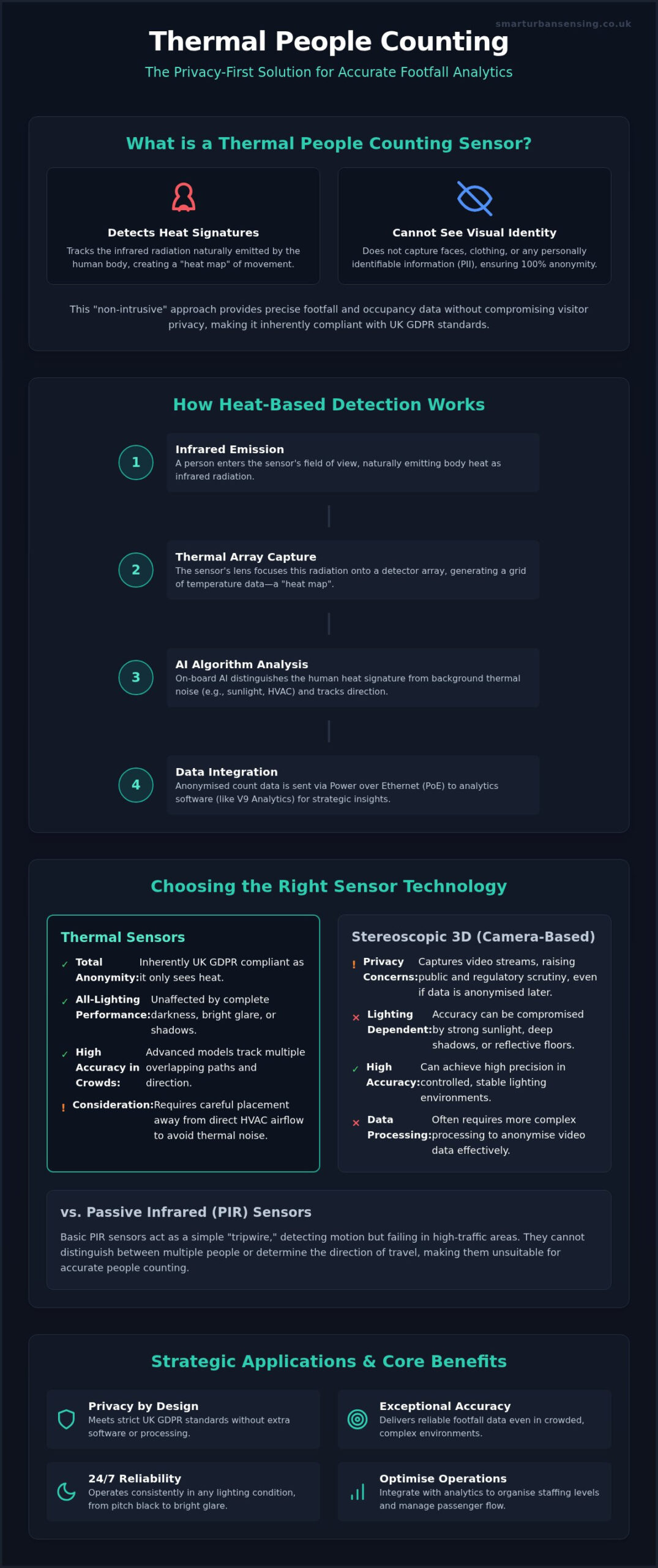
A thermal people counting sensor is a sophisticated hardware device that uses heat signatures rather than visible light to track movement within a space. While standard cameras rely on light reflecting off surfaces, thermal sensors detect the infrared radiation naturally emitted by the human body. This fundamental difference allows the technology to operate in complete darkness or bright glare with equal efficiency. This technology is particularly effective in spaces where lighting conditions vary throughout the day, as heat signatures remain constant regardless of shadows or artificial light levels. Because these sensors don’t capture facial features or identifiable clothing, they’re defined by their “non-intrusive” nature. They provide the high-level data needed to measure footfall, occupancy, and traffic flow in real-time without compromising the anonymity of the individuals being counted.
The Core Components of a Thermal Counter
At its heart, a thermal counter consists of a specialised infrared lens and a thermal detector array. This array doesn’t produce a high-resolution image; instead, it generates a grid of temperature data points. An on-board processing unit then analyses these “heat maps” to identify human shapes and directions of travel. For modern infrastructure, connectivity is streamlined. Most devices utilise Power over Ethernet (PoE) for a single-cable installation, though wireless options exist for locations where cabling is impractical. This hardware works in tandem with software like V9 Analytics to turn raw heat data into actionable business intelligence that can be used to optimise staffing and energy usage.
Thermal vs Passive Infrared (PIR) Sensors
It’s vital to distinguish these systems from basic Passive Infrared (PIR) sensors. PIR technology typically acts as a simple “tripwire” that detects a change in heat across a single point. These often fail in high-traffic environments because they can’t distinguish between two people walking side-by-side or identify the direction of travel accurately. In contrast, people counting technologies that utilise 2D or 3D thermal arrays can track multiple overlapping paths simultaneously. By mapping the entire detection area, a true thermal people counting sensor provides precision that basic infrared counters simply can’t match, ensuring that crowded entrances don’t lead to under-counting or data errors. This level of detail allows managers to understand not just that someone entered, but how they moved through the doorway.
The Science of Heat Signatures: How Detection Works
Every human being naturally emits infrared radiation, a form of energy that remains invisible to the naked eye but is highly distinct to a thermal people counting sensor. Unlike standard cameras that look for light and colour, these sensors focus on the specific heat signature of a person. This signature is typically warmer than the surrounding walls or floor, creating a clear contrast that the device can track. Sophisticated AI algorithms play a crucial role here, as they’re designed to distinguish the biological heat of a person from inanimate objects like shopping trolleys or suitcases, which don’t possess the same internal thermal regulation.
Managing environmental interference is where the technology truly proves its worth. Sunlight entering through a glass atrium or a sudden blast of cold air from an HVAC system can create thermal “noise.” High-quality sensors use differential analysis to account for these ambient temperature shifts, ensuring that a sun-warmed floor isn’t mistaken for a stationary visitor. For those looking to implement these systems, choosing the right people counting hardware is essential to ensure these variables are managed correctly. This technical resilience makes thermal sensing reliable in environments where visual-based systems might struggle with glare or deep shadows.
Spatial Resolution and Field of View
Accuracy depends heavily on the sensor’s pixel array, which determines the spatial resolution of the detection area. When a sensor is mounted at an optimal height, it can capture a wide area whilst maintaining enough detail to separate individuals walking closely together. The field of view refers to the total angular area the sensor covers through its thermal aperture, essentially defining the “footprint” of the detection zone on the ground. A wider aperture allows for greater coverage at lower mounting heights, making it a versatile choice for varied ceiling structures.
Algorithm-Based Counting Logic
Modern sensors do more than just detect heat; they interpret movement through vector-based logic. This allows for precise directional counting, distinguishing between someone entering a shop and someone leaving. These algorithms also manage “dwell time” by tracking how long a heat signature remains stationary, providing invaluable data for queue management or service desk optimisation. Even in crowded entrances where heat signatures might overlap, advanced segmentation logic can identify the distinct peaks of heat to accurately count individuals within a group, maintaining high precision in the busiest transport hubs.
Choosing the Right Sensor: Thermal vs Stereoscopic 3D
Selecting the optimal technology requires balancing precise data needs with operational constraints. While a thermal people counting sensor excels in specific niches, stereoscopic 3D systems like the AI 3DPro series offer the highest possible fidelity. Lighting is the primary differentiator. Thermal sensors operate flawlessly in total darkness or heavy glare because they don’t rely on visual contrast. In contrast, even the most advanced 3D sensors generally require a minimum level of ambient light to map depth effectively, though they compensate with significantly higher peak accuracy in standard conditions.
Privacy remains the strongest argument for thermal hardware. It’s the safest choice for areas where any form of video capture, even if processed locally, might cause visitor discomfort or regulatory friction. From a cost perspective, thermal units often provide a more accessible entry point for basic footfall tracking. However, the AI 3DPro series represents a strategic investment in granular data, offering a level of detail that simpler heat-based systems cannot replicate. Choosing between them isn’t about finding the “better” sensor, but rather identifying which tool matches the specific environmental challenges of your venue.
When to Choose Thermal Sensors
These devices are the ideal solution for low-light corridors, storage areas, or high-privacy zones such as healthcare facilities and changing rooms. They integrate seamlessly with Building Management Systems (BMS) to automate lighting or HVAC based on real-time occupancy, helping to reduce energy waste. However, they have physical limits. If your venue has exceptionally high ceilings, the heat signature may dissipate before reaching the detector, potentially reducing accuracy. In these instances, a ceiling-mounted thermal unit is best suited for heights between 2.5 and 4 metres. They’re also excellent for outdoor counters where shadows from trees or buildings might confuse a standard visual sensor.
When Stereoscopic 3D is Superior
For complex retail environments or transport hubs demanding 99% accuracy, stereoscopic 3D is the industry standard. Hardware like the AI 3DPro3 uses dual-lens technology to create a depth map, allowing it to distinguish between adults and children or filter out inanimate objects with near-perfect reliability. Crucially, these systems offer staff exclusion capabilities through specialised tags or height filtering, ensuring your team’s movements don’t skew conversion rates. For a truly comprehensive urban analytics strategy, many managers combine both types: using AI 3DPro units at main entrances for maximum precision and thermal sensors in secondary zones to maintain total privacy whilst gathering essential flow data. Retailers seeking detailed guidance on installation best practices and achieving peak accuracy with a shop entrance footfall counter will find a thorough breakdown of these considerations worth reviewing.
Privacy by Design: Meeting UK GDPR Standards
Privacy is no longer a secondary consideration for facility managers; it’s a legal mandate. Under UK GDPR, any system collecting data in public spaces must prioritise the rights of the individual through data protection by design and default. A thermal people counting sensor is fundamentally different from a CCTV-based system because it doesn’t “see” in the traditional sense. It perceives heat signatures, which are inherently anonymous. This distinction is critical for compliance in sensitive environments. Because the sensor captures infrared radiation rather than visible light, it bypasses the need for facial recognition entirely. This makes it the most ethical choice for high-traffic areas where public backlash against surveillance is a significant concern.
Anonymisation at the Edge
Localised processing is the cornerstone of modern data protection. Instead of streaming raw data to a central server, the sensor performs analysis directly on the device. It identifies a human heat signature and converts that movement into a simple numerical value—an entry or an exit—before any data leaves the hardware. Thermal sensors rely on infrared radiation patterns that lack the resolution to capture facial features or unique identifiers, making individual identification technically impossible. This ensures that the information stored in the cloud is purely statistical. By focusing on “counting” rather than “tracking” individuals across a network, you eliminate the risks associated with processing personal data.
Compliance and Cyber Security
Adhering to the guidelines set by the Information Commissioner’s Office (ICO) requires a transparent approach to data. When you integrate a thermal people counting sensor with a platform like V9 Analytics, the numerical data is transmitted via encrypted channels to prevent unauthorised access. This multi-layered security approach ensures your infrastructure remains robust against cyber threats. Future-proofing your facility against evolving privacy regulations is simpler when the hardware itself cannot collect identifiable information. By choosing technology that is private by design, you build long-term trust with the public whilst gathering the insights needed for urban growth. If you are ready to implement an ethical data strategy, you can explore our GDPR-compliant footfall solutions to find the right balance for your venue.
Strategic Applications in Modern Infrastructure
Data transforms from a passive record into a strategic asset when applied to the logistical complexities of modern infrastructure. In the retail sector, a thermal people counting sensor provides the granular insights necessary to organise staff rotas around actual visitor behaviour rather than estimated footfall. By identifying peak periods with high precision, managers can ensure that customer service levels remain high without overstaffing during quieter hours. Similarly, public centres such as libraries and museums rely on this data to produce accurate usage reports. These reports are often essential for securing government funding, as they provide an objective, privacy-compliant audit of how a community utilises its public spaces.
Public transport operators utilise specialised thermal technology to manage passenger flow and monitor bus occupancy in real-time. This application is vital for maintaining safety standards and improving the reliability of urban transit networks. Within the broader context of a smart city, monitoring pedestrian density allows planners to identify bottlenecks in city centres and design more efficient walkways. This heat-based detection remains effective regardless of external weather conditions or lighting, making it a dependable tool for 24-hour urban monitoring where visual cameras might fail to provide consistent results.
From Raw Data to Actionable Insights
Hardware alone is only half of the solution; the true value lies in how that information is processed. Integrating a thermal people counting sensor with V9 Analytics Software allows for the visualisation of complex footfall trends through intuitive dashboards. This real-time reporting enables facility managers to automate building functions based on occupancy. For instance, HVAC systems can be programmed to adjust temperature and ventilation based on the number of people in a specific zone. This synergy between sensor data and building management significantly improves energy efficiency, reducing operational costs whilst maintaining a comfortable environment for visitors.
The Future of Thermal Sensing in Smart Cities
The evolution of urban planning is increasingly focused on “Living Lab” experiments where real-time data informs immediate infrastructure adjustments. Thermal sensors are playing a pivotal role in these initiatives, particularly when integrated with smart junction and cycle lane monitoring systems. By tracking the movement of pedestrians and cyclists without capturing personal identities, cities can optimise traffic light timings and improve safety at busy intersections. This ethical approach to data collection ensures that technological progress does not come at the cost of civil liberties. Discover how Smart Urban Sensing can transform your venue data and help you build a more responsive, efficient infrastructure.
Future-Proofing Your Venue with Ethical Intelligence
Integrating a thermal people counting sensor into your infrastructure represents a strategic commitment to both operational excellence and ethical data handling. By prioritising heat-based detection, you achieve reliable footfall insights whilst maintaining absolute visitor anonymity and UK GDPR compliance. This approach ensures your data remains precise and your reputation for privacy remains intact, regardless of the complexity of your environment.
Our team provides dedicated UK-based expert support to ensure your hardware integrates perfectly with V9 Analytics for immediate, actionable reporting. While thermal sensing provides a robust privacy-first foundation, we also offer industry-leading 99% accuracy options through our AI 3DPro series for environments where every data point is critical to success. Explore our range of GDPR-compliant people counting sensors and take the first step towards a more informed, efficient future. We’re ready to help you unlock the full potential of your space through intelligent, human-centric data.
Frequently Asked Questions
Is a thermal people counting sensor the same as a thermal camera?
A thermal people counting sensor is distinct from a thermal camera in its primary output. While a camera produces a visual representation of heat for human viewing, a sensor interprets infrared radiation as numerical data. It doesn’t capture facial features or identifiable imagery, ensuring total anonymity. This makes it a data collection tool rather than a surveillance device, which is a crucial distinction for public trust and privacy compliance.
How accurate are thermal sensors in high-traffic environments?
Accuracy typically ranges between 95% and 97% in busy environments. While this is significantly higher than basic infrared beam counters, it’s slightly below the 99% accuracy provided by 3D stereoscopic systems like our AI 3DPro series. Thermal technology excels by tracking multiple heat signatures simultaneously, allowing it to count individuals in dense crowds without the “tripwire” failures associated with older, less sophisticated hardware that often miscounts overlapping paths.
Do thermal people counters work in total darkness?
Yes, thermal sensors operate perfectly in total darkness. Because they detect heat signatures rather than reflected light, their performance isn’t affected by lighting conditions, shadows, or glare. This makes them ideal for 24-hour monitoring in city centres or low-light corridors where standard visual-based sensors would fail. It’s a reliable solution for maintaining consistent data across varied operational hours without needing to invest in additional lighting infrastructure or security equipment.
Are thermal sensors compliant with UK GDPR regulations?
Thermal sensors are inherently compliant with UK GDPR regulations because they don’t capture personally identifiable information. They operate on a “privacy by design” principle, processing heat signatures into anonymous numerical counts at the source. Since facial features and clothing details aren’t recorded, the data collected doesn’t fall under the scope of personal data. This allows facility managers to gather essential footfall insights whilst maintaining the highest ethical and legal standards.
Can thermal sensors distinguish between adults, children, and pets?
Thermal technology can distinguish between different heat sources based on the size and intensity of the thermal signature. Most systems use algorithms to filter out smaller heat signatures, such as pets, to prevent skewed data. However, for precise differentiation between adults and children, 3D stereoscopic sensors are generally more effective. Thermal units provide a reliable baseline for human-sized occupancy whilst ignoring inanimate objects like trolleys that don’t emit biological heat.
What is the typical mounting height for a thermal footfall sensor?
The typical mounting height for a thermal footfall sensor is between 2.5 and 4.0 metres. Installing the device within this range ensures an optimal field of view and maintains the resolution required for accurate detection. If a sensor is mounted too high, the heat signature may become too faint for the detector array to process reliably. Correct positioning is essential for covering the entire entrance area whilst ensuring individual heat signatures remain distinct.
How do thermal sensors handle changes in ambient temperature?
Modern sensors use advanced AI algorithms and differential analysis to manage ambient temperature shifts. They’re designed to distinguish the moving heat of a human body from static or gradual changes, such as sunlight warming a floor or a blast of air from an HVAC system. This technical resilience prevents environmental “noise” from causing false counts. It’s a sophisticated method of ensuring data integrity in complex indoor and outdoor urban environments where conditions fluctuate.
Do I need a subscription for thermal counting software?
Accessing the full potential of your thermal people counting sensor usually requires a software platform like V9 Analytics. While the hardware performs the initial count, the software organises this raw information into actionable reports and real-time dashboards. Most professional systems operate on a subscription model to provide ongoing updates, secure cloud storage, and advanced integration features. This ensures your analytics remain accurate and your hardware continues to receive the latest algorithmic improvements.
Researching footfall analytics?
Get the supplier-neutral footfall & occupancy buyer checklist
Entrance survey sheet, 24 buyer checks, a simple ROI worksheet and the red flags to watch for. We will email it to you — and, if you like, a short monthly retail analytics briefing.


