

AI-powered systems now account for 58% of new people counting installations, representing a fundamental shift from simple footfall tracking to sophisticated, human-centric asset optimisation. You likely recognise the frustration of making high-stakes staffing decisions based on “gut feeling” whilst facing the constant pressure to maintain a premium customer experience. It is a delicate balance, made more complex by the looming threat of GDPR non-compliance fines and the need for absolute data integrity in an increasingly regulated environment.
This article provides the framework you need to build a high-impact business case for people counting sensors that quantifies ROI and secures stakeholder buy-in. We’ll demonstrate how leveraging advanced hardware like the AI 3DPro2, alongside V9 Analytics Software, creates a future-proof technology stack that is ready for the 2026 landscape. You will gain a clear roadmap for operational efficiency that prioritises privacy-first principles and ethical data handling. For expert guidance on tailoring these solutions to your infrastructure, contact us at sales@smarturbansensing.co.uk or visit the contact us page on smarturbansensing.co.uk.
Key Takeaways
- Recognise the financial impact of the “accuracy gap” and why 99% precision from AI-powered 3D sensors is now a non-negotiable requirement for operational success.
- Learn to build a robust business case for people counting sensors by quantifying ROI across three distinct streams: revenue growth, labour optimisation, and regulatory risk mitigation.
- Discover how to slash overheads by synchronising staffing schedules and energy usage with precise, real-time occupancy data provided by the AI 3DPro series.
- Ensure total GDPR compliance whilst protecting your organisation from significant legal exposure through privacy-first architecture that processes data anonymously at the edge.
- Master the transition to a data-driven model using Retail Starter Kits and V9 Analytics Software; for tailored guidance, contact sales@smarturbansensing.co.uk or visit smarturbansensing.co.uk/contact-us/.
Beyond the Door: Why 2026 Demands Precision in People Counting
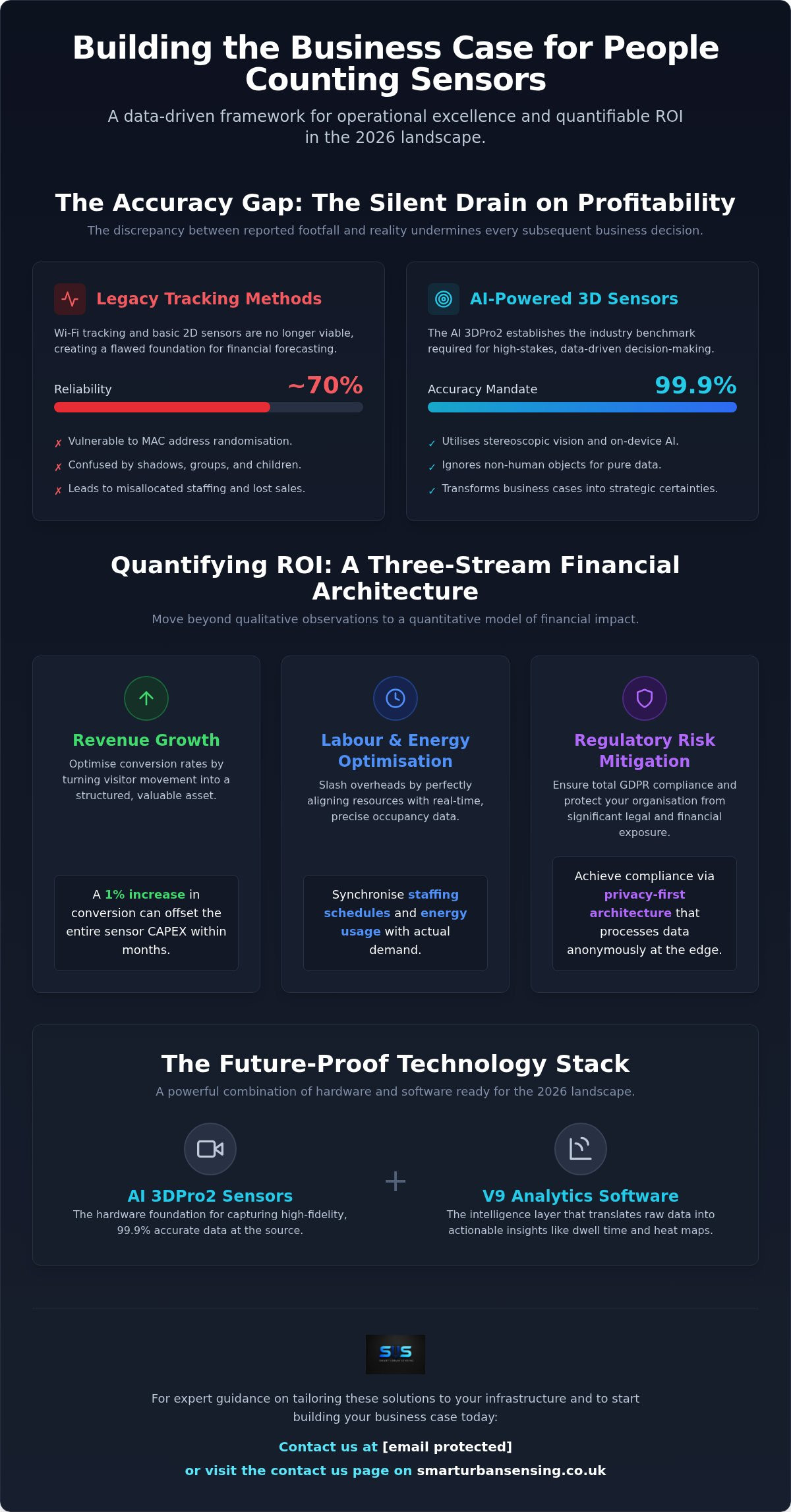
In the competitive landscape of 2026, the “Accuracy Gap” has become a silent drain on corporate profitability. This gap represents the discrepancy between reported footfall and the physical reality of visitor behaviour. When your data is merely “approximate”, every subsequent calculation, from conversion rates to labour spend, is built on a foundation of sand. A robust business case for people counting sensors depends entirely on the integrity of this primary data stream. Without near-perfect precision, financial forecasting becomes little more than educated guesswork that fails to survive board-level scrutiny.
The Failure of Legacy Tracking Methods
Reliance on outdated people counting technology, such as Wi-Fi tracking or manual clickers, is no longer viable for modern infrastructure. Wi-Fi-based counting has seen its reliability plummet to roughly 70% as smartphone manufacturers increasingly randomise MAC addresses to protect user privacy. Similarly, basic 2D sensors are frequently confused by shadows, overlapping groups, or children. For a large-scale retail operation, a 10% error margin isn’t just a statistic; it’s a structural flaw that leads to thousands of pounds in misallocated staffing costs and lost sales opportunities every month.
The 99% Accuracy Mandate
Board-level confidence requires a technical standard that legacy systems simply cannot meet. The AI 3DPro2 has established itself as the industry benchmark, utilising stereoscopic vision and on-device AI to achieve the 99% accuracy rate required for high-stakes decision-making. This level of data quality transforms the business case for people counting sensors from a speculative proposal into a strategic certainty. By capturing the exact movements of individuals whilst ignoring non-human objects, these sensors provide the granular detail needed for a sophisticated 2026 IoT ecosystem.
Modern analytics have evolved far beyond simple door-counting. We’ve moved into an era of complex urban and retail insights where understanding dwell times and pathing is as critical as knowing the total visitor count. High-precision sensors allow managers to move past “gut feeling” and embrace a methodical, data-driven approach to space utilisation. To explore how high-fidelity data can transform your specific operations, contact our consultancy team at sales@smarturbansensing.co.uk or visit the contact us page on smarturbansensing.co.uk.
The Financial Architecture: Quantifying the ROI of Footfall Analytics
Establishing a business case for people counting sensors requires a transition from qualitative observations to quantitative financial modelling. In the 2026 fiscal environment, ROI is no longer a singular metric but a composite of revenue growth, operational cost reduction, and strategic risk mitigation. By integrating high-precision data into the financial architecture of an organisation, decision-makers can move beyond survival and toward aggressive optimisation. High-fidelity data allows for the categorisation of every visitor interaction, turning anonymous movement into a structured asset.
Driving Revenue via Conversion Optimisation
The most immediate financial lever is the conversion rate, calculated by dividing total transactions by verified footfall. Without accurate sensors, businesses often ignore the “Lost Opportunity” cost; this represents the potential revenue from visitors who entered the premises but left without purchasing. By using AI 3DPro2 data to measure the effectiveness of specific window displays or marketing campaigns, retailers can refine their front-of-house strategy in real time. The value of dwell time and heat mapping is particularly pronounced in high-value retail spaces, where understanding which zones attract the most attention allows for the premium pricing of shelf space. A mere 1% increase in conversion rates, identified through precise footfall tracking, frequently generates enough additional revenue to fully offset the initial CAPEX of a sensor installation within months.
Asset and Space Optimisation
Beyond the shop floor, footfall data serves as a critical tool for asset management and lease negotiations. Property managers can justify premium rents or negotiate renewals based on verified pedestrian density rather than outdated estimates. In transport hubs, passenger flow data informs the strategic placement of retail units to maximise exposure to high-value traffic. Even in the public sector, the use of outdoor counters provides the necessary evidence for managing park infrastructure and justifying budget allocations. This evidence-based approach ensures that capital expenditure is directed towards areas with the highest proven demand.
The path from raw data to actionable profit is streamlined through V9 Analytics Software, which synthesises complex inputs into clear, manageable dashboards. For public infrastructure, products like Smart Junctions & Cycle Lane Monitoring provide the data necessary to improve urban mobility and reduce the economic burden of congestion. To see how these metrics apply to your specific site, you can request a tailored ROI analysis from our technical team. For direct enquiries regarding our Retail Starter Kits or hardware specifications, please contact sales@smarturbansensing.co.uk.
Strategic Resource Allocation: Optimising Staffing and Energy
Operational efficiency in 2026 relies on the precise synchronisation of resources with human demand. For most organisations, labour remains the primary overhead, yet it’s often the area managed with the least amount of granular data. Building a compelling business case for people counting sensors involves demonstrating how real-time occupancy insights can transform a static rota into a dynamic, responsive workforce. By aligning staff presence with actual visitor peaks, businesses can eliminate the financial drain of over-staffing whilst ensuring the customer experience doesn’t suffer during unexpected surges.
Labour Cost Reduction and Staffing Efficiency
Traditional scheduling often relies on historical averages that fail to account for modern volatility in footfall patterns. High-precision sensors, such as the AI 3DPro series, provide the live data stream necessary to implement data-led scheduling. This approach allows managers to deploy staff exactly where and when they’re needed most. Our Retail Staffing Optimization guide illustrates how this methodology slashes unnecessary labour spend by identifying quiet periods that previously went unnoticed. In transport hubs, this same logic applies to predictive passenger flow; by anticipating arrivals, facilities can manage queues more effectively and reduce the friction that often defines the passenger journey.
Energy Management and ESG Compliance
The synergy between occupancy monitoring and building automation represents a significant opportunity for cost reduction. When people counting sensors are integrated with Building Management Systems (BMS), they enable demand-led heating, ventilation, and air conditioning (HVAC). Rather than climate-controlling an empty floor, the system adjusts in real time based on headcounts. This reduces energy waste in low-occupancy zones, providing a direct boost to the bottom line whilst supporting the UK’s 2026 Net Zero targets. These metrics are increasingly vital for mandatory ESG reporting, as they provide verifiable evidence of a company’s commitment to sustainable resource management.
For fleet operators, the business case for people counting sensors extends to the AI 3D APC and Bus Passenger counter systems. These tools allow for precise capacity management and route optimisation, ensuring that fuel and maintenance costs are justified by actual passenger demand. To discuss how these efficiencies can be integrated into your infrastructure, please contact our technical consultants at sales@smarturbansensing.co.uk or visit the contact us page on smarturbansensing.co.uk.
Risk Mitigation and Compliance: The Business Value of Privacy-First Sensors
In 2026, data privacy has transitioned from a regulatory hurdle to a cornerstone of corporate risk management. A comprehensive business case for people counting sensors must prioritise the mitigation of legal and reputational exposure. GDPR compliance is not merely a box-ticking exercise; it is a critical protection against catastrophic financial penalties that can cripple even the most resilient organisations. By selecting sensors that are inherently anonymous, businesses shield themselves from the inherent risks associated with capturing personally identifiable information. This shift towards ethical sensing is a strategic move that aligns technological capability with public expectation.
The Financial Cost of Non-Compliance
Current UK GDPR penalty structures remain severe, with fines reaching up to £17.5 million or 4% of total annual global turnover. Legacy systems or invasive facial recognition technologies carry a high “compliance tax” due to the extensive data protection impact assessments and security protocols they require. Anonymous 3D stereoscopic sensors represent the safest investment for 2026 because they eliminate the need to store or transmit sensitive visual data. Thermal and infrared sensors are inherently privacy-first because they detect heat signatures or silhouettes rather than facial features. This architectural choice reduces the surface area for potential data breaches and simplifies the governance of your analytics platform.
Building Brand Trust with Ethical Data
Transparent data collection is a powerful driver of customer loyalty in a privacy-conscious market. Using GDPR compliant people counters signals to visitors that their anonymity is respected whilst you gather the insights needed to improve their experience. This ethical approach is particularly vital for securing long-term public sector contracts, where adherence to high AI standards is a mandatory procurement requirement. The AI 3DPro series utilises “Edge Computing” architecture, ensuring that all image processing occurs on the sensor itself. Only anonymous numerical data leaves the device, meaning identifiable images never exist on your network or in the cloud.
Choosing anonymous 3D counting over facial recognition protects your brand from the significant reputational damage associated with “surveillance” labels. This strategic choice reinforces your position as a sophisticated, human-centric operator. To ensure your infrastructure meets the highest ethical and legal standards, consult with our compliance experts today. For technical specifications regarding our privacy-by-design hardware, contact our team at sales@smarturbansensing.co.uk.
Executing the Strategy: Implementing AI 3DPro2 and V9 Analytics
Transitioning from a theoretical business case for people counting sensors to a tangible deployment requires a methodical selection of hardware. Every environment presents unique challenges; a high-traffic retail entrance demands different specifications than a sprawling public park or a complex transport interchange. Smart Urban Sensing provides a range of solutions, from the flagship AI 3DPro2 for indoor precision to robust Outdoor counters designed for urban infrastructure. Our UK-based manufacturing and support ensure that lead times remain short and technical assistance is always available when required.
Selecting the Right Hardware
Accuracy isn’t just a product feature; it’s a result of matching the right sensor to the specific physical constraints of a site. Our High Precision 3D Counters guide provides the technical depth required to understand how mounting heights and lighting conditions affect data integrity. Professional installation remains the vital final step in maintaining the 99% accuracy mandate. Without expert calibration, even the most advanced hardware can fall short of the precision required for high-stakes board-level reporting.
Your Roadmap to Implementation
A successful rollout begins with a consultative approach rather than a bulk purchase. We recommend starting with a pilot scheme using our Retail Starter Kits. This low-friction entry point allows you to gather real-world data within a controlled environment, providing the evidence needed to secure further funding for a national rollout. Once the pilot proves the ROI, V9 Analytics Software centralises data from multiple national locations into a single, cohesive dashboard. This allows for cross-site comparisons and the identification of regional performance trends that might otherwise go unnoticed.
The journey from initial consultation to full-scale data integration is purposeful and steady. It ensures that your technology stack is future-proof and fully optimised for the 2026 market. Smart Urban Sensing acts as a strategic partner, guiding you through every stage of the implementation process to ensure long-term stability and data accuracy. To begin building your bespoke business case for people counting sensors, contact our team at smarturbansensing.co.uk/contact-us/ or email sales@smarturbansensing.co.uk.
Future-Proofing Your Operations with High-Precision Analytics
The shift toward data-driven decision-making is no longer optional for organisations aiming to thrive in the 2026 economic landscape. By addressing the accuracy gap and prioritising ethical, privacy-first technology, you transform raw footfall into a high-value strategic asset. A robust business case for people counting sensors rests on the ability to quantify every visitor interaction whilst maintaining total GDPR compliance. This precision allows for the seamless optimisation of labour costs and energy usage across your entire estate.
Smart Urban Sensing provides the reliability required for large-scale infrastructure and retail projects, backed by our 99% accuracy guarantee and UK-based manufacturing. Our consultative approach ensures that your technology stack isn’t just powerful, but also purpose-built for your specific sector needs. Request your free consultation and business case review today to begin your transition toward total operational clarity. For direct enquiries, please email our specialists at sales@smarturbansensing.co.uk. Embracing these advanced sensors today ensures your organisation remains resilient, efficient, and ready for the challenges of tomorrow.
Frequently Asked Questions
What is the typical ROI period for a people counting sensor system?
The typical ROI period for a people counting sensor system varies by sector. In retail environments, payback is usually achieved within 2 to 9 months, whilst transportation and public sector deployments generally range from 4 to 14 months. These periods are shortened when high-precision data from the AI 3DPro2 is used to optimise staffing and conversion. For a detailed projection tailored to your specific infrastructure, please email our team at sales@smarturbansensing.co.uk.
How do people counting sensors differ from standard CCTV analytics?
People counting sensors differ from standard CCTV analytics by using dedicated hardware, such as 3D stereoscopic lenses, to achieve 99% accuracy. Whilst CCTV often relies on 2D image processing that can be affected by shadows or lighting, our AI 3DPro series uses depth perception to distinguish between humans and objects. This specialised technology processes data at the edge, ensuring identifiable images are never stored, which is a critical part of a business case for people counting sensors.
Are people counting sensors fully GDPR compliant in the UK?
Yes, our sensors are fully GDPR compliant in the UK. We employ a privacy-by-design architecture where all image processing occurs on the device itself. This means only anonymous numerical data is transmitted to the V9 Analytics Software. Identifiable facial features are never captured or stored, protecting your organisation from data breach risks. You can find more details on our privacy protocols by visiting the contact us page on smarturbansensing.co.uk.
Can people counting data be integrated with our existing POS or BMS systems?
People counting data can be integrated with existing Point of Sale (POS) and Building Management Systems (BMS). Our V9 Analytics Software provides the necessary API connectivity to synchronise footfall data with transaction records for conversion analysis. Similarly, integrating with a BMS allows for demand-led HVAC and lighting control. This synergy reduces energy waste and forms a compelling financial pillar in any business case for people counting sensors within modern smart buildings.
What is the difference between 3D stereoscopic and thermal sensors for business?
The primary difference lies in the method of detection and the level of granular detail provided. 3D stereoscopic sensors, like the AI 3DPro2, use dual lenses to create a depth map, offering 99% accuracy even in crowded entrances. Thermal sensors detect heat signatures, making them highly effective in complete darkness or sensitive areas where absolute anonymity is required. Both technologies are privacy-first, but 3D sensors are generally preferred for high-traffic retail and transport hubs.
How much does it cost to install a people counting system across multiple sites?
The cost of a multi-site installation depends on the number of entrances, mounting heights, and the specific hardware required, such as the AI 3DPro3 or outdoor counters. We recommend starting with our Retail Starter Kits to establish a pilot scheme and verify the ROI before a national rollout. Our UK-based team handles the professional installation to ensure data integrity across all locations. For a bespoke quote, please contact our consultants at sales@smarturbansensing.co.uk.
Do people counting sensors work in outdoor or low-light environments?
Our technology is specifically engineered to perform reliably in challenging outdoor and low-light environments. We offer dedicated outdoor counters and AI-powered sensors that maintain high accuracy regardless of weather conditions or time of day. For areas with zero light, thermal sensing technology ensures that footfall is captured accurately without the need for external illumination. To discuss the best hardware for your outdoor infrastructure, visit the contact us page on smarturbansensing.co.uk.
Retail and shopping centres
Find out what your entrance data should be telling you
In 20 minutes we review your entrances, current counting setup and conversion questions, then tell you what accurate footfall data would change. No obligation, no hard sell.


