

Did you know that legacy infrared sensors often miscount footfall by as much as 15 per cent, leading to skewed staffing budgets and lost revenue? Relying on inaccurate data from outdated systems creates a frustrating disconnect between your digital analytics and physical reality, yet choosing the right AI people counting sensors UK remains a challenge for many. You’re likely managing multiple national sites and feeling the constant pressure to balance operational efficiency with increasingly strict UK GDPR requirements and visitor privacy concerns.
This 2026 guide reveals how advanced technology can deliver 99.9 per cent data precision whilst maintaining total anonymity for your visitors. We’ll explore how the AI 3DPro2 sets the industry benchmark for accuracy, the ways V9 Analytics Software simplifies complex multi-site management, and why a privacy-by-design approach is the only sustainable path for retail, transport, and smart city infrastructure. By the end of this article, you’ll understand how to transform raw footfall into actionable intelligence that drives growth without compromising on ethical responsibility.
Key Takeaways
- Understand how 3D stereoscopic technology in the AI 3DPro2 achieves 99% accuracy by precisely distinguishing between adults, children, and objects like prams.
- Master the 2026 regulatory landscape to ensure your deployment of AI people counting sensors UK remains fully compliant with UK GDPR and privacy-by-design principles.
- Discover how to optimise shop-floor efficiency and passenger logistics using targeted tools such as Retail Starter Kits and AI 3D APC technology.
- Learn to scale your operations effectively by centralising data from a national fleet of sensors through the sophisticated V9 Analytics Software.
- Identify the strategic advantages of an end-to-end consultation model that transitions your organisation from legacy systems to future-proof smart city infrastructure.
The Evolution of AI People Counting Sensors in the UK
Modern AI people counting represents the sophisticated intersection of computer vision and urban logistics. It’s no longer just about counting heads; it’s about transforming physical movement into actionable intelligence that respects the boundaries of personal privacy. Within the UK, there’s been a definitive transition from traditional surveillance towards “anonymous analytics”. This approach focuses on the movement of shapes and patterns rather than identifying individuals, aligning perfectly with the stringent requirements of the Data Protection Act 2018. As we navigate the 2026 economic landscape, high-precision data from AI people counting sensors UK has become a vital tool for maintaining healthy margins and operational resilience in an increasingly competitive market.
From Manual Tallying to Real-Time AI Sensing
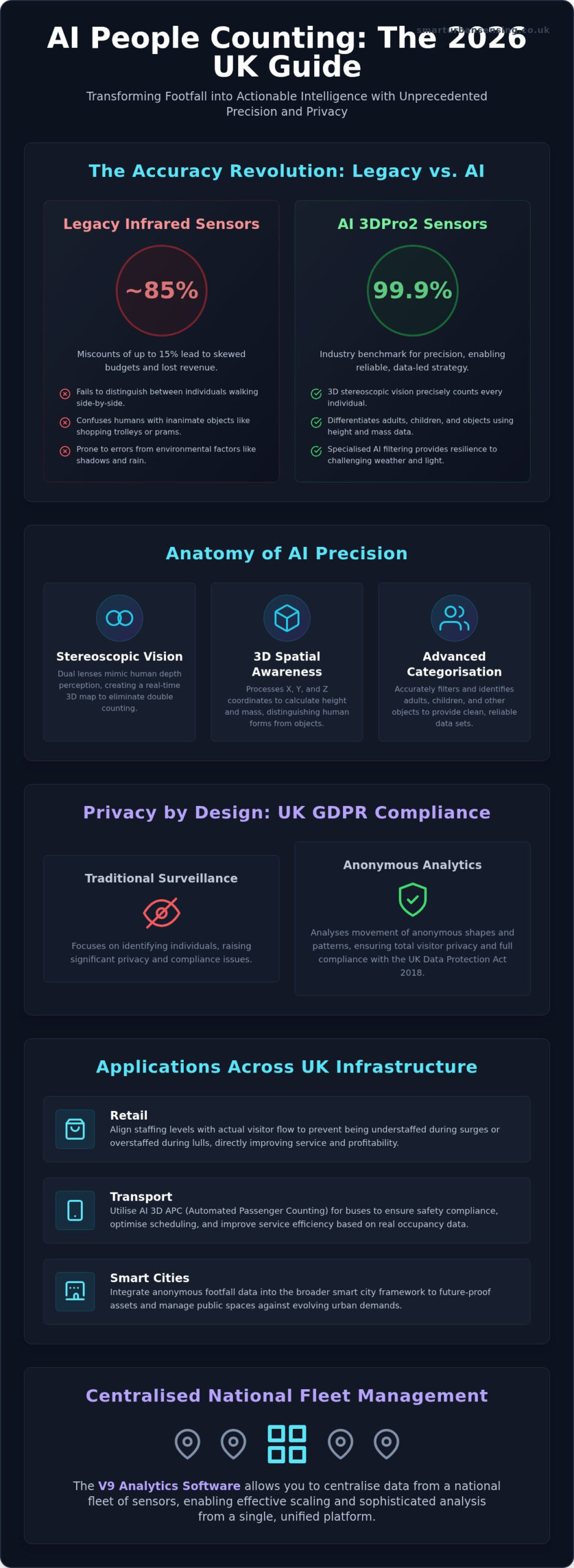
The journey of people counting technology has been one of constant refinement, moving from mechanical clickers to the edge-processing power of the modern era. Legacy infrared beams and thermal sensors, whilst revolutionary in their time, often fall short in complex, high-traffic environments. These older systems typically achieve between 85 and 95 per cent accuracy because they cannot effectively distinguish between individuals walking side-by-side or differentiate a human from an inanimate object like a shopping trolley. 3D stereoscopic sensors, such as the AI 3DPro2, solve this by mimicking human depth perception. By utilising dual lenses to process spatial coordinates, these sensors achieve 99.9 per cent accuracy. This level of precision allows for immediate operational adjustments, as managers can trust real-time data reflecting their actual site occupancy at any given second. Real-time sensing provides a level of agility that manual tallying simply cannot match, allowing for automated alerts when occupancy thresholds are reached or when queue lengths exceed acceptable limits.
Strategic Importance for UK Infrastructure
Implementing a robust sensing strategy is now a prerequisite for managing large-scale UK infrastructure with confidence. In the retail sector, the ability to align staffing levels with actual visitor flow directly impacts the bottom line, preventing the common pitfall of being understaffed during unexpected surges or overstaffed during lulls. Beyond the shop floor, the transport sector utilises the AI 3D APC for bus passenger counting, which provides the occupancy data necessary for safety compliance and efficient scheduling. This shift towards data-led management ensures that public spaces and transport hubs remain safe and efficient without the need for intrusive monitoring. By integrating AI people counting sensors UK into the broader smart city framework, decision-makers can future-proof their assets against the evolving demands of urban populations. This methodical approach to data collection reflects a broader commitment to integrity and transparency, positioning technology as a strategic partner in long-term growth.
How AI 3DPro Sensors Achieve Industry-Leading Accuracy
Precision in footfall data is the cornerstone of modern operational strategy. The AI 3DPro2 and AI 3DPro3 series represent a significant leap in hardware capability, moving beyond simple motion detection to true spatial awareness. These AI people counting sensors UK utilise advanced stereoscopic vision to map environments in three dimensions, ensuring that every data point is grounded in physical reality. By processing X, Y, and Z coordinates simultaneously, the sensors can distinguish between human forms and inanimate objects with surgical precision. This capability is vital for modern facilities that require more than just a raw number of entries and exits.
Depth perception is the primary differentiator. These sensors identify height and mass, allowing them to accurately categorise visitors. They don’t just count moving objects; they distinguish between adults, children, and items like prams or shopping trolleys that would typically trigger a false positive in legacy systems. Dual-lens systems eliminate the risk of double counting by creating a real-time 3D map of the entrance. By calculating the disparity between two viewpoints, the sensor identifies each person as a unique volumetric object. This ensures that individuals who linger or pace near the threshold are recorded only once, providing a clean data set for your analytics.
Environmental resilience is equally critical. Our outdoor counters are engineered with specialised AI filtering to handle the unpredictable UK weather. Shadows, heavy rain, and fluctuating light levels can confuse lesser technology, but the AI 3DPro series uses sophisticated algorithms to ignore non-human movement and environmental noise. This level of reliability is why these systems are increasingly integrated into broader infrastructure projects, including AI in UK transport simulators and smart city planning.
Stereoscopic Vision vs. Thermal Imaging
Whilst thermal imaging has its place, stereoscopic vision is the superior choice for high-traffic retail entrances. Thermal people counting sensors rely on heat signatures, which can become blurred in crowded spaces or fail when ambient temperatures rise. In contrast, 3D stereoscopic sensors maintain 99.9 per cent accuracy in varied lighting, from bright glass-fronted foyers to dim warehouse interiors. Thermal sensors still provide a tactical advantage in specific low-light zones where visual detail is non-existent, but for most commercial applications, the visual clarity of 3D vision is the benchmark.
Edge Computing: Processing Data on the Device
The “brain” of the sensor sits at the edge. By processing data locally on the device, we ensure maximum speed and reliability. This approach reduces the bandwidth requirements for national multisite rollouts, as only the final count is transmitted rather than a constant stream of video data. Most importantly, edge processing is the foundation of our privacy-first architecture. Because the AI identifies human shapes and converts them into anonymous numerical data on-device, no identifiable images ever reach the cloud. If you’re looking to upgrade your current infrastructure, exploring our range of high-precision sensors is an excellent starting point for achieving this balance of performance and privacy.
Privacy-by-Design: Navigating UK GDPR and Ethical Data
Ethical data collection is no longer a secondary consideration; it’s a fundamental requirement for any UK organisation operating in the public eye. As we move through 2026, the legal landscape surrounding UK GDPR and the Data Protection Act 2018 has become increasingly focused on “privacy by design.” This principle mandates that privacy must be integrated into the very fabric of the technology rather than added as an afterthought. Deploying AI people counting sensors UK requires a clear distinction between surveillance and analytics. Whilst surveillance aims to identify “who” is in a space, our focus is strictly on “how many” people are present and how they move through an environment.
We provide a definitive assurance to all stakeholders: Smart Urban Sensing Ltd sensors do not store or transmit personal video data. By processing information at the edge, the hardware acts as a one-way gate where visual patterns enter and only anonymous numerical data exits. This non-intrusive approach is essential for maintaining public trust and ensuring that your data strategy remains sustainable in the face of evolving regulations. It positions your organisation as a strategic partner in the ethical handling of information, rather than a mere collector of data.
The Anonymisation Process Explained
The transition from a visual image to a data point happens in milliseconds. The onboard AI identifies human shapes based on mathematical coordinates and depth patterns, immediately discarding the raw visual input. Because no Personally Identifiable Information (PII) is ever captured or archived, the risk of a data breach involving visitor identities is effectively eliminated. To maintain full transparency, we recommend that UK businesses follow Information Commissioner’s Office (ICO) best practices by displaying clear signage. This informs the public that anonymous AI people counting sensors UK are in use for operational optimisation, reinforcing your commitment to integrity and transparency.
Comparison: AI Sensors vs. CCTV Analytics
Many organisations attempt to use existing CCTV systems for people counting, but this often leads to both privacy and performance compromises. CCTV-based analytics typically require the transmission of high-resolution video streams to a central server, creating a significant privacy footprint and increasing the risk of data exposure. In contrast, dedicated AI sensors are purpose-built for anonymity. This methodology is supported by Loughborough University research on AI-based transport monitoring, which demonstrates how overhead tracking can be both highly efficient and inherently private. Dedicated hardware also avoids the common failures of CCTV, such as poor performance in low-light or high-density crowds, providing a more cost-effective and reliable long-term solution for sophisticated problem-solvers.
Applications Across Retail, Transport, and Smart Cities
High-precision sensing is the foundation of modern operational intelligence. Whilst legacy systems provided a vague estimate of footfall, modern deployments of AI people counting sensors UK offer a granular view of visitor behaviour across diverse environments. This versatility allows organisations to move beyond simple counting and begin solving complex logistical challenges. V9 Analytics Software synthesises data from disparate sensor types, including indoor retail units and ruggedised outdoor counters, into a single, cohesive intelligence platform. This unified approach ensures that whether you’re managing a single boutique or a national transport network, your data remains consistent and accessible.
Optimising the Retail Customer Journey
Our Retail Starter Kits provide a low-friction entry point for businesses looking to transform shop-floor efficiency. By measuring dwell times and generating heatmaps, retailers can identify which displays capture attention and which areas of the store remain underutilised. This data allows for evidence-based improvements to store layouts that directly influence the bottom line. Furthermore, calculating capture rates by comparing the number of passers-by to actual store entrants provides a clear metric for window display effectiveness. For retailers seeking to eliminate double-counts and skewed conversion rates caused by a basic shop entrance footfall counter, upgrading to 3D stereoscopic technology delivers the granular accuracy needed for confident decision-making. When integrated with Point of Sale (POS) data, these insights reveal your true conversion rates, allowing you to distinguish between high footfall and high-value engagement.
The Future of UK Transport Mobility
In the transport sector, the AI 3D APC (Automatic Passenger Counting) system is becoming a critical component of national mobility. By providing real-time bus occupancy updates, operators can improve passenger safety and comfort through data-led scheduling. This technology ensures that fleet capacity matches demand, reducing the incidence of overcrowding during peak hours. In major transport hubs, managing the flow of people is essential to prevent bottlenecks and ensure a seamless travel experience. High-accuracy sensing allows hub managers to deploy staff dynamically to areas where congestion is beginning to form, maintaining safety and operational continuity.
Smart Junctions and Cycle Lane Monitoring
Urban planners are increasingly turning to Smart Junctions & Cycle Lane Monitoring to build more resilient cities. Unlike traditional sensors, our AI-driven hardware can differentiate between pedestrians, cyclists, and various vehicle types with 99.9 per cent accuracy. This multi-modal detection is vital for justifying cycle path investments and ensuring that new infrastructure meets actual usage patterns. Real-time monitoring at smart junctions also contributes to safer urban environments by providing the data needed to optimise signal timings and reduce conflict between different road users. If you’re ready to enhance your infrastructure with these capabilities, you can view our full range of AI sensing solutions to find the right fit for your project.
Implementing a National AI Sensing Strategy
Transitioning from a single-site pilot to a national rollout requires more than just hardware; it demands a strategic roadmap that ensures data consistency across every location. Our end-to-end service model begins with a technical consultation to assess the unique architectural requirements of your sites. We manage the entire lifecycle from initial site surveys to professional installation and ongoing support. This methodical approach ensures that your AI people counting sensors UK are perfectly calibrated for their specific environment, providing the 99.9 per cent accuracy levels essential for high-level decision-making. By partnering with a UK-based specialist, you gain the advantage of national support and a deep understanding of local regulatory expectations.
Choosing the Right Hardware for Your Environment
Selecting the correct sensor depends on technical factors like ceiling heights and entrance widths. The AI 3DPro1 is an excellent standard for traditional retail entryways, whilst the AI 3DPro2 serves as the industry benchmark for precision in high-density areas. For more complex environments or ultra-high mounting requirements, the AI 3DPro3 offers the most advanced detection capabilities available. If you’re looking for a rapid, pre-configured solution, our Retail Starter Kits provide everything needed for immediate deployment. We also offer ruggedised outdoor counters designed to withstand the British climate whilst maintaining data integrity. Each device is selected based on its ability to provide reliable data under specific site conditions, ensuring long-term stability for your infrastructure.
V9 Analytics: Transforming Raw Data into Actionable Insights
Managing a national fleet of sensors is simplified through our V9 Analytics Software. This platform acts as the central brain, synthesising data into customisable dashboards tailored to different stakeholders. A Store Manager might focus on daily peak hours to optimise local staffing, whilst a CEO can review national trends to inform long-term property investments. The software’s cloud-based architecture includes robust data redundancy and security, ensuring your analytics are always available and protected. Integration is seamless; our API allows you to connect footfall data with existing business intelligence tools or POS systems. This creates a unified data ecosystem where physical traffic is as measurable as digital clicks. Remote management capabilities allow our team to monitor sensor health 24/7, proactively resolving issues before they impact your data stream and maintaining the integrity of your national sensing strategy.
Future-Proofing Your Infrastructure with Precision Data
The landscape of 2026 demands more than just estimations; it requires the absolute precision that only stereoscopic 3D technology can provide. By prioritising a 99.9 per cent accuracy guarantee whilst maintaining a privacy-first architecture, your organisation can navigate the complexities of UK GDPR with total confidence. Whether you’re optimising a retail floor or managing a national transport network, the right data serves as a strategic partner for long-term growth.
Implementing AI people counting sensors UK ensures that every operational decision is backed by verified, anonymous analytics. We provide fully GDPR-compliant hardware alongside the reassurance of UK-based technical support and professional installation. Our methodical approach guarantees that your infrastructure remains resilient and scalable as urban demands evolve. Ready to transform your site’s intelligence? Request a free consultation with our UK experts today to see how high-precision analytics can redefine your logistics. We look forward to helping you build a smarter, more efficient future.
Frequently Asked Questions
Are AI people counting sensors legal under UK GDPR?
Yes, these systems are fully compliant with UK GDPR and the Data Protection Act 2018 when designed with privacy-first architecture. Our AI people counting sensors UK process all visual information locally on the device, immediately converting human shapes into anonymous numerical data. Because no personally identifiable information (PII) is captured or transmitted to the cloud, the system remains non-intrusive. This approach ensures your data collection is ethical and legally robust for public environments.
What is the difference between 3D stereoscopic and infrared sensors?
Infrared sensors rely on simple light beams, which often fail in high-density areas where people walk side-by-side. In contrast, 3D stereoscopic sensors like the AI 3DPro2 utilise dual lenses to mimic human depth perception. This allows the hardware to map the environment in three dimensions, accurately distinguishing between individual visitors. Whilst infrared accuracy typically peaks at 90 per cent, our 3D systems achieve a 99.9 per cent benchmark by eliminating common miscounts.
Can these sensors distinguish between staff and customers?
Yes, our advanced sensors can differentiate between various visitor types using sophisticated AI logic. By setting specific height thresholds, the system can exclude children from primary footfall counts or identify staff members wearing specialised exclusion tags. This ensures your conversion rates are calculated against genuine potential customers. This level of granularity allows retail managers to refine their staffing models based on actual customer-to-staff ratios rather than raw entry numbers.
How accurate are AI people counters in crowded environments?
High-precision sensors maintain 99.9 per cent accuracy even during peak traffic periods. Unlike older technologies that struggle with “group counting,” the AI 3DPro series identifies each person as a unique volumetric object. This ensures that groups entering together or individuals lingering near the doorway are counted correctly. The system’s ability to process complex movement patterns in real time makes it the ideal choice for busy transport hubs and flagship retail stores.
Do I need to store video footage for the AI to work?
No video storage is required for the system to function effectively. The AI identifies human patterns at the “edge”, directly on the sensor hardware, and discards the visual input in milliseconds. Only the resulting anonymous numerical data is transmitted to your dashboard. This eliminates the need for expensive high-capacity storage servers and significantly reduces your data security risks. It’s a methodical solution that balances high-tech performance with a human-centric approach to privacy.
Can I monitor multiple locations from a single dashboard?
Yes, you can centralise data from a national fleet of sensors using our V9 Analytics Software. This platform provides a unified view of all your sites, allowing you to compare performance across different regions from a single interface. Dashboards are fully customisable, ensuring that stakeholders from store managers to executive directors have access to the specific insights they need. The cloud-based architecture ensures that your footfall intelligence is accessible whenever and wherever it’s required.
What happens if the internet connection goes down?
Our sensors are designed with internal data redundancy to protect your intelligence during connectivity outages. If your local internet connection fails, the hardware continues to count and store data on its internal memory. Once the connection is restored, the sensor automatically synchronises with the V9 Analytics Software to fill any gaps in your reporting. This ensures 24/7 data integrity, preventing the loss of valuable insights during unexpected technical disruptions at your site.
Are the sensors suitable for outdoor use in the UK climate?
Yes, we provide specialised outdoor counters engineered to withstand the unpredictable UK climate. These units feature ruggedised housings and advanced AI filtering to compensate for environmental factors such as heavy rain, drifting shadows, and fluctuating light levels. Whether monitoring a high-street entrance or a cycle lane, the hardware maintains its precision. This durability makes them a reliable choice for long-term urban infrastructure projects and smart city monitoring across the country.
Retail and shopping centres
Find out what your entrance data should be telling you
In 20 minutes we review your entrances, current counting setup and conversion questions, then tell you what accurate footfall data would change. No obligation, no hard sell.


