
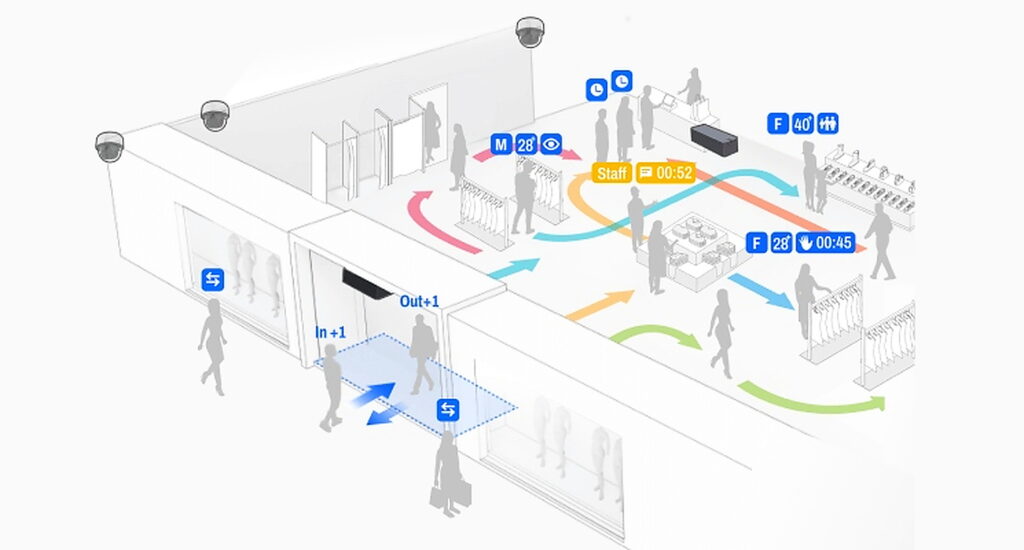
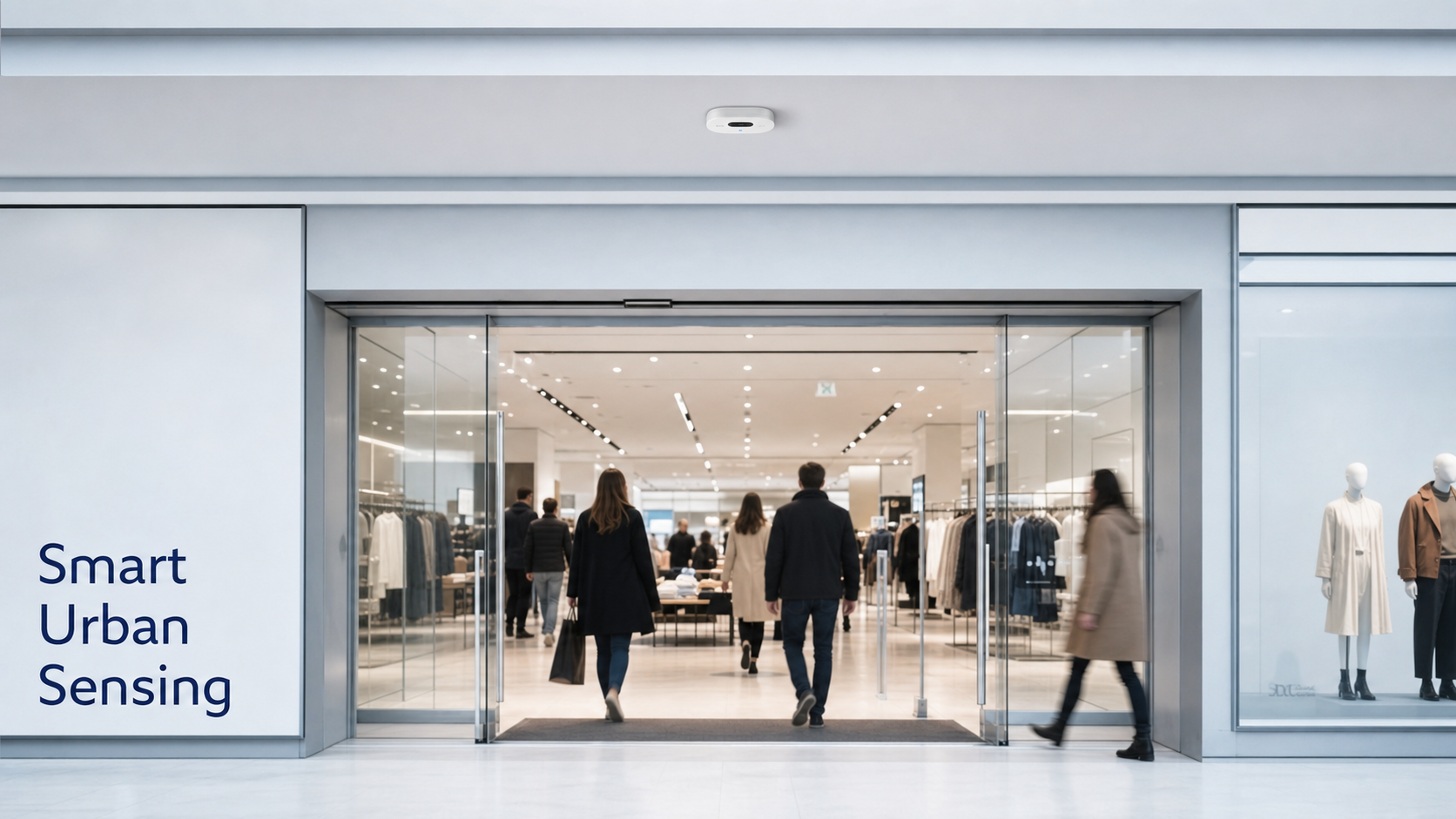
AI people counting is transforming how UK organisations measure footfall, understand customer behaviour, and prove ROI. In this guide, Smart Urban Sensing answers the three questions buyers ask most often about AI people counting: how accurate is it, is it GDPR compliant, and how quickly does it pay back? An effective AI people counting system replaces guesswork with data you can act on across retail, transport, and smart-city sites.
By Smart Urban Sensing | Manchester, UK | Updated July 2026
Quick Answer: AI-powered IoT people counting systems deliver up to 99.96% accuracy, are fully GDPR compliant by design, and generate measurable ROI through conversion uplift, smarter staffing, and better marketing decisions — typically within months of deployment. Read on for the full expert breakdown.
Table of Contents
- How accurate are AI people counting systems and can I trust the data?
- Is people counting GDPR compliant? What about privacy?
- What is the ROI of a people counting system, and how quickly does it pay back?
- Why Smart Urban Sensing?
- FAQ
Question 1: How Accurate Are AI People Counting Systems and Can I Trust the Data?
This is the single most common question buyers ask before committing to a people counting deployment, and rightly so. If your footfall data is wrong, every downstream decision — staffing, conversion tracking, marketing ROI — is built on sand.
The short answer: modern AI-powered 3D sensors achieve up to 99.96% accuracy under controlled lab conditions and 99.5–99.7% accuracy across real-world site deployments. But not all technologies are equal, and the gap between a cheap infrared beam counter and a premium AI stereo-vision system is significant.
How Different Technologies Compare
| Technology | Typical Accuracy | Privacy | Best For |
|---|---|---|---|
| Infrared Beam | 60–80% | No images | Simple single-door count only |
| Wi-Fi / Bluetooth | <50% | MAC addresses | Rough outdoor footfall trends |
| 2D Camera Edge AI | 95–98% | On-device processing | Zone counting, queue management |
| 3D Stereo Vision AI | 99–99.9% | No identifiable images | Retail entrances, transport hubs |
Infrared systems are notoriously unreliable — a single person in a wide coat or a parent carrying a child can throw off the count, and fundamental flaws in crossing detection mean real-world accuracy can be as low as 60%. Wi-Fi probe counting is even less reliable, capturing only devices with Wi-Fi enabled and inflating figures with passersby who never entered.
Why AI 3D Stereo Vision Is the Gold Standard
Smart Urban Sensing deploys the full FootfallCam 3D range — the 3D Pro1, 3D Pro2, and flagship 3D Pro3 — each using binocular stereo vision with AI deep learning, neural processing units, and octa-core CPUs processing at 25 frames per second. The AI distinguishes two people walking together, filters out staff using badge-based AI exclusion, handles group counting, ignores reflections and shadows, and operates in lighting conditions as low as 0.05 lux.
Based on over 2.3 million test cases, FootfallCam counters achieved an average accuracy of 99.96% under lab test environments. Across 13,000 real-world site installations:
- 99.7% accuracy under ideal conditions (ceiling height 2.6–3.5m, entrance width 2–4m)
- 99.5% accuracy under normal conditions (ceiling 2.3–4.5m, entrance 2–10m)
- More than 99.5% of counters achieve 95% accuracy after professional installation and tuning
Smart Urban Sensing validates this further — after calibration and validation by SUS engineers, the delivered counting accuracy range is 98–100% across every deployment, with an Accuracy Audit Report with video proof for every counter installed.
The Five Metrics One Device Delivers
- Visitor Count — accurate bidirectional traffic volume
- Conversion Rate — transactions / visitors, the most powerful retail KPI
- Dwell Time — how long customers spend in-store or in specific zones
- Returning Customer Rate — loyalty signals for CRM and marketing
- Staff Exclusion — clean customer-only counts using AI badge detection
Question 2: Is People Counting GDPR Compliant? What About Privacy?
Privacy is the second most searched topic by buyers evaluating people counting — and it is the most misunderstood. The good news is that modern AI people counting is not just GDPR compliant, it can be GDPR-exempt by design, depending on the technology chosen.
Does GDPR Apply to People Counting?
The UK GDPR defines personal data as any information relating to an identified or identifiable natural person. A plain count — “142 people entered this hour” — is a statistical aggregate about a crowd, not personal data. The measurement method, not the act of counting, determines whether GDPR applies.
| Method | GDPR Status | Why |
|---|---|---|
| 3D stereo vision + privacy mask | GDPR compliant | AI anonymises faces/clothing before any processing or storage |
| Wi-Fi MAC address tracking | GDPR applies | Device identifiers can single out individuals |
| Standard CCTV / face recognition | Full GDPR scope | Biometric data — strongest obligations apply |
How FootfallCam Embeds Privacy-First AI
- Privacy Masks are hardcoded at the video stream level. Faces, clothing, and identifiers are permanently blurred or obscured in real time, before footage is processed or stored — an irreversible anonymisation at source.
- Zero storage of PII. No identifiable data is retained, eliminating the risk of a data breach involving personal images.
- AI-powered precision is preserved. Privacy masks do not interfere with people-counting accuracy or dwell time analytics — the AI extracts behavioural patterns, not personal identifiers.
UK GDPR and the Data Use and Access Act 2025
The UK’s Data Use and Access Act 2025 updated the GDPR framework, introducing a more permissive ground for certain automated processing and clarifying that storage and access technologies can operate without explicit consent in specified low-risk situations. For anonymised footfall analytics — where no personal data is produced — this further reinforces compliance confidence for UK organisations.
Best-Practice Checklist for UK Compliance
- Choose technology that does not capture personal data — AI stereo vision with privacy masks as the first preference
- Conduct a DPIA if your system uses video analytics that could theoretically identify individuals
- Apply data minimisation — collect only footfall counts and behavioural aggregates, not raw video
- Update your Privacy Policy to disclose footfall analytics usage transparently
- Ensure edge processing — counting happens on-device; only aggregate counts are transmitted to the cloud
- Audit regularly — ICO guidance recommends ongoing review of AI-adjacent data systems
Question 3: What Is the ROI of a People Counting System and How Quickly Does It Pay Back?
ROI is the question that turns interest into a signed order. The honest answer is that a people counting system does not earn ROI by counting — it earns ROI by replacing guesswork with a number you can act on. The four primary ROI levers are conversion uplift, staffing optimisation, marketing effectiveness, and operational savings.
The Conversion Rate Lever — The Biggest Return
Conversion rate — the percentage of store visitors who make a purchase — is the single most powerful KPI in physical retail, and it is completely invisible without a people counter.
The formula is straightforward:
Conversion Rate = (Number of Transactions / Number of Visitors) × 100
For example: 180 transactions / 1,200 visitors × 100 = 15% conversion rate.
Industry benchmarks for physical retail in 2026:
- Specialty retail: 15–30%
- Grocery: 20–40%
- Big-box / department: 10–20%
A 1% improvement in conversion rate is typically the largest single ROI lever available to a physical retailer. A store receiving 2,000 visitors per day at an average transaction value of £35, improving conversion from 15% to 16%, generates an additional £70 per day / £25,550 per year per store from a single percentage point. McKinsey research indicates retailers using advanced footfall analytics have seen up to 20% revenue growth uplift when data is systematically linked to operational decisions.
The Staffing Optimisation Lever
People counting data reveals exactly when your peak hours, peak days, and seasonal demand spikes occur — with granular hourly resolution. This enables staffing schedules to be matched to actual demand rather than manager intuition. Over-staffing during quiet periods wastes payroll; under-staffing during peaks causes queue abandonment and lost conversions. A FootfallCam analytics dashboard surfaces both problems in real time.
The Marketing Effectiveness Lever
Without footfall data, marketing campaigns are evaluated on sales alone — which conflates conversion improvement with footfall improvement. People counting separates the two: did the campaign drive more people through the door, or did in-store execution convert the existing audience better? This attribution data transforms marketing spend from a cost into a measurable investment.
Real-World ROI: Smart Urban Sensing Case Studies
The Body Shop — 80-Store National Rollout
SUS deployed FootfallCam people counting across 80 Body Shop stores nationwide, each individually calibrated and validated, with all data centralised through a single online portal. The Body Shop gained visibility across sales conversion, visitor peak hours, and high- and low-performing store tiers — enabling data-driven staffing, store optimisation, and improved sales performance chain-wide.
Pandora — 200 Stores, UK & Ireland
FootfallCam, supplied and supported through SUS as the appointed UK main distributor, was selected by Pandora to replace its incumbent people counting platform across more than 200 stores in the UK and Ireland — delivering reliable conversion, occupancy, and performance data at enterprise scale at a lower total cost of ownership than the legacy system.
CityVerve Manchester — Smart City IoT Sensor Network
SUS designed and installed 10 IP66-rated IoT sensors on lampposts across Manchester, monitoring pedestrians, cyclists, vehicles, and public transport in real time. Data was delivered through an open-data city platform, supporting strategic transport decisions and smart-city infrastructure planning.
Henry Moore Institute, Leeds
SUS installed multiple FootfallCam systems throughout the Henry Moore Institute and adjacent Leeds Art Gallery, covering visitor usage, internal footfall, and zone-level people-flow — giving the institute reliable visitor data and zone visibility to support resource planning and evidence-based reporting to funders.
ROI Timeline: What to Expect
| Timeline | Milestone |
|---|---|
| Day 1 | Live footfall data, dashboards active, real-time occupancy visible |
| Week 1–4 | Baseline conversion rate established; peak hour profile confirmed |
| Month 1–3 | First staffing schedule optimisations; marketing attribution live |
| Month 3–6 | Typical payback period for most retail deployments |
| Year 1 | Chain-wide performance benchmarking; ROI compounding across estate |
Why Smart Urban Sensing Is the Right UK Partner
Smart Urban Sensing is the appointed main UK partner and distributor for FootfallCam — the world’s leading people counting platform. Based in Manchester with national delivery capability, SUS provides genuinely end-to-end service that sets it apart from box-shifting resellers.
What end-to-end means in practice:
- Site survey and consultation — the right solution is designed before any hardware is ordered
- Hardware and software supply — counters, dashboards, and analytics as one joined-up package
- Professional installation — UK-based engineers trained to FootfallCam specification
- Calibration, verification, and validation — every deployment validated to 98–100% accuracy
- Data analysis and reporting — KPI dashboards translating footfall into conversion, dwell time, and peak-hour trends
- System integration — POS, CRM, fleet management, and open-data city platforms
- Lifetime support and maintenance — proactive monitoring, remote diagnostics, on-site visits
The SUS team carries over 100 years of combined industry experience, with an in-house R&D team and thousands of site installations completed across retail, transport, cultural venues, and smart-city environments.
Sectors served:
- Retail stores and shopping centres
- Transportation — buses, trams, trains (UK-manufactured AI APC)
- Smart cities and towns — multi-modal IoT sensor networks
- Libraries, museums, and cultural venues
- Stadiums, leisure venues, and social spaces
- Offices, government, and public buildings
Frequently Asked Questions
What is a people counting system?
A people counting system is a combination of hardware sensors and analytics software that automatically measures the number of individuals entering, exiting, or moving through a physical space — such as a retail store, public building, transport vehicle, or urban environment. Modern AI-powered systems deliver far more than a head count: they also measure dwell time, conversion rate, zone flow, and returning visitor rates.
What accuracy should I expect from an AI people counter?
A professionally installed and calibrated AI 3D stereo-vision people counter should deliver 98–100% accuracy in real-world conditions. FootfallCam’s published accuracy, validated across 13,000 real-world installations, shows 99.5–99.7% in normal environments, and Smart Urban Sensing guarantees 98–100% after calibration and validation on every UK deployment.
Is people counting GDPR compliant in the UK?
Yes — when the right technology is used. FootfallCam’s AI stereo-vision systems (the 3D Pro1, 3D Pro2, and 3D Pro3) apply privacy masks at the video stream level, producing no personally identifiable data. SUS includes full compliance guidance in every project.
How long does installation take?
A single-site retail deployment typically takes one day for installation, configuration, and on-site validation. Large multi-site rollouts are project-managed by SUS with phased scheduling. The FootfallCam Pro2 and Pro3 are engineered for fast setup with a guided configuration process that minimises installation effort and project cost.
Can the system integrate with our POS, CRM, or fleet management system?
Yes. FootfallCam Analytics Manager V9 supports API integration with point-of-sale systems, CRM platforms, business intelligence tools, fleet management systems, and open-data city platforms. SUS handles integration as part of every deployment.
What is the total cost of ownership?
The total cost of ownership includes hardware, software licences, installation, calibration, integration, and ongoing support. SUS provides transparent pricing proposals at the outset. For most retail deployments, payback is achieved within three to six months through conversion uplift and staffing savings alone.
How does people counting work in outdoor or smart-city environments?
SUS deploys IP66-rated outdoor IoT sensors rated for weather exposure on lampposts and street furniture. These sensors detect and count pedestrians, cyclists, vehicles, and public transport modes simultaneously, delivering open-data dashboards and historic datasets for transport planning and urban analytics. The CityVerve Manchester project is a live example.
Ready to Talk?
Smart Urban Sensing delivers AI people counting and IoT footfall analytics across the UK — from single-store retail to national chains and smart-city networks.
5 Piccadilly Place, Manchester M1 3BR
Sales@smarturbansensing.co.uk
www.smarturbansensing.co.uk
To learn more, explore our AI people counting solutions or book a free consultation. For official guidance on privacy compliance, see the ICO’s data protection guidance and McKinsey research on retail analytics.
Smart Urban Sensing is the appointed main UK partner and distributor for FootfallCam — the world’s leading people counting platform.
© Smart Urban Sensing Ltd 2026. All rights reserved. Manchester, United Kingdom.


