Searches for “AI ethics” have exploded this year, and privacy-by-design people counting is suddenly the answer buyers ask for. People no longer only wonder what AI can do. Instead, they ask what it should do, especially when a camera sits above their head.Email me the footfall buyer checklist
Therefore, if you run a shop, a museum, a stadium or a smart building, this debate is not abstract. It is already happening in your own doorways, today. If you are new to the technology, our introduction to people counting covers the basics first.
Watching people, or counting people?
Every footfall camera raises one quiet question. Does this system watch people, or does it count them?
Those two things sound alike. However, they are not remotely the same.
Watching stores faces, follows individuals and builds profiles over time. Counting turns a crowd into a simple number. As a result, that number stays accurate, useful and completely anonymous.
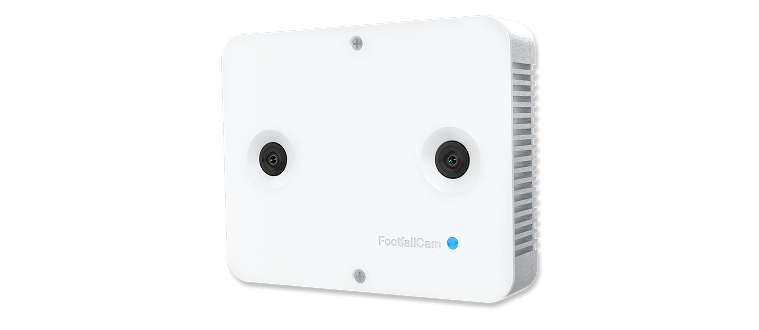
Our own AI3DPro anonymised camera does the second job only. Yet almost nobody outside the industry knows the difference exists. Right now, though, the whole internet is ready to learn it.
Why privacy-by-design people counting matters now
Three forces collide at once. Together, they explain the sudden surge of interest in ethical sensing.
- First, the market is booming. Fortune Business Insights expects it to grow from $1.66 billion in 2026 to $4.69 billion by 2034.
- Second, the law is firmer. The ICO refreshed its guidance in February 2026, and privacy must sit in the design phase rather than in a later patch.
- Third, public expectations have moved. The UK’s five AI principles cover safety, transparency, fairness, accountability and redress.
In short, privacy-by-design people counting is no longer a nice extra. It is the baseline that buyers, auditors and regulators now expect. Any business still treating the camera in the corner as a black box sits behind the curve.
Not every counting method is equal
The trade-off between accuracy and privacy is measurable, not theoretical. For a deeper look, read our comparison of counting technologies.
| Method | Accuracy | Coverage | Privacy profile | Typical cost |
|---|---|---|---|---|
| Infrared beam | 90-95% | Doorways only | High | £200-500 per door |
| Thermal sensors | 90-95% | About 10m² per sensor | High | £100-200 per sensor |
| Stereo or 3D cameras | 95-99% | Doorways only | Low, unless anonymised | £1,000-3,000 per unit |
| Wi-Fi tracking | 60-75% | Building-wide | Medium | Low |
Notice the tension in that table. Stereo and 3D cameras count best of all. Yet they also carry the largest privacy risk, unless the design strips identity at the point of capture.
That single word, “unless”, decides the entire argument. Because of it, two systems with identical specs can sit on opposite sides of the law.
How privacy-by-design people counting actually works
Good systems process each frame on the device itself. They convert shapes into counts within milliseconds. Then they discard the image straight away.
Because nothing identifiable ever leaves the sensor, you keep full computer-vision accuracy without the surveillance risk. Consequently, privacy-by-design people counting removes your legal exposure instead of merely documenting it. That is not a compromise, and it is not marketing language either.
Above all, it answers the exact question millions of people are searching about today. To see the approach in practice, browse our retail and smart building case studies.
AI observability means proof, not promises
“AI observability” is trending alongside AI ethics. It means monitoring a live AI system so you catch bias, drift or failure early.
Applied to footfall, a dashboard should show why a number is right. For example, it can display sensor health, confidence scores and anomaly flags together. Auditors can then check the data themselves.
This is the gap between “trust us” and “verify it yourself”. Our real-time analytics dashboard makes that difference visible. Therefore, privacy-by-design people counting should stay observable as well as anonymous. Moreover, platforms with this level of openness are future-proofed against rules that demand explainability by default.
Your privacy-by-design people counting checklist
Before you deploy AI sensing in a public or retail space, work through this short list.
- Build data minimisation and purpose limitation in from the start, rather than later.
- Record a lawful basis for any personal data, even very brief processing.
- Run a Data Protection Impact Assessment for higher-risk systems.
- Keep human oversight over any automated decision that affects someone.
- Log system behaviour, so you can explain results instead of assuming them.
Tick these five boxes, and the AI ethics panic stops being your problem. Skip them, though, and every doorway camera becomes a liability. Need a second opinion on your setup? Ask us for an audit through our contact page.
From technology-led to trust-led
Analysts describe 2026 as the year smart cities turn insights-driven. Sensors themselves are now cheap and widely available. Meanwhile, trustworthy analytics carry almost all of the value.
Fortune Business Insights puts IoT in smart cities at $327 billion in 2026, rising toward $1.42 trillion by 2034. Clearly, that growth rewards better intelligence rather than more hardware.
So the winners will not own the most cameras. Rather, they will say plainly, and prove, that their AI counts people instead of watching them. That one sentence now beats any spec sheet. Read more in our smart city trends report.
The bottom line
This AI ethics moment will last. Because it rests on a growing market, tighter UK guidance and clear national principles, it will not fade quickly.
Privacy-by-design people counting is not a defensive reply to the trend. Rather, it is the answer this industry already built and rarely explains. Ready to see it working on your site?
www.smarturbansensing.co.uk/contact-us/
Researching footfall analytics?
Get the supplier-neutral footfall & occupancy buyer checklist
Entrance survey sheet, 24 buyer checks, a simple ROI worksheet and the red flags to watch for. We will email it to you — and, if you like, a short monthly retail analytics briefing.