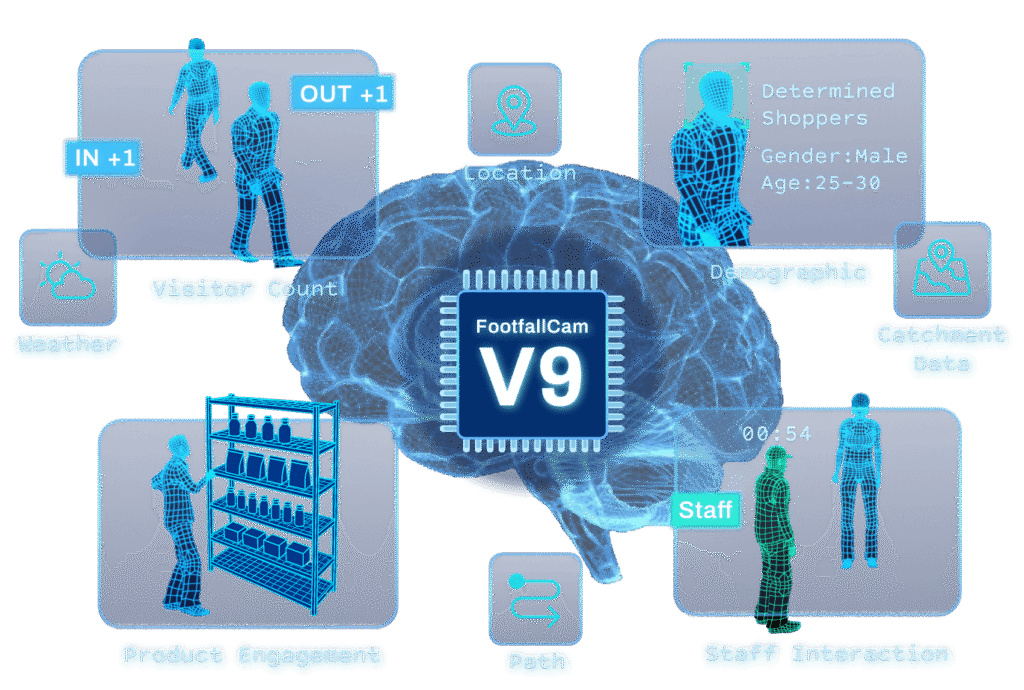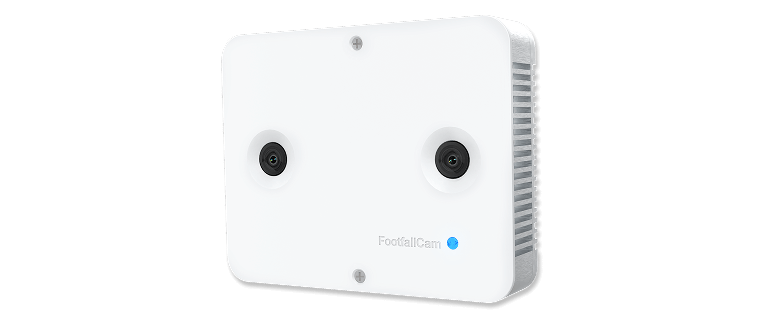
AI people counting sensors are transforming how businesses measure footfall, occupancy, and visitor behaviour. This comprehensive guide by Smart Urban Sensing answers the 20 most frequently asked questions about AI people counting sensors — covering the technology, accuracy, privacy, ROI, and deployment of modern AI people counting sensors across retail, smart buildings, and urban environments. Whether you are evaluating the growing people counting market or comparing AI people counting sensors for your next project, this guide has the answers.
By Smart Urban Sensing | April 2026
Everything you need to know about how AI-powered people counting sensors actually work — from the physics of 3D depth detection to GDPR compliance, staff exclusion algorithms, retail ROI, and smart building integration. Written for technical buyers, operations managers, and anyone serious about footfall intelligence.
Section 1: Fundamentals — What AI People Counting Sensors Actually Are
Q: What exactly is an AI-powered people counter, and how is it different from a traditional infrared beam sensor?
A traditional infrared (IR) beam sensor works on a simple break-beam principle: the device projects a single horizontal beam of IR light across a doorway, and any interruption of that beam increments a counter. Although cheap and easy to install, these legacy systems are notoriously inaccurate — they cannot distinguish between one person or three walking abreast, they cannot differentiate direction of travel without additional hardware, and they count pushchairs, trolleys, and dogs alongside humans. As a result, accuracy with these systems typically peaks between60% and 85%.
In contrast, an AI-powered people counter is fundamentally different. It uses computer vision algorithms — combined with depth-sensing hardware — to construct a real-time three-dimensional model of the scene below the sensor. The AI identifies individual human shapes (or “blobs”) within that depth map, assigns them unique tracking IDs, and follows their trajectory across the sensor’s field of view. The system only logs a count when a tracked individual crosses a virtual counting line in the correct direction. Consequently, the result is bidirectional, individual-level counting with accuracy rates ofup to 99%.
Q: What hardware technologies are used inside modern AI people counting sensors?
There are four primary hardware approaches in active use today, each with distinct physics, accuracy profiles, and privacy characteristics:
| Technology | How It Works | Accuracy | Privacy | Best For |
|---|---|---|---|---|
| 3D Stereo Vision | Two lenses capture offset images; parallax calculation builds a depth map | ~99% | Very High (no RGB data) | Retail entrances, airports, narrow doorways |
| Time-of-Flight (ToF) | Pulses of IR light are emitted; sensor measures round-trip time to calculate per-pixel depth | ~99%+ | Very High (no facial data) | Retail, offices, any indoor space |
| 2D Camera + Edge AI | Standard RGB or IR camera; AI model runs on-device | 95–98% | High (only metadata leaves device) | City mobility, wide-area retail, queue monitoring |
| 2D Camera + Cloud AI | Video streamed to a server; AI model runs in cloud | 95–98% | Medium (full video transmitted) | Heatmaps, journey analytics, large venues |
| WiFi Probe Counting | Detects probe requests from mobile devices’ Wi-Fi chips | <50% | Very High | Rough outdoor estimates only |
Q: How does a 3D stereo vision people counter actually work at a technical level?
A 3D stereo vision counter is based on binocular stereo vision technology and 3D target detection and tracking. The sensor contains two high-definition cameras positioned a fixed distance apart — like two eyes. Both lenses capture the same scene simultaneously but from slightly different horizontal positions. This creates a measurable disparity: the same object appears at different pixel positions in each image.
The on-board processor performs parallax calculations by comparing the position of matching features across both images. Using the known baseline distance between the two lenses and standard triangulation geometry, the sensor computes a full depth map — a pixel grid where each value encodes the distance between the sensor and that point in the physical space below. The AI then runs a 3D blob detection algorithm across this depth map, identifying human-shaped volumes (typically 1.5–2.0m tall, upright, and moving) and tracking them frame-by-frame as unique individuals.
Because the output is pure depth data — no colour, no texture, no facial features — the system is inherently privacy-safe. Even in a dense crowd, the 3D model accurately separates individuals whose heads are in close proximity, something 2D cameras fundamentally cannot achieve.
Q: How does Time-of-Flight (ToF) technology differ from stereo vision, and which is more accurate?
Time-of-Flight operates on a completely different physical principle. Specifically, the sensor emits pulses of invisible infrared light that flood the scene below. Each pulse travels to a surface, reflects, and returns to the detector array. Since light travels at a known speed, the sensor calculates the distance to every point in the scene by measuring the exact round-trip travel time for each pixel — which it expresses as aphase shiftbetween the emitted and received signals.
The result is a dense point cloud or range map updated at frame rates typically between 15fps and 100fps. Critically, ToF depth accuracy does not degrade with distance in the same way stereo vision does, stabilising at approximately centimetre-level accuracy across its operational range of 0.4m to 5m indoors.
| Metric | Stereo Vision | ToF |
|---|---|---|
| Depth accuracy | 5–10% of distance | ≤0.5% of distance |
| Working distance | ≤2m (standard) | 0.4–5m |
| Performance in low light | Poor (requires ambient light) | Excellent (active IR source) |
| Performance with dark surfaces | Poor | Good |
| Hardware cost | Low–Medium | Medium |
| Software processing requirement | High | Low |
| Field of view | Medium | Medium–Wide |
For pure people counting applications, therefore, most industry experts regardToF as the superior hardwaredue to its independence from ambient light conditions, its consistent depth accuracy, and its lower on-device compute requirement.
Section 2: AI People Counting Sensors — Algorithms, Tracking, and Accuracy
Q: What AI and machine learning algorithms power the counting logic?
The AI layer in a modern people counter consists of several sequential processing stages:
- Frame capture and pre-processing — The sensor captures either a depth map (ToF/stereo) or an RGB image (2D camera) at a defined frame rate. Pre-processing normalises the frame for lighting variation, removes background artefacts, and isolates foreground objects.
- Human detection — A trained deep learning model (typically a convolutional neural network, or CNN) analyses each frame to identify regions of interest that match the shape, size, and movement characteristics of a human. For depth sensors, this involves detecting upright blobs of the correct height and volume. For 2D cameras, the model draws bounding boxes around detected individuals and assigns a confidence score to each detection.
- Multi-object tracking (MOT)— The tracker assigns each detected individual a unique tracking ID. Tracking algorithms — includingKalman filters(which predict the future position of a moving object based on its prior trajectory) and centroid tracking methods — follow each ID across successive frames. As a result, this prevents double-counting: a person who briefly pauses, turns around, or whom another person temporarily occludes retains the same ID and still counts as a single individual.
- Counting line logic— The operator defines a virtual counting line within the sensor’s field of view. The system only registers a count when a tracked ID crosses this line. Directional vectors (calculated from the trajectory of the bottom-centre point of each bounding box across multiple frames) then determine whether the crossing represents an entry or an exit.
- Post-processing and data output— Finally, the system transmits aggregated counts, timestamps, and optional metadata to a local gateway, a cloud platform, or both — typically overMQTT, HTTP API, or Modbus RS485.
Q: What is the practical accuracy of AI people counters in real deployments, and what factors affect it?
AI-based 3D people counters with ToF or stereo hardware consistently achieve 99% accuracy in typical retail entrance deployments. 2D Edge AI systems operate at 95–98% accuracy, sufficient for most commercial applications. Real-world performance depends on several variables:
- Mounting height and angle— Manufacturers typically calibrate most sensors for 2.5m to 4.0m directly above the counting line. In addition, an incorrect mounting angle introduces parallax errors.
- Occlusion and crowd density — In extremely dense crowds, 3D depth sensors outperform 2D cameras because they resolve depth-based separation between individuals even when their horizontal positions overlap.
- Lighting conditions— Low-light or artificial lighting does not affect active sensors (ToF, IR stereo). However, passive 2D RGB cameras may require supplemental IR illumination in dark environments.
- Environmental interference — Reflective floors, glass partitions, and HVAC ducts can create spurious depth readings in ToF systems. Proper site survey mitigates most of these issues.
- Staff contamination — Without a staff exclusion mechanism, employee movements inflate visitor totals and corrupt conversion rate calculations.
Q: How do AI people counters handle groups of people entering simultaneously?
Group counting is one of the most common failure modes of legacy IR beam systems. For example, when two or three people enter a doorway simultaneously side-by-side, an IR beam sensor registers this as a single event — and this corrupts the count.
A 3D sensor running a blob tracking algorithm resolves this at the hardware level. The depth map clearly differentiates two adjacent human bodies as distinct volume objects — they have separate depth profiles, separate head positions, and separate movement vectors. The AI’s multi-object tracker assigns them separate IDs from the first frame of detection. Even if the individuals are in physical contact (e.g., a parent and child holding hands), the 3D volume model typically resolves them as separate entities above a minimum size threshold.
In extremely high-density scenarios — such as a festival entrance — operators can augment AI systems withU-turn detection,polygonal counting zones, andcrowd density estimationalgorithms that transition from individual tracking to statistical density modelling when scene complexity exceeds the system’s single-track resolution limits.
Section 3: Staff Exclusion — Keeping Your Data Clean
Q: What is staff exclusion, and why is it critical for accurate analytics?
Staff exclusion is the process of automatically removing employee movements from customer count data. Without it, every time a member of staff walks through the entrance — arriving for their shift, stepping outside for a delivery, or crossing between zones — they inflate the visitor count. For retailers who use footfall data to calculate conversion rate (transactions ÷ visitors), even moderate staff contamination renders the metric meaningless.
Consider a store with 500 daily customer visits and 10 staff members each entering and exiting twice per shift — that is40 staff movements per daycontaminating the count. If the raw sensor count reads 540, this artificially suppresses the reported conversion rate by 7.4%. Over time, this corrupts staffing models, marketing ROI calculations, and space utilisation reports built on that data.
Q: What are the different methods used to exclude staff from people counting data?
Staff wear a small hardware tag — often on the shoulder — made of a material actively detectable by the ToF sensor. When the sensor’s depth scan encounters a person carrying this tag signature within a defined exclusion zone, the system flags and removes the associated tracking ID from the customer count in real-time. Importantly, this method remains GDPR-compliant: the system detects the tag, not the person.
Method 2: Staff Exclusion Zones with Button
A staff-only entry path is marked as an exclusion zone in the sensor’s configuration. Staff press a physical button when entering or exiting through this zone, instructing the system to subtract that crossing from the count. Simple to implement but requires staff discipline.
The installer defines a secondary virtual line (distinct from the customer counting line) in a location only Method 3: Staff Exclusion Line
staff use. The system then logs crossings of this line separately and excludes them from visitor totals.
Method 4: Uniform Recognition (AI Vision-Based)
The retailer trains the AI model on examples of the store’s staff uniform, enabling it to visually identify and exclude staff detections without any wearable hardware. However, this approach requires consistent, recognisable uniforms and a sufficient training dataset.
Method 5: Re-ID Based Staff Exclusion
The system builds an anonymousmovement signaturefor each staff member based on non-personal visual cues: body shape, clothing consistency, walking style, and recurring path patterns. Over time, the system learns which movement signatures appear repeatedly (staff) versus once or twice (customers). As a result, the process remains entirely anonymised — nobody can identify any individual staff member.
Method 6: Time-Based Scaling Factor
A fixed percentage adjustment applied to the daily count based on known staffing levels. Useful only where staff presence is consistent; unsuitable for variable-shift environments.
Section 4: Privacy and GDPR Compliance
Q: Are AI people counting sensors GDPR compliant? Do they capture personal data?
Properly implemented AI people counting systems are fully GDPR compliant, and this compliance is achieved at the hardware and algorithm level. The key principle: non-identifiable count data is not personal data under GDPR.
For ToF and stereo depth sensors, the hardware itself outputs only depth values — distance measurements per pixel. There are no colour values, no facial features, and no biometric data in the raw sensor output.
For2D Edge AI systems, the AI model runs entirely on-device. The camera captures an RGB or IR image, the on-device model detects and counts people, and the device transmits only thecount metadata(a timestamp and integer value). The device never stores or transmits the source video.
For2D Cloud AI systems, the camera streams raw video to a server for processing. Consequently, this creates a significantly more complex GDPR compliance burden, as video footage constitutes personal data under Article 4 of the GDPR if individuals are identifiable. Compliance therefore requires proper data processor agreements, defined retention policies, data minimisation measures, and documented legitimate interest assessments.
Q: What happened to WiFi-based people counting, and why has it largely been abandoned?
WiFi probe counting operated by passively scanning for probe requests — broadcast packets that Wi-Fi-enabled mobile devices transmit when scanning for available networks. Each probe request historically contained the device’s unique MAC address, allowing a receiver to estimate the number of distinct devices in an area.
The defining technical blow was the universal adoption of MAC address randomisation by mobile operating systems. Starting with iOS 14 (2020) and Android 10 (2019), all major platforms began replacing a device’s real MAC address with a randomly generated address that changes on a per-network, per-session basis.
The practical consequence is a collapse in accuracy tobelow 50%. Additionally, European data protection authorities flagged WiFi probe counting as personal data processing under GDPR, and regulators shut down multiple deployments across EU retail and smart city projects for non-compliance.
The verdict: WiFi probe counting is technically obsolete. Smart Urban Sensing does not offer or recommend WiFi-based people counting for any application requiring reliable data.
Section 5: AI People Counting Sensors — Industry Applications and ROI
Q: What industries use AI people counting sensors, and what specific decisions does the data drive?
Retail — The most mature use case. Sensors track footfall at every entrance, enabling calculation of accurate conversion rate, sales per visitor (SPV), and traffic-to-labour ratio. These metrics allow retailers to identify peak traffic windows, align staffing accordingly, measure the real-world footfall impact of marketing campaigns, and detect whether promotional uplift translated into actual sales conversion.
Smart Buildings and Offices — Building operators use real-time occupancy data to drive automated HVAC and lighting control — adjusting temperature zones, ventilation rates, and lighting levels based on actual occupancy rather than scheduled timetable assumptions. Occupancy-based HVAC control strategies can reduce energy consumption by up to 20% in commercial buildings.
Public Venues and Museums— Venue operators use footfall data for capacity planning, exhibition layout decisions, and funding reporting. Moreover, public funding bodies often contractually require accurate visitor counts.
Airports and Transport Hubs — Sensors at check-in desks, security lanes, and boarding gates monitor queue lengths in real-time and trigger staff interventions when wait times exceed defined thresholds.
Fire Safety and Regulatory Compliance— Building managers with legal occupancy limits use real-time people counting to maintain compliance with maximum occupancy regulations. When occupancy approaches defined thresholds, the system automatically sends SMS or email alerts to FM teams.
Q: How do you calculate retail conversion rate using people counting data, and what does it actually tell you?
Conversion rate is defined as:
Conversion Rate (%) = (Number of Transactions ÷ Number of Visitors) × 100
For this metric to be meaningful, the visitor count must be bidirectional (counting entries only), deduplicated (re-entries not double counted), staff-excluded, and temporally aligned with POS transaction data at the same time intervals.
When these conditions are met, conversion rate separates traffic performance (driven by marketing, location, and external factors) from in-store conversion performance (driven by product availability, staff service levels, pricing, and store layout). A store that sees footfall rise 15% after a campaign but conversion rate fall from 28% to 22% has attracted more visitors but failed to convert them — a clear in-store execution signal.
Retailers combining footfall and POS data at hourly resolution can also derive:
- Average Transaction Value (ATV): Revenue ÷ Transactions
- Sales Per Visitor (SPV): Revenue ÷ Visitors — the single most honest store productivity KPI
- Traffic-to-Labour Ratio: Visitors ÷ Staff hours — enabling precision workforce scheduling
Section 6: Smart Building and IoT Integration
Q: How do AI people counting sensors integrate with building management systems (BMS) and HVAC?
Modern AI people counting sensors support a range of integration protocols designed for the IoT and smart building stack:
- MQTT — Lightweight publish/subscribe messaging protocol. The sensor publishes count events and occupancy totals to a broker (such as HiveMQ or Mosquitto), where downstream systems subscribe and act on the data in real-time.
- HTTP/REST API — The sensor exposes a standard web API endpoint. BMS platforms, dashboards, and third-party analytics systems can poll or subscribe for occupancy data.
- Modbus RS485 — Legacy hardwired protocol used in older BMS infrastructure. Most enterprise-grade sensors support this alongside IP-based protocols.
- BACnet / KNX — Building automation protocols used in sophisticated HVAC, lighting, and access control systems in commercial properties.
In practice: the Smart Urban Sensing sensor publishes a real-time occupancy value to the MQTT broker every 60 seconds. The BMS subscribes to this topic and compares current occupancy against zone-specific thresholds. If occupancy exceeds the defined threshold, the BMS automatically increases the fresh air intake rate and adjusts the zone thermostat set-point. When occupancy drops at the end of the day, the BMS scales back to minimum maintenance levels.
Q: Can people counting sensors be used for fire safety compliance, and how does that work technically?
Yes — and this is one of the fastest-growing enterprise use cases in the UK, particularly following the Building Safety Act 2022, which imposed new obligations on responsible persons (RPs) to manage and document safety risks in multi-occupied and high-rise buildings.
The technical architecture for compliance-grade occupancy monitoring:
- Footfall sensors installed at all entrance and exit points to the building and individual floors.
- Real-time data aggregation — entry and exit events maintain a live occupancy count per zone.
- Threshold alerts— when occupancy approaches a defined warning threshold (e.g., 80% of fire-code maximum), the system sends an escalating alert via SMS and email to FM staff.
- Audit trail — all alarm events, acknowledgements, and occupancy histories logged with timestamps, exportable for fire risk assessment reviews and regulatory inspection.
- Visual display — live occupancy data broadcast to screens around the building, accessible on mobile devices for FM staff.
Section 7: Choosing the Right Technology
Q: How do I choose between ToF, 3D Stereo, Edge AI Camera, and Cloud AI Camera for my deployment?
| Decision Factor | ToF Sensor | 3D Stereo | 2D Edge AI Camera | 2D Cloud AI Camera |
|---|---|---|---|---|
| Accuracy | ~99% | ~99% | 95–98% | 95–98% |
| Works in darkness | ✅ Yes | ❌ No | ⚠️ IR illumination needed | ⚠️ IR illumination needed |
| GDPR complexity | Very Low | Very Low | Low | High |
| Video leaves device | ❌ No | ❌ No | ❌ No | ✅ Yes |
| On-device AI processing | ✅ Yes | ✅ Yes | ✅ Yes | ❌ No |
| Heatmap / journey analytics | ❌ Limited | ❌ Limited | ⚠️ Basic | ✅ Full |
| Wide entrance coverage | ⚠️ Limited FoV | ⚠️ Limited FoV | ✅ Good | ✅ Good |
| Hardware cost | Medium–High | Medium | Low–Medium | Low |
| Bandwidth requirement | Minimal | Minimal | Minimal | High |
| Best for | Retail entrances, airports | Narrow doorways | Retail, offices, city | Large venues, behaviour analytics |
For most retail entrance, office building, and smart city deployments, the 2D Edge AI camera offers the best balance of accuracy, cost, scalability, and privacy. For applications where maximum accuracy is non-negotiable — airport security lanes, legal compliance counting — ToF sensors are the appropriate choice.
Q: What is the difference between edge AI and cloud AI processing in people counting, and why does it matter?
Edge AI means the entire AI inference pipeline runs on a dedicated processor embedded within the sensor hardware itself. Only the count result (an integer plus a timestamp) is transmitted off the device. The source video never leaves the sensor.
Cloud AI means the camera captures video and streams it continuously to a remote server where a more powerful AI model performs detection and counting.
| Factor | Edge AI | Cloud AI |
|---|---|---|
| Bandwidth | A few bytes per event | Gigabytes per day per camera |
| Latency | Sub-100ms, real-time | Network round-trip dependent |
| Resilience | Counts during internet outages | Stops if server connection is lost |
| Privacy | Inherently GDPR-safe by architecture | Requires governance framework |
| Analytics depth | Count + occupancy + basic zone data | Full heatmaps, journey mapping, demographics |
For most commercial deployments, Edge AI is the recommended default. Cloud AI should be reserved for use cases that genuinely require additional analytics capabilities and where the privacy governance overhead is justified.
Section 8: Implementation and Operations
Q: What does a Smart Urban Sensing AI people counter deployment look like from installation to live data?
A complete deployment follows five phases:
Phase 1: Site Survey
The entrance geometry, mounting options, ceiling height, lighting conditions, and network infrastructure are assessed. Optimal sensor placement is determined — typically centred above the counting zone at a height between 2.5m and 4.0m, with the sensor’s field of view covering the full entrance width. For wide entrances (>3m), multiple sensors in a tiled configuration may be required.
Phase 2: Hardware Installation
The sensor is ceiling-mounted via a standard 3/8″ mounting thread or VESA-compatible bracket. Power is supplied either via PoE (Power over Ethernet) or a dedicated 12V DC supply. A single Cat5e/Cat6 cable carries both data and power in PoE configurations, minimising installation complexity.
Phase 3: Network and Gateway Configuration
The sensor is assigned an IP address and connected to the local network or via a cellular IoT gateway (such as the UR35 router) for remote sites without fixed-line connectivity. MQTT broker credentials, API endpoints, or RS485 Modbus addresses are configured to route data to the analytics platform.
Phase 4: Sensor Calibration
The counting line is positioned within the sensor’s field of view via the configuration interface. Exclusion zones for architectural features are defined. Staff exclusion is configured if required. A live test count is performed and validated against a manual benchmark count over a 30-minute observation window.
Phase 5: Analytics Platform Integration
Count data begins flowing to the analytics dashboard. KPI baselines are established over the first four weeks: footfall by day and hour, peak periods, entry/exit ratios, and (where POS data is available) conversion rate and SPV. Automated reports and threshold alerts are configured.
Q: What ongoing maintenance does an AI people counting sensor require?
AI people counting sensors require minimal ongoing maintenance. There are no moving parts, no consumables, and — for ToF and stereo sensors — no optical components that require regular cleaning under normal indoor conditions.
Primary ongoing maintenance activities:
- Firmware updates — Over-the-air (OTA) updates improve AI model accuracy, add new features, and address security vulnerabilities.
- Lens cleaning — Annual inspection and lens cleaning with an appropriate lens cloth is sufficient in most retail and office environments.
- Counting line recalibration — Required if the physical entrance configuration changes.
- Accuracy audit — Periodic manual count validation against sensor logs. Annual accuracy audits are standard in airport and regulated building applications.
Ready to Deploy?
Smart Urban Sensing designs and deploys AI-powered people counting sensors for retail, smart buildings, councils, transport hubs, and urban environments across the UK and internationally.
Get in touch:
- 🌐 smarturbansensing.co.uk
- 📧 Request a demo or site survey via the website
- 🛒 Shop sensors: smarturbansensing.co.uk/shop
© Smart Urban Sensing 2026. All rights reserved.
Researching footfall analytics?
Get the supplier-neutral footfall & occupancy buyer checklist
Entrance survey sheet, 24 buyer checks, a simple ROI worksheet and the red flags to watch for. We will email it to you — and, if you like, a short monthly retail analytics briefing.