A busy entrance can produce a large visitor total and still leave you unsure what to change. An automated visitor counting system can do more than record arrivals. Depending on its sensors and software, it can show how people move through a space and when activity changes. To choose a useful system, understand how its counts are produced and which measures answer your organisation’s questions.
It’s sensible to ask whether a sensor can distinguish people moving in opposite directions and what happens to the resulting data. Raw totals rarely explain how to plan staffing, assess a layout or understand visitor flow. Useful insight depends on choosing an approach that fits the environment, then interpreting counts in context and handling data responsibly.
This guide explains the components and data flow behind automated counting, the measures that may support decisions in retail, transport and urban settings, and the privacy considerations to discuss. It also includes practical questions for comparing solutions, so you can check whether a system suits your space and can turn reliable counts into operational insight.
Key Takeaways
- An automated visitor counting system combines sensors and software, but detection methods and the way movement is interpreted vary.
- Visitor counts measure movement through a space. They are not the same as identifying named individuals.
- Choose measures that answer a practical question, such as how visitor flow varies in your retail, transport or outdoor environment.
- Before comparing options, define the area to measure, the count you need, who will use the reports and how often they’ll review them.
- Explore how counting hardware and analytics could suit your organisation via Smart Urban Sensing’s contact page or email sales@smarturbansensing.co.uk.
What is an automated visitor counting system, and what does it measure?
An automated visitor counting system uses sensors to estimate how many people move through a defined space, then organises the resulting data for review. A visitor count is an estimate of people passing a counting point or present in an area. It is not a booking total or transaction total: bookings record intended attendance, while transactions record purchases or other exchanges.
Counting visitors is also different from identifying them. A counter may detect movement and estimate numbers without determining who someone is or whether they’re authorised to enter. Technology and data handling vary, so check what a specific system captures, processes and retains. This overview of a people counter introduces common uses and sensor approaches.
For a visual example of a people-counting display, watch this video:
What information can a visitor counting system provide?
Depending on its sensors, configuration and reporting platform, a system may provide entrance and exit counts, direction of travel or an estimate of occupancy within a defined area. Where supported, teams can review counts over selected periods to see when activity rises or falls.
These measures answer different questions. Entrance counts can help assess how many people arrive, while exit counts show how many leave through a monitored point. Occupancy estimates may help teams understand how many people are in a space at a given time. A change in counts is a measurement, not an explanation. To decide whether it reflects a promotion, layout change or visitor preference, compare it with relevant context.
How is visitor counting different from access control?
A people counter estimates flow. Access control manages entry permissions, for example by checking a credential against an organisation’s rules. Don’t assume a counter verifies someone’s identity or authorisation.
At a venue, a counter might estimate arrivals at the entrance while a separate access-control system checks tickets or staff credentials. Keeping these purposes distinct helps teams choose suitable technology and avoid treating anonymous footfall data as an attendance or identity record.
To discuss counting hardware and analytics for your environment, contact Smart Urban Sensing through its contact page or email sales@smarturbansensing.co.uk.
How automated visitor counting turns movement into usable data
An automated visitor counting system turns activity in a monitored area into counts that teams can review. The data journey is straightforward in principle, although the technology and processing behind each stage vary by system.
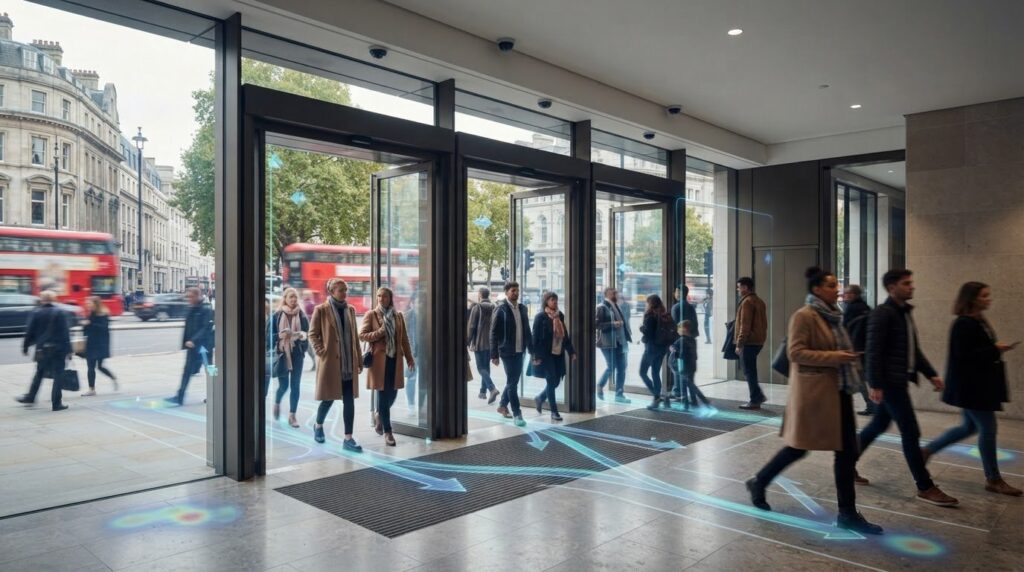
Movement is sensed, interpreted as a count, grouped into useful records, then presented for review.
From sensor observation to a visitor count
First, a sensor observes movement through a defined space, such as a doorway or passage. Depending on the system, sensing may use stereoscopic, thermal or infrared approaches. These detect activity in different ways; a count doesn’t, by itself, identify a person. The suitable approach depends on the environment and the question the organisation needs to answer.
Next, the system interprets observations according to its configuration. Where supported, it may distinguish direction of travel or register a passage as an entry or exit. The resulting count can be affected by installation conditions, the monitored area and system setup. A busy entrance, for example, presents different conditions from a clear, single passage. Ask where equipment should be positioned and how it should be configured to meet your counting objective.
From counts to reports and operational insight
Once observations have been interpreted, software can organise counts into reports. Depending on the platform and setup, results may be grouped by location or time, making it easier to compare activity across selected periods or monitored areas. Smart Urban Sensing’s V9 Analytics Software is its named analytics offering for data-driven insights. Confirm which reports and comparisons are available for the system you’re considering.
A report shows a measurement, not its cause. If a retailer sees more entries during a particular period, that increase doesn’t establish why it happened. Managers can compare the result with relevant context, such as changes to opening hours or an in-store event, before deciding what to do. Keeping measurement separate from interpretation helps prevent a pattern being treated as proof of visitor intent.
Before choosing a solution, clarify where movement needs to be measured, which counts matter and how the data will inform a decision. Ask how installation and configuration affect the results, and what the reporting platform can present. To discuss how counting hardware and analytics may fit your requirements, visit Smart Urban Sensing’s contact page or email sales@smarturbansensing.co.uk.
Which automated visitor counting approach fits your environment?
The right choice depends on what you need to measure, the conditions where counting will take place and how the results will be used. A system suited to a shop entrance may not suit a moving transport environment or an exposed public space. Start with the operational question, then compare sensor approach, privacy implications and reporting needs against it. No single technology is right for every setting.
| Environment | Question to answer | Relevant measurement | Selection consideration |
|---|---|---|---|
| Retail | How does store activity change over time? | Entrance and exit counts, where supported | Check how reports can be reviewed across locations and periods. |
| Transport | How many passengers use a vehicle or monitored area? | Passenger counts for the specific flow being assessed | Consider the counting context, operating conditions and intended reporting use. |
| Outdoor public space | How does footfall vary across a monitored area? | Counts at selected access points or locations | Assess environmental suitability, privacy requirements and the purpose of the data. |
What should retail teams assess before choosing a system?
Define what an entrance count should help you understand. It might support comparisons of store activity over time or inform operational planning, but the count alone won’t explain why activity changed. Decide who needs access to reports and whether they need to compare results across locations. For more on interpreting store footfall, see the guide to store traffic analysis. When comparing sensor types such as stereoscopic and thermal approaches, consult a dedicated technical comparison rather than relying on a general summary.
How do transport and outdoor requirements differ?
Passenger counting in transport has a distinct context from general visitor counting. The measurement needs to reflect the flow being assessed, such as boarding or alighting, if those are the intended measures. For outdoor settings, ask whether the proposed equipment is suitable for the location’s conditions and whether its reporting can answer the planning question. Smart Urban Sensing offers bus passenger counters and outdoor counters; suitability depends on the specific use case and configuration.
For public-space applications, the guide to smart-city footfall monitoring explores the urban context. In every setting, include privacy expectations in your shortlist. Ask what the sensor observes, what information is processed or retained, and how reports are made available. These questions help you choose a counting approach that produces useful data for your purpose. If your organisation is also evaluating how footfall data is stored and accessed, the practical buyer’s guide to cloud based footfall analytics covers how data moves from sensor to reporting platform and what to assess when comparing solutions.
To discuss your environment and measurement requirements, visit Smart Urban Sensing’s contact page or email sales@smarturbansensing.co.uk.

How to evaluate and prepare for an automated visitor counting system
Start with the decision you want the data to inform, not a preferred sensor or dashboard. A clear objective helps your team assess whether an automated visitor counting system is suitable and gives suppliers a practical basis for explaining their recommendations. Counts can inform decisions, but they can’t guarantee a particular operational outcome.
Define the measurement objective before comparing suppliers
Turn a broad aim, such as improving operations, into a question that can be answered with a defined measure. For example, do you need to compare visitor numbers at selected entrances, understand how activity changes over time or monitor occupancy in a particular area? Then agree who will use the reports and what decisions the data should support. A report that’s useful to an operations team may not provide the detail another team needs.
What should a system evaluation include?
Use a consistent checklist when assessing options. It keeps the discussion focused on suitability, responsible data handling and useful outputs:
- Define the area: Identify the entrance, passage, vehicle or public-space location to be measured. Note how people approach and move through it.
- Specify the count: Clarify whether you need entries, exits, direction of travel, passenger counts or another supported measure.
- Identify report users: Decide who needs access, what comparisons they need and how frequently they’ll review results.
- Ask about method and limits: Have suppliers explain how the proposed approach measures movement, what data it produces and what conditions may affect interpretation. For method-specific context, consult a guide to infrared people-counting systems.
- Clarify privacy and access: Ask what information is captured, processed, retained and made available, and who can access it. Verify any privacy or compliance statements for the system and intended deployment rather than relying on a broad claim. Teams evaluating how visitor data is handled after collection may also find it useful to review what cloud based footfall analytics platforms cover in terms of data governance and reporting access.
Site conditions matter. Entrance layout, mounting position, lighting, surrounding activity and other installation details may affect which approach is appropriate. Their relevance depends on the technology and location. Don’t assume a system will perform as expected based on a general description alone. Ask the supplier to assess the proposed installation context and explain any limitations, configuration requirements or checks needed before you rely on the counts.
Before committing, make sure the proposed measures match your objective and that your organisation understands how to interpret the reports. To discuss your counting requirements with Smart Urban Sensing, contact the team about your system requirements or email sales@smarturbansensing.co.uk.
How Smart Urban Sensing connects visitor counting hardware with analytics
When assessing an automated visitor counting system, start with the criteria established above: the environment, the movement you need to measure, privacy expectations and the reports your team will use. Confirm how the proposed equipment is installed, what it observes and processes, and whether its outputs answer your operational question. These checks are more useful than choosing a product based on a headline claim alone.
Where Smart Urban Sensing’s visitor-counting solutions may be relevant
Smart Urban Sensing provides people-counting hardware and analytics for retail, transport and smart-city applications. AI 3DPro2 is one option to consider once you’ve defined your measurement needs. Its suitability depends on the intended use, site conditions and system configuration, so ask for details relevant to your setting rather than assuming a particular result.
The company also offers indoor and outdoor counters, outdoor counters and bus passenger counting systems. These options relate to different contexts: a retail team may be assessing activity at an entrance, while a transport operator may need passenger counts. For urban monitoring, the measurement location and intended use of the data should guide the discussion. Assess the appropriate option against those requirements rather than treating different systems as interchangeable.
Smart Urban Sensing describes its technologies as privacy-first and GDPR-compliant, and states accuracy of up to 99.9%. Treat these as claims to verify for the specific solution under consideration. Ask what the accuracy figure applies to, the measurement conditions and use case behind it, and what the privacy or compliance statement covers. The precise data handling and system configuration matter to an informed assessment.
Discuss your visitor-counting requirements with Smart Urban Sensing
Bring a concise outline to a supplier conversation: the environment and area to monitor, the count you need, who will review reports and how those reports will inform decisions. Include privacy expectations and questions about installation conditions. This gives both sides a practical basis for discussing suitable hardware alongside V9 Analytics Software, Smart Urban Sensing’s named analytics offering for data-driven insights. Ask which outputs are relevant to your requirements rather than assuming features that haven’t been confirmed.
To discuss your needs, contact Smart Urban Sensing about visitor counting or email sales@smarturbansensing.co.uk.
Turn visitor counts into better-informed decisions
A useful automated visitor counting system is chosen to answer a clear operational question, not just for the promise of a dashboard. Define the area and movement you want to measure, decide who needs the reports, and check how the sensors, setup and data handling suit your environment. Counts can inform decisions, but interpreting them still requires context.
Smart Urban Sensing’s offering includes AI 3DPro2, its priority listed solution, alongside V9 Analytics Software and indoor and outdoor counters. Its systems are used across retail, transport and smart-city applications. The right combination depends on your measurement needs, site conditions and reporting requirements, so confirm the relevant details before selecting a system.
Ready to explore what may fit your organisation? Discuss your visitor-counting requirements with Smart Urban Sensing, or email sales@smarturbansensing.co.uk. Start with a clear question, then evaluate the equipment and reporting against it so visitor data can provide a more useful basis for planning.
Frequently Asked Questions
What is an automated visitor counting system?
An automated visitor counting system uses sensors and software to estimate how many people pass through or occupy a monitored area. Depending on its setup, it may report counts by direction, location or time period. It measures movement or presence, not bookings or transactions, and it need not identify individuals. Check which measures the proposed technology supports, as outputs depend on the sensor, configuration and deployment.
How does an automated visitor counting system work?
Sensors detect movement within a defined area, and the system processes those observations into counts. Analytics software can then organise the results for review. Sensing methods and interpretation vary, so ask how the proposed setup distinguishes the movements you need to measure. For example, clarify whether it can report entries separately from exits at your chosen entrance and what site conditions could affect the results.
Is an automated visitor counting system GDPR compliant?
Compliance can’t be assumed from the product category alone. Ask what the specific system captures, processes, stores and reports, and whether any identifiable data is involved. Check what controls apply to your intended use and have the deployment assessed against relevant requirements. Verify the supplier’s compliance statements for the particular system and configuration. A privacy-focused design may help inform the assessment, but it doesn’t replace a context-specific review.
Can visitor counting work without facial recognition?
Yes. Visitor counting doesn’t inherently require facial recognition: sensors can detect movement and estimate numbers without identifying who a person is. However, sensing approaches and data handling differ. Before deployment, ask what the proposed sensors observe, whether identifiable information is captured or retained, and what appears in reports. Then confirm that the configuration aligns with your organisation’s privacy expectations and intended measurement.
How accurate are automated visitor counting systems?
Accuracy depends on the technology, installation, configuration and conditions in the monitored area, so a headline figure shouldn’t be treated as universal. Smart Urban Sensing states accuracy of up to 99.9% for its solutions. Ask which product and measurement method that claim applies to, the conditions under which it was assessed, and whether those conditions match your site and intended use.
What is the difference between visitor counting and occupancy monitoring?
Visitor counting estimates how many people enter, leave or pass a monitored point. Occupancy monitoring estimates how many people are present in an area at a particular time. The measures can inform different operational questions. Entrance counts, for instance, may help review arrivals over a period, while occupancy figures may help teams understand how full a space is. Confirm which output your decision requires before comparing systems.
What should I ask when choosing an automated visitor counting system?
Ask which measures the system provides, how its sensors work in your environment and what limitations may affect the results. Clarify reporting options, installation requirements, privacy practices, data access and the context behind accuracy claims. Explain the decision you want the data to inform so the supplier can address your use case. To discuss your requirements, Book a free 20-minute footfall review or email sales@smarturbansensing.co.uk.
Retail and shopping centres
Find out what your entrance data should be telling you
In 20 minutes we review your entrances, current counting setup and conversion questions, then tell you what accurate footfall data would change. No obligation, no hard sell.