A visitor count is useful when it answers a park-management question. If you’re unsure whether to count at entrances, along paths or near activity areas, define what you need to learn before choosing equipment. A public park visitor counter must suit the site, and its data must help clarify how people use the park. A raw total alone may not show where demand is building or what managers should do next.
This guide explains how to define your measurement needs, plan counter locations and assess options for outdoor conditions. It also covers how to check data quality and use counts alongside site context, so the results can inform decisions about park facilities and management. Use the questions and steps below to prepare a focused brief before discussing a system with a provider.
Key Takeaways
- Start with the management question you need visitor data to answer, then decide what to measure.
- Map entrances, trail links and key routes to prioritise where a public park visitor counter could provide useful evidence.
- Match the sensing approach to the park’s site conditions, infrastructure and reporting needs.
- Set a baseline and check data quality and site events before drawing conclusions from changes in visitor counts.
- Prepare your project brief and contact Smart Urban Sensing Ltd or email sales@smarturbansensing.co.uk to discuss site-specific considerations.
What a Public Park Visitor Counter Measures, and Why It Matters
A public park visitor counter records movement at a selected point, such as an entrance, path or trail connection. It provides evidence about movement through that location, not a complete record of everyone in the park or everything they do. Choose the measure to match the decision you need to make.
Start with the decision the visitor data should support
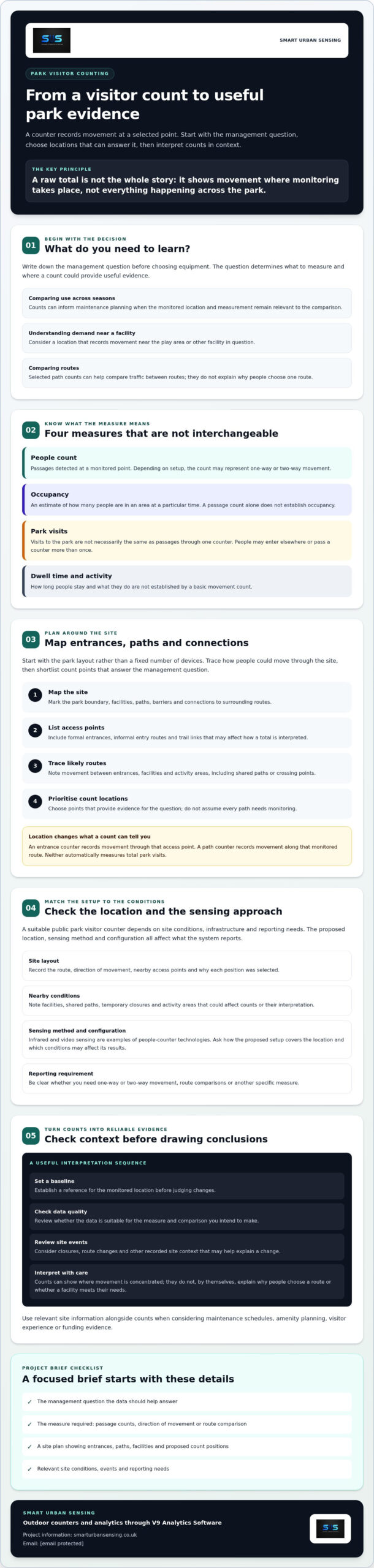
Before choosing a device, write down the management question. Are you comparing use across seasons to inform maintenance planning, reviewing demand near a play area or another facility, or checking which routes people use? Each question calls for a different measurement plan.
A counter at a main entrance can show movement through that access point. Counters on selected paths can help compare traffic between routes. Neither automatically measures total park visits: people may enter elsewhere, pass a counter more than once or use the park without crossing a monitored point. Define what evidence would support your decision, then select locations and measures that can provide it.
What can an outdoor visitor counter tell you?
Counts show movement where monitoring takes place. They are not interchangeable with other measures:
- People counts record passages detected at a monitored point. Depending on the setup, a count may represent one-way or two-way movement.
- Occupancy is an estimate of how many people are in an area at a particular time. A passage count alone doesn’t establish occupancy.
- Visits refer to visits to the park, which aren’t necessarily the same as passages through one counter.
- Dwell time concerns how long people stay, whilst activity describes what they do. A basic movement count doesn’t establish either.
These distinctions matter when using data for maintenance schedules, amenity planning, visitor experience or funding evidence. For example, counts at different access points may show where movement is concentrated. They won’t explain why people choose a route or whether a facility meets their needs. Consider relevant site information alongside counts before deciding what the pattern means.
What a system reports depends on its location, sensing method and configuration. People counter technologies include approaches such as infrared and video sensing, but the general capabilities of a method don’t confirm its suitability for a particular park. Ask how the proposed setup will cover the location and what conditions may affect its results.
Smart Urban Sensing provides outdoor counters and analytics through V9 Analytics Software. To discuss the measures you need for your park, visit the contact page on the Smart Urban Sensing website or email sales@smarturbansensing.co.uk.
How to Map Park Entrances and Paths Before Installing a Counter
A useful count plan starts with the park’s layout, not a fixed number of devices. Begin with the management question, then trace the routes people could take through the site. A single entrance counter may suit a straightforward access point. A park with several entrances, connecting trails or paths through activity areas may need a broader plan.
Which park entrances and paths should be counted?
Use this sequence to turn a site overview into a practical shortlist:
- Map the site. Mark the park boundary, facilities, path network and relevant barriers or connections to surrounding routes.
- List access points. Include formal entrances, informal entry routes and trail links that could affect how a total is interpreted.
- Identify routes. Trace likely movement between entrances, facilities and activity areas. Note where people, cyclists or vehicles share or cross a route.
- Prioritise count locations. Select points that answer the management question, rather than trying to monitor every path by default.
If you want to compare access-point use, identify alternative entrances that could make one counter’s total incomplete. If you want to understand movement between areas, consider whether separate route counts are needed. Decide whether you need to distinguish movement into and out of an area, then confirm that the proposed configuration can provide that measure.
How to record a useful site plan
Mark each proposed counter location on a simple plan. Show the route, direction of movement, nearby access points and reason for selecting each position. Add context that could affect the count, such as nearby facilities, shared paths, temporary closures or activity areas. These notes help explain later changes and make comparisons more meaningful if conditions or equipment change.
Be precise about the measure. A passage count on a path is not the same as the number of people present in an area at a particular time. For more on that distinction, see this guide to real-time occupancy monitoring. Record relevant site events and operational context alongside the plan so stakeholders can interpret the counts.
Date the plan and note its assumptions. Review it if routes or access change. If you’d like to discuss how a proposed layout could inform counter placement, contact Smart Urban Sensing Ltd or email sales@smarturbansensing.co.uk.
How to Choose a Public Park Visitor Counter for Site Conditions
The right public park visitor counter fits both the measurement objective and the place where it will operate. An exposed route, a secluded trail with limited infrastructure and a busy entrance can each raise different questions. Compare the proposed sensing method and installation requirements with your site, rather than relying on a general claim that one technology is best.
What should you check in an outdoor counting system?
Ask the supplier to assess the intended location and explain how the proposed system suits its outdoor conditions. Check what power and connectivity are required, and what arrangements may be possible if either is limited. Clarify how installation and data retrieval will work, along with the maintenance and support arrangements.
3D stereoscopic, thermal and infrared methods each need to be assessed for the proposed location and counting task. Consider what you need the system to distinguish, such as direction of movement or different types of route users. Ask whether the recommended configuration can provide that measure, and what could affect its performance. Read this guidance on high-precision 3D counters for further context on assessing accuracy claims against a particular deployment, rather than relying on a headline figure alone.
| Selection criterion | Questions to ask |
|---|---|
| Sensing method | Does it suit the route, expected movement and measure required? |
| Site conditions | How is the proposed equipment suited to the actual outdoor location? |
| Power and connectivity | What does the setup require, and how will data be accessed if infrastructure is limited? |
| Installation and upkeep | How will installation, maintenance and data retrieval be handled? |
| Reporting | Can reports provide the measures and time intervals needed for planned decisions? |
How to assess privacy, accuracy and reporting
Ask what information the system captures and reports, and how privacy is addressed for the proposed configuration. Smart Urban Sensing Ltd describes its systems as privacy-first and GDPR-compliant. Confirm whether those claims apply to the specific equipment and setup you’re considering.
Request evidence for accuracy claims under conditions relevant to your park, including the proposed position and counting configuration. Ask how performance is assessed, what conditions may affect the count and whether validation is available. Check that reports provide the measures and time intervals your team needs. To discuss outdoor counters and analytics for your site, contact Smart Urban Sensing Ltd or email sales@smarturbansensing.co.uk.
How to Turn Park Visitor Counts into Reliable, Useful Evidence
A count becomes useful evidence when its limits and context are clear. Establish a baseline by recording the monitored locations, counting method, direction and period covered. Note any known changes to equipment or routes. This gives you a reference point for later comparisons and helps distinguish a change in observed movement from a change in how data was collected.
How to check and interpret visitor-count data
Check the data before drawing conclusions. Look for missing periods, interruptions or unexpected changes, and note relevant site events such as a path closure, facility work or a change to an entrance. Compare periods that are meaningfully alike, such as the same season or comparable days, only when you understand the collection conditions. If the location, configuration or access has changed, explain the limitation rather than treating the figures as directly comparable.
Keep observations separate from explanations. If counts rise near a facility, the data shows increased movement at that monitored point. It doesn’t prove the facility caused the change. Consider whether operational records, maintenance notes or staff observations could add useful context. A public park visitor counter can support planning for facilities, maintenance and visitor experience, but decisions should reflect what the count measures and what it cannot establish.
How to share findings with park stakeholders
Make the result easy to assess. State the management question, count locations, period covered and important limitations alongside the figures. A clear chart or short summary can highlight the change relevant to a decision. Notes on data gaps and site events help stakeholders judge how much confidence to place in a comparison.
For example, a report on route use could show counts by monitored path and period, then flag any closure that affected access. Avoid presenting a single total without explaining whether it represents passages at selected points, visits to the park or another measure. Wider public-space analysis can also help put local findings in context; explore this smart city footfall monitoring guidance for a broader perspective.
Use findings to inform a decision, then review whether the next round of data helps assess its impact. To discuss outdoor counters and analytics for your reporting needs, contact Smart Urban Sensing or email sales@smarturbansensing.co.uk.
A Practical Next Step for Your Public Park Visitor Counter Project
A clear project brief makes it easier to compare options and discuss whether a proposed system fits your park. Before approaching a provider, bring together the management question, the locations you want to monitor and the decisions the results should inform. This keeps the discussion focused on useful evidence, not equipment specifications in isolation.
What to prepare before speaking to a provider
Gather a concise set of details about the site and the reporting you need. A simple plan and a list of priorities can help surface practical questions early, including whether each proposed point suits the intended count.
- Objectives: State what you want to learn and which planning or operational decisions the data may support.
- Site plan: Mark entrances, relevant paths, proposed count points and the direction of movement you need to measure.
- Infrastructure: Note known power or connectivity constraints, access limitations and outdoor conditions at each location.
- Reporting: Describe the measures, time intervals and format that would help your team review results.
- Privacy and review: List questions about what data is captured and how it is handled, alongside how and when your team plans to assess the findings.
Bring uncertainties as well as requirements. If you’re unsure whether a route should be counted separately, or whether you need a passage count or occupancy measure, raise it for discussion. Ask the provider to explain the proposed configuration, how its suitability and performance will be assessed at your site, and what installation, data access and maintenance arrangements apply.
How Smart Urban Sensing may support the project
Smart Urban Sensing provides outdoor counters and V9 Analytics Software, alongside AI-powered people-counting and footfall analytics. These are options to consider, not a universal configuration for every park. Match the sensing approach, installation requirements and analytics to your priority locations, site conditions and reporting needs.
Before selecting a setup, confirm which performance claims apply to the specific equipment and proposed deployment. Check whether privacy information applies to that exact configuration too, rather than relying on a general description.
A well-prepared brief gives both sides a practical starting point. To discuss your park counting requirements with Smart Urban Sensing, contact the team about your project or email sales@smarturbansensing.co.uk.
Make Your Park Data Work for Better Decisions
A useful public park visitor counter project begins with a clear management question. Map the entrances and routes that matter, choose a counting approach suited to the site, then interpret results alongside collection conditions and relevant park activity. Counts can inform planning, but they’re most useful when their scope and limitations are understood.
Prepare a brief with your objectives, site plan, priority count points, infrastructure constraints and reporting needs. Use it to discuss installation, performance and data handling with a provider.
Smart Urban Sensing offers outdoor counters and AI-powered people-counting solutions, with analytics through V9 Analytics Software. Match sensor and reporting choices to your park, and check any privacy or GDPR-compliance claims against the selected configuration.
Ready to take the next step? Discuss your park visitor counting requirements or email sales@smarturbansensing.co.uk. Share your management question and site plan to start a focused conversation about a suitable approach.
Frequently Asked Questions
What is a public park visitor counter?
A public park visitor counter measures movement through selected locations, such as an entrance or path. It can help park teams identify patterns at those monitored points when the locations fit the question being asked. A counter won’t automatically record every visit or activity across the whole park. Before interpreting results, check what the equipment detects, which routes it covers and whether people passing the same point more than once affect the total.
How do you count visitors in a public park?
Start by deciding what information would support a management decision. Map entrances and routes, choose count points that relate to the question, then select a system suited to the site and reporting requirements. During collection, note interruptions and site changes, and check for missing data. Compare like-for-like periods where conditions allow, explain limitations and distinguish observed changes from possible reasons that need further evidence.
Where should a visitor counter be placed in a park?
Place a visitor counter where it can answer a defined management question, such as at a main entrance or on a priority path. First map other access points and routes, because one monitored location may not represent use across the whole park. If you need to understand movement between areas, separate route counts may be relevant. Record why each position was chosen, what direction is counted and how the data will inform a decision.
Can a public park visitor counter work without electricity or internet?
Some outdoor counting systems may suit sites with limited power or connectivity, but capabilities depend on the equipment and configuration. Before selecting one, ask the supplier about power needs, connectivity, data storage and retrieval, and maintenance. Check how data will be accessed and whether that arrangement fits your reporting schedule. Don’t assume an offline or battery-powered option will suit every location; confirm its suitability for the intended deployment.
How accurate are outdoor visitor counters?
Accuracy depends on the sensing method, configuration, placement and conditions at the monitored site. Ask for evidence relevant to the proposed deployment, and clarify how accuracy was assessed and which situations may affect results. A headline figure on its own may not describe performance on your paths or at your entrances. Ask whether a site test or validation process is available before using the data to support important planning decisions.
Do public park visitor counters identify individual people?
Counting systems can detect and handle information differently, so ask what the proposed setup captures, stores and reports. Discuss how privacy is addressed for that specific configuration before deployment. Don’t assume a general product description answers every question. Smart Urban Sensing describes its systems as privacy-first and GDPR-compliant, but you should confirm whether those claims apply to the equipment and configuration being considered.
How can park teams use visitor count data?
Park teams can use counts to examine movement patterns and inform decisions about maintenance, amenities and visitor services. Treat the results as evidence about monitored points, not proof of why a pattern occurred. Check data quality and consider relevant observations or operational records before explaining a change to stakeholders. To discuss outdoor counters and analytics for your park, contact Smart Urban Sensing or email sales@smarturbansensing.co.uk.
Retail and shopping centres
Find out what your entrance data should be telling you
In 20 minutes we review your entrances, current counting setup and conversion questions, then tell you what accurate footfall data would change. No obligation, no hard sell.