A queue length monitoring system is useful when its measurements help your team make a better operational decision. A live count can show where a line is building, but it won’t necessarily tell you how long people have waited, where service is slowing or when staffing needs to change.
If queue build-up is hard to see or you’re unsure which figures are worth tracking, start with the layout and the decision you need to make. Camera-based analytics and overhead sensors can suit different settings, and privacy requirements should be part of the assessment from the outset.
This 2026 buyer’s guide explains how to compare monitoring approaches, choose useful measures such as queue length, waiting time and service time, and prepare questions for suppliers before installation. It also considers whether people-counting technology, including AI 3DPro2, may be relevant to your use case. Confirm first whether a proposed system supports queue-specific measurement and reporting.
Key Takeaways
- Choose a queue length monitoring system by identifying the operational decision it needs to support, not by starting with the technology.
- Separate direct measurements, such as the number of people in a defined area, from derived measures such as estimated waiting time.
- Compare manual observation, analytics using existing CCTV and dedicated sensors for site suitability, data handling, integration needs and ongoing review.
- Before implementation, define queue boundaries and reporting intervals, and clarify privacy arrangements and how performance will be assessed in your environment.
- Smart Urban Sensing’s people-counting and analytics capabilities may be relevant, but queue-specific functions need to be confirmed. Contact the team or email sales@smarturbansensing.co.uk to discuss your use case.
What a queue length monitoring system measures, and what decisions it should support
A queue length monitoring system observes people or movement within a defined area and turns those observations into information a team can use. Defining that area is essential: a sensor may count everyone moving through a zone unless the measurement boundary distinguishes people waiting from passers-by.
Queue monitoring is meaningful when the measured area is clear and the data answers an operational question. Useful outputs might include a count at a particular moment or a pattern across the day. The site layout, measurement method and reporting interval all affect what those figures can tell you.
Which queue metrics are useful to an operations team?
Queue length is the number of people within the defined area. Depending on the system, it may be reported as a snapshot or a trend over time. A snapshot can help staff spot a build-up in progress; a trend can help managers compare service periods and identify recurring pressure points.
Throughput and service time are different measures. Throughput describes how many people move through a service point during a period, while service time concerns how long a service interaction takes. Don’t assume a queue counter captures either. Ask which outputs are supported and how each is calculated. Estimated waiting time is also a derived measure, not necessarily a direct observation, so its value depends on the data and assumptions behind it. Queueing theory explains the relationships between arrivals, service rates, queue lengths and waiting times, but a theoretical model doesn’t confirm what a particular system measures.
What problem should monitoring solve first?
Start by stating the decision you need to make. Do you want to spot a growing queue, compare busy and quiet service periods or inform how resources are allocated? Each goal calls for relevant data and a plan for who will act on it. For example, recurring build-ups at one service point could prompt a review of staffing, the number of open service points or the customer-flow process.
Monitoring can make queues easier to see, but it won’t fix every underlying issue. A queue that is difficult to observe presents a visibility problem; insufficient staffing, a slow process or a restrictive layout may need a separate operational response. Use the measurements to identify where pressure occurs, then investigate the cause before deciding what to change.
If you’re considering people-counting technology for this use case, ask Smart Urban Sensing whether its capabilities suit your defined queue area and required outputs. Confirm queue-specific measurement for the intended deployment. Visit the contact us page or email sales@smarturbansensing.co.uk to discuss your requirements.
How queue length monitoring systems detect and interpret a queue
A queue length monitoring system senses activity in a defined area, processes observations according to set rules and presents the results for review. The output depends on whether the monitored zone reflects the real queue and whether the system can distinguish people waiting from passers-by.
That distinction can be difficult when customer routes cross, queues turn corners or the layout changes during the day. A boundary that worked before a counter or barrier was moved might now include unrelated movement or miss part of the line. When assessing a site, map the queue edges, entry and exit points, nearby circulation routes and any changes that could affect counting.
Camera-based computer vision and sensor-based measurement
Camera-based computer vision analyses a monitored scene to identify movement or people within a specified area. Suitability may depend on camera position, sightlines, lighting and the existing layout, as well as the information your team needs. Clarify what data is processed, whether images are retained or transmitted, and how privacy is addressed for the proposed deployment.
Dedicated sensors use a different approach. Smart Urban Sensing lists 3D stereoscopic, thermal and infrared technologies among its sensing capabilities, but these technologies aren’t interchangeable or automatically suitable for every queue. Compare options against site conditions, installation constraints, required outputs and data-handling requirements. Ask how obstructions, overlapping flows and layout changes could affect the results, and how these factors will be checked on site.
From observations to dashboards and operational insight
A single queue count is a snapshot. Reviewing observations over time can help teams identify recurring build-ups, compare service periods and investigate whether an operational change coincides with a different queue pattern. The reporting interval matters: a summary may help with planning, while more frequent updates may be needed for decisions during service. Confirm what the system records and how your team can access and review it.
A measured observation records what the sensor detects; an estimated or calculated queue indicator depends on additional assumptions and should be assessed separately. For example, estimated waiting time may be calculated rather than directly observed. Ask what information and method underpin the estimate.
V9 Analytics Software is a Smart Urban Sensing offering, but queue-specific dashboards, indicators and integrations haven’t been confirmed. Ask whether these functions are available for your intended use and how performance and data handling will be demonstrated. To discuss whether its people-counting capabilities may be relevant to your site, visit the contact us page or email sales@smarturbansensing.co.uk.
How to compare queue length monitoring system options
Compare methods against the question your team needs answered, rather than a general promise of accuracy or automation. A system that suits a straight, separated line may not interpret a shared entrance or a queue that regularly changes shape in the same way. Before weighing up installation or integration, check the measurement area, expected outputs and how the data will support a decision.
What should buyers compare between monitoring approaches?
A side-by-side assessment makes practical trade-offs easier to spot. Ask suppliers to explain their assumptions about entrances, queue shape, lighting, intersecting footfall and obstructions. A method that works in one layout may need a different configuration in another.
| Approach | Potential outputs | Site and data considerations | Integration and review |
|---|---|---|---|
| Manual observation | Counts or timed observations, depending on the task and recording method. | Observations can focus on a specific area, but results depend on a consistent plan and recording process. Decide how observations will be documented. | Records can be compared when they use consistent intervals. Confirm who will collect, organise and review them. |
| Analytics using existing CCTV | Potentially automated observations from a camera view. Confirm the exact metrics and reporting interval. | Assess camera angle, visibility, lighting and whether other movement crosses the scene. Clarify what data is processed, retained or shared. | Ask how outputs are accessed and whether they fit existing workflows. Confirm who reviews results and how scene changes are handled. |
| Dedicated sensing | People-counting or other outputs depend on the selected sensor and configuration. Confirm queue-specific capabilities. | Assess mounting position, coverage, obstructions and fit with the queue layout. Clarify data handling for the proposed deployment. | Check how results are presented, which integrations are available and what ongoing checks are expected. |
When might a dedicated people counter be relevant?
A dedicated counter may be worth assessing when you need to count people in a defined area and the site can accommodate the sensor. It isn’t automatically the right option. Compare its outputs and installation requirements with the actual queue conditions. For broader considerations when evaluating sensor technology, see this high-precision 3D counters guide.
Smart Urban Sensing offers AI-powered people-counting capabilities, including AI 3DPro2, but its suitability for queue monitoring hasn’t been confirmed. Ask for a demonstration using a representative layout and how queue-specific performance would be assessed. To discuss your requirements, visit the contact us page or email sales@smarturbansensing.co.uk.
Queue monitoring buying checklist: site fit, privacy and implementation
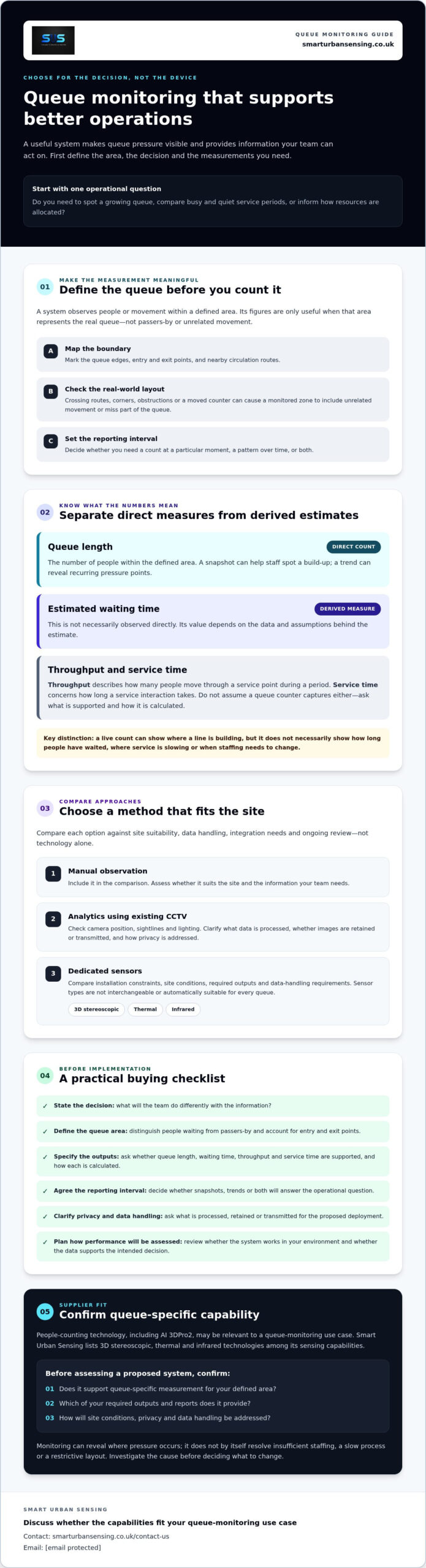
A well-scoped proposal starts with the operational question, not a device specification. Before choosing a queue length monitoring system, document the site conditions, required outputs and how the information will be used. This gives suppliers a clear basis for assessing fit and makes it easier to compare proposals consistently.
What to document before requesting a proposal
Use this sequence to prepare a practical brief:
- 1. Define the decision. State whether you need to identify queue build-up, compare service periods or inform resource allocation. Name the people who will act on the findings.
- 2. Map the site. Mark queue locations, boundaries, entrances, service points and areas where pedestrian flows overlap. Note where queues may change shape or people pass nearby.
- 3. Specify the measures. Distinguish direct counts from derived measures, define the reporting interval you need and ask how each output will be calculated.
- 4. Record existing systems. List cameras, network access and analytics systems that may be relevant, without assuming they’re compatible with a proposed solution.
- 5. Prepare for a site survey. Identify installation constraints, access requirements and the site conditions a supplier should assess before recommending an approach.
Questions to ask during a supplier demonstration
Ask for a demonstration under conditions that represent your site, including its queue shape, nearby movement and required metrics. Confirm which outputs are directly measured and which are estimated or calculated. Ask how measurement quality will be assessed in your environment, what could affect results, and how the supplier would handle a changed layout or obstructed view.
Clarify what data is collected, where it is processed and stored, who can access it, how access is managed and how long information is retained. Ask the supplier to provide details supporting privacy or data-handling claims for the proposed configuration, rather than relying on a broad product description. For additional context on privacy considerations, read the GDPR-compliant people counter guide.
Finally, agree how results will reach the people who need them and whether integration with existing systems is supported. Smart Urban Sensing’s people-counting and analytics capabilities may be relevant, but queue-specific functions and data-processing details need to be confirmed for your use case. Discuss your queue monitoring requirements or email sales@smarturbansensing.co.uk.
Assessing Smart Urban Sensing for a queue length monitoring project
Smart Urban Sensing provides AI-powered people-counting and footfall analytics for retail, transport and smart-city applications. Its confirmed offerings include AI 3DPro2, indoor and outdoor counters, and V9 Analytics Software. These capabilities may be relevant to a queue length monitoring project, but that doesn’t establish that a particular product measures queue length or provides queue-specific waiting-time estimates, alerts or reports.
Assess fit against your site and the decisions you need to make. Share the queue layout, operating patterns and target metrics, then ask the team to confirm what a proposed setup can deliver under those conditions. A useful response should distinguish supported functions from those that need further assessment.
Which Smart Urban Sensing capabilities may be relevant?
AI 3DPro2 and the company’s other counters are products to discuss with the team, not confirmed queue-monitoring solutions. Smart Urban Sensing’s business overview includes 3D stereoscopic, thermal and infrared sensing technologies. Their suitability depends on the specific environment, including queue configuration, nearby pedestrian flows, obstructions and practical installation constraints.
V9 Analytics Software is also a confirmed offering. Before treating it as part of a queue-monitoring solution, verify whether it supports the queue-specific dashboards, reporting intervals or integrations your team requires. Smart Urban Sensing describes its solutions as privacy-first and GDPR-compliant. Ask what data the proposed setup collects and processes, and what details can be evidenced for your use case.
What to include in an initial supplier conversation
Give the supplier enough context to assess the application, rather than relying on a general product description. Prepare a site plan showing queue boundaries, entrances, service points and places where other pedestrian flows cross the area. Explain when queues form or change shape, and which operational decisions the monitoring data should inform.
List the metrics you need, such as a queue count at defined intervals or an estimated waiting time. Ask which can be measured directly, which are calculated or estimated, and how performance will be assessed under representative site conditions. Also clarify data access, retention, privacy arrangements and any required connections to existing systems.
To assess whether Smart Urban Sensing’s people-counting capabilities may fit your requirements, Book a free 20-minute footfall review or email sales@smarturbansensing.co.uk.
Choose a system that supports the next decision
The strongest queue monitoring choice is the one that measures what your team needs to act on. Define the queue area, decide which outputs matter, and check whether they’re direct measurements or estimates. Then compare approaches against the site layout, data-handling requirements and operational workflow.
Assess a queue length monitoring system in its intended environment, not on general claims alone. Ask suppliers to demonstrate how their approach handles your queue boundaries and movement patterns. Confirm which dashboards, integrations and privacy details apply to the proposed setup.
Smart Urban Sensing provides AI-powered people-counting and footfall analytics for retail, transport and outdoor applications. AI 3DPro2 and V9 Analytics Software are confirmed offerings, but their queue-specific capabilities must be verified for your requirements.
To explore whether these capabilities may suit your site, discuss your queue monitoring requirements or email sales@smarturbansensing.co.uk. A clear brief and focused questions can help you make a more informed decision.
Frequently Asked Questions
What does a queue length monitoring system measure?
A queue length monitoring system can be configured to measure or estimate information about people in a defined queue area. Depending on the technology, outputs may include queue size, movement or other operational indicators. Ask which figures are directly observed and which are calculated from additional data or assumptions. The most useful metric depends on the decision you need to make, such as reviewing service capacity or identifying recurring congestion.
How does a queue length monitoring system work?
A queue length monitoring system senses activity in a defined area, processes observations and presents results for review. It may use camera-based computer vision or dedicated sensors, but capabilities vary by supplier and site. Queue boundaries, overlapping pedestrian flows, obstructions and other site conditions can affect interpretation. Ask the supplier to explain the sensing method and demonstrate how it performs against your layout, required metrics and operational questions.
Can a people counter monitor queue length?
A people counter may be relevant to queue monitoring, but counting general footfall and measuring a queue aren’t automatically the same task. Confirm whether the proposed product can distinguish people waiting from those passing nearby, and whether it supports your required boundaries, metrics and reporting. Request a demonstration under representative conditions. Ask how queue-specific performance will be assessed rather than relying on general people-counting accuracy claims.
Can queue monitoring systems estimate waiting times?
Some queue monitoring systems may calculate estimated waiting times using queue observations and service information, but this isn’t a universal capability. The estimate depends on its data inputs and assumptions, so ask the supplier to explain the calculation and how it can be checked in your setting. Treat waiting time as an estimate, not a guaranteed outcome, and confirm whether the system supports this measure before including it in your requirements.
Are queue length monitoring systems privacy-friendly?
Privacy depends on the technology, configuration, information collected and how it’s managed. Ask what data the proposed setup captures, whether identifiable information is involved, who can access it and how long it’s retained. Request documented details to support any privacy or compliance claims for your specific deployment. Don’t assume that a particular sensor type settles privacy questions; assess the complete data-handling approach with the supplier.
What should I ask before choosing a queue monitoring system?
Start by defining the operational decision and the metrics needed to support it. Ask about the sensing method, site suitability, queue boundaries, measurement assumptions, reporting intervals, integrations, privacy and implementation requirements. Request a demonstration under representative conditions, and confirm which outputs are measured directly and which are derived. Smart Urban Sensing can discuss its people-counting capabilities and their potential relevance to your use case. Discuss your queue monitoring requirements or email sales@smarturbansensing.co.uk.
Retail and shopping centres
Find out what your entrance data should be telling you
In 20 minutes we review your entrances, current counting setup and conversion questions, then tell you what accurate footfall data would change. No obligation, no hard sell.