
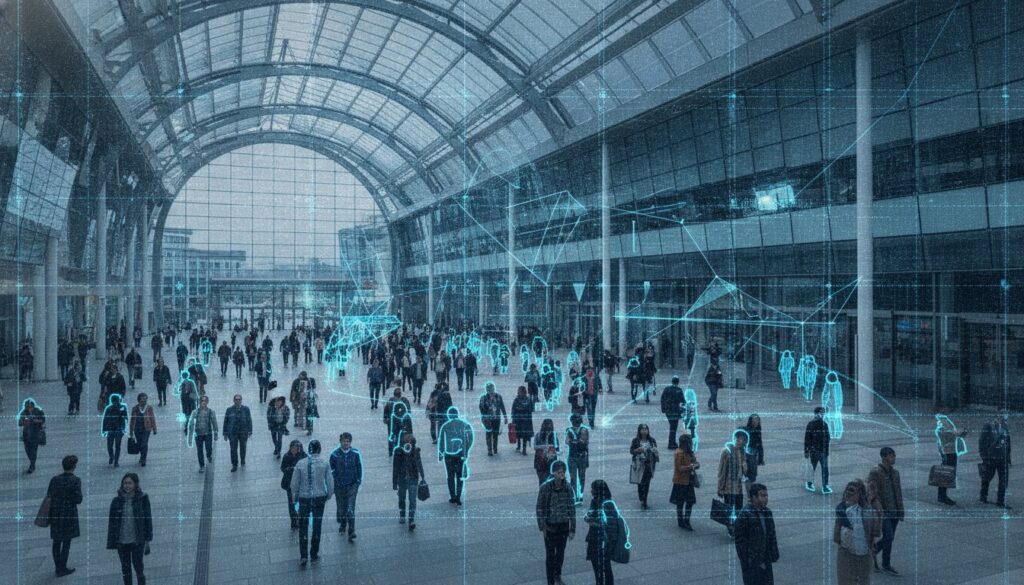
If your staffing levels are based on footfall data with a 15% margin of error, you aren’t just losing efficiency; you’re actively draining your bottom line. Most retail and transport managers recognise that traditional infrared beams or thermal sensors often fail to distinguish between a group of shoppers and a single pram, leading to skewed analytics that make precise planning impossible. Relying on such fragmented information is no longer sustainable in a market where every overhead must be justified. By upgrading to high precision 3D counters, you can capture 99% accurate data that remains audit-ready and fully compliant with the latest UK GDPR standards under the Data (Use and Access) Act 2025.
This strategic guide demonstrates how advanced stereoscopic sensing transforms raw visitor numbers into actionable operational intelligence. You’ll discover how to integrate these sophisticated tools into your existing analytics platforms whilst ensuring non-intrusive, privacy-first monitoring. We will examine the transition from simple counting to deep behavioural insights, providing a roadmap for seamless installation and long-term data integrity. By aligning high-tech hardware with robust ethical standards, you can move beyond simple observation and start making decisions with absolute confidence.
Key Takeaways
- Understand the evolution from basic infrared sensors to AI-driven stereoscopic vision, establishing a new technical standard for 99% data accuracy.
- Learn how dual-lens technology mimics human depth perception to solve the “occlusion” problem, ensuring precise counts even in dense crowds or groups.
- Discover how to specify the ideal high precision 3D counters for your facility by evaluating environmental factors such as ceiling height and entrance width.
- Explore how to transform raw footfall data into operational intelligence, from optimising retail staff schedules to managing real-time bus passenger occupancy.
- Gain clarity on maintaining total UK GDPR compliance through edge-processing technology that prioritises visitor privacy without sacrificing analytical depth.
What Defines High Precision 3D Counters in 2026?
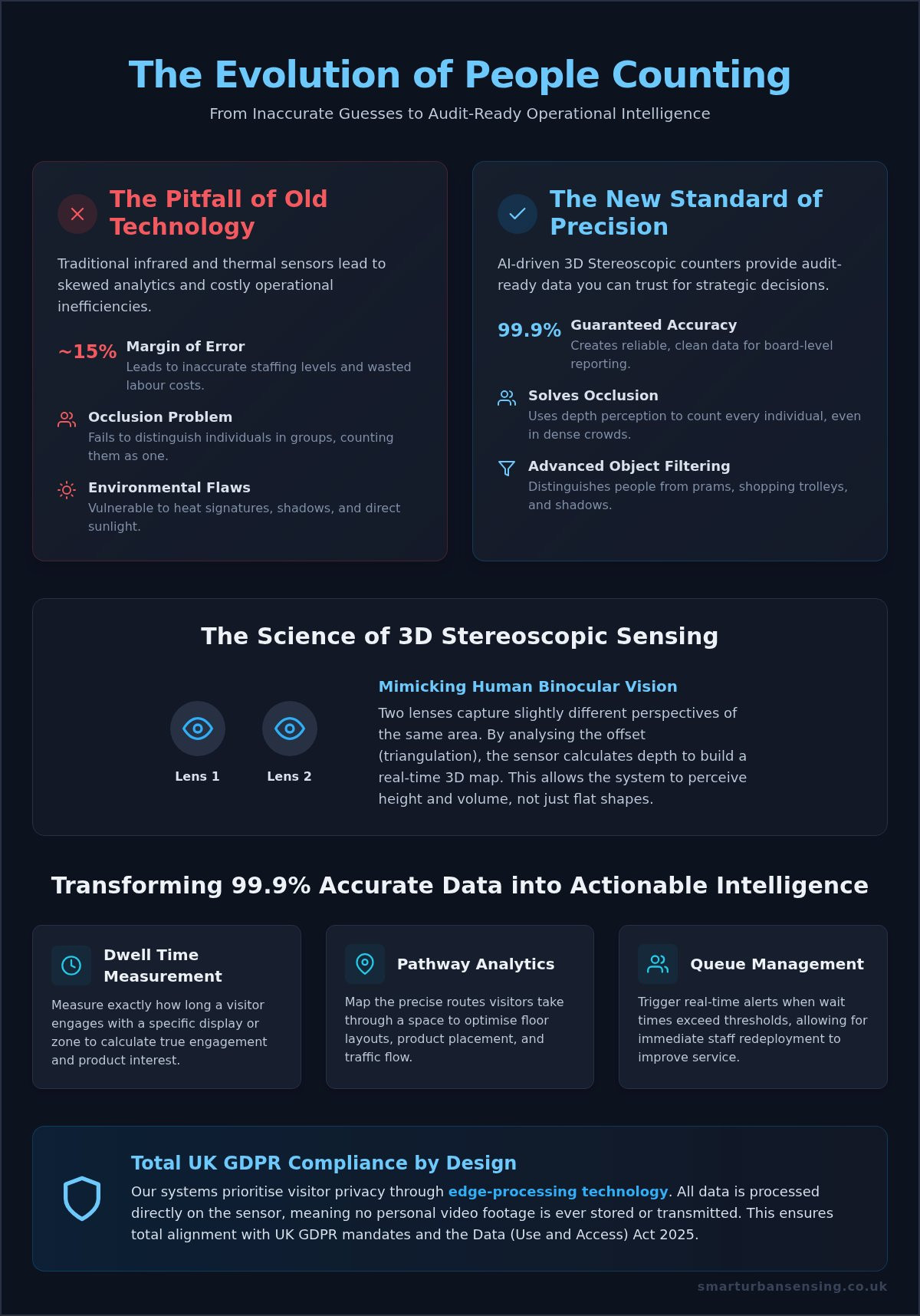
High precision isn’t merely a marketing label; it’s a rigorous technical threshold. In 2026, the industry defines high precision 3D counters as systems capable of maintaining 99% accuracy or higher under challenging real-world conditions. Whilst older technologies often struggled with environmental variables, modern AI-driven sensors like the AI 3DPro2 utilise sophisticated algorithms to filter out non-human objects. These systems distinguish between a customer and a shopping trolley, a child’s pram, or even shifting shadows on a polished floor. This level of granularity ensures that the data reaching your V9 Analytics Software is clean, reliable, and ready for board-level reporting.
The Evolution of People Counting Technology
The journey from manual clickers and infrared beams to modern sensing has been driven by the need for deeper operational clarity. Infrared systems, which rely on simple beam breaks, are notoriously inaccurate in dense crowds where “occlusion” occurs. Similarly, thermal sensors often falter in high-temperature environments or crowded UK shopping centres where heat signatures overlap. The current shift focuses on Computer Stereo Vision, which provides the depth perception required to count individuals within a group. This hardware architecture prioritises “Privacy by Design,” processing all data at the edge so that no personal video footage ever leaves the device, ensuring total alignment with UK GDPR mandates.
Why 99% Accuracy is the New Industry Benchmark
A 10% error margin might sound negligible, but for a large-scale retail operation, it represents a significant financial risk. If your footfall data is consistently inflated by 10%, your staffing models will follow suit, leading to thousands of pounds in wasted labour costs every month. Conversely, undercounting leads to poor service levels and lost conversion opportunities. High precision is equally vital for government-funded infrastructure, where precise passenger metrics dictate budget allocations and safety protocols. Beyond simple totals, high precision 3D counters enable advanced metrics such as:
- Dwell Time: Measuring exactly how long a visitor engages with a specific display or zone to calculate true engagement.
- Pathway Analytics: Mapping the precise routes visitors take through a space to optimise floor layouts and product placement.
- Queue Management: Triggering real-time alerts when wait times exceed predefined thresholds, allowing for immediate staff redeployment.
When accuracy reaches the 99% mark, data moves from being a general indicator to becoming an audit-ready asset. This precision allows managers to link footfall directly to till transactions, providing a transparent view of conversion rates that can be trusted for strategic investment decisions. For organisations managing multiple national sites, our comprehensive guide to AI people counting sensors UK explores how advanced technology delivers this level of precision whilst maintaining full GDPR compliance across complex retail, transport, and smart city environments.
The Science of 3D Stereoscopic Sensing
Stereoscopic sensing is the technical engine behind 99% accuracy in modern people counting. It utilizes two distinct lenses to mimic human binocular vision, capturing two slightly different perspectives of the same area. By analyzing these offset images, the sensor calculates depth through triangulation to build a real-time 3D map of the entrance. It’s the same fundamental 3D Stereo Camera Technology used in scientific research to count and measure objects with absolute precision in complex, shifting environments. This depth perception allows high precision 3D counters to see volume rather than just flat shapes.
Identifying individuals within a dense crowd is where 2D systems typically fail. Traditional cameras see a “blob” of movement, but 3D sensors identify the distinct height and volume of each person, effectively solving the “occlusion” problem where one person blocks another from view. This capability also enables sophisticated height filtering. You can configure the system to ignore children under a specific height or filter out inanimate objects like shopping trolleys, cleaning equipment, and prams. For facilities with high ceilings or expansive entrances, the use of wide-angle lenses ensures a broad field of view without losing the granularity required for audit-ready data.
3D Stereoscopic vs. Thermal and IR Sensors
Thermal sensors rely on heat signatures, which makes them vulnerable to “ghosting” in direct sunlight or near powerful HVAC vents. Infrared (IR) beams are even more limited; they only detect a break in a light path and cannot distinguish between a single visitor and a group. Modern 3D sensors remain unaffected by lighting changes, shadows, or temperature fluctuations. They are particularly effective for outdoor counters or bus passenger counting, where lighting conditions shift rapidly. Because these AI-driven high precision 3D counters are self-calibrating, they require far less manual intervention and maintenance than legacy hardware.
Edge Processing: The Key to Speed and Privacy
Speed and security are maintained through edge processing, where the analytical heavy lifting happens directly on the hardware rather than being sent to a central cloud server. This architecture significantly reduces bandwidth requirements for large-scale retail or transport networks, as only small numerical data packets are transmitted. In the context of sensor privacy, edge computing refers to the on-device conversion of visual data into anonymous numerical values, ensuring that no personally identifiable imagery ever leaves the hardware or is stored on a drive. This approach guarantees that your data collection is both instantaneous and inherently compliant with privacy regulations.
If you’re looking to upgrade your current infrastructure to a more reliable standard, explore our range of AI-powered sensors designed for maximum accuracy and privacy.
High Precision Applications Across Key UK Sectors
Data serves as the foundation for modern infrastructure management, providing the clarity needed to move from guesswork to strategic certainty. High precision 3D counters offer the granular detail required to manage complex environments, whether you’re overseeing a high-street storefront or a major transport hub. In an era where operational efficiency is paramount, the ability to rely on 99% accurate data allows decision-makers to justify investments with absolute confidence.
Transforming Retail Operations with Footfall Data
High-street retailers face constant pressure to justify every pound of operational expenditure. By linking high-precision footfall data with Point of Sale (POS) systems, managers can calculate true conversion rates rather than relying solely on transaction counts. This insight is essential for staff scheduling optimisation; it ensures more colleagues are available during peak periods whilst preventing overstaffing during quieter mornings. For businesses taking their first steps into data-driven management, Retail Starter Kits provide a streamlined entry point, offering the necessary hardware and V9 Analytics Software to begin measuring store performance immediately. To understand how these technologies are reshaping the sector in 2026, our comprehensive guide to 3D stereoscopic sensors for retail analytics provides an in-depth look at the latest advancements and best practices. These insights allow for the testing of new store layouts and marketing campaigns, providing clear evidence of what truly drives customer engagement. For retailers seeking to go further, a dedicated approach to store traffic analysis can transform raw footfall into sophisticated behavioural insights, enabling layout optimisations and precise staff scheduling that deliver measurable improvements in conversion rates.
Enhancing Public Transport Efficiency
Transport operators increasingly rely on the AI 3D APC to manage bus and rail occupancy in real-time. This technology is a cornerstone of Automatic Passenger Counting, allowing operators to monitor fleet usage and provide data-driven justifications for route adjustments or fleet expansions. For fleet operators seeking to quantify the financial impact of this technology, understanding the ROI of bus passenger counters is essential for building a compelling business case and calculating precise payback periods. In busy transport interchanges, high-precision sensors facilitate real-time flow management, which is critical for preventing overcrowding and enhancing passenger safety. Accurate passenger data ensures that operators can meet stringent reporting requirements whilst providing a more reliable, efficient service for the travelling public.
The utility of these sensors extends into the broader public sector through Smart Junctions & Cycle Lane Monitoring. Local authorities use this data to monitor pedestrian density and cycle lane usage, informing long-term urban planning and sustainability initiatives. Similarly, public venues such as museums, libraries, and stadiums utilise high precision 3D counters to maintain safe occupancy levels. By providing a clear, real-time view of visitor numbers, these institutions can ensure compliance with health and safety regulations whilst improving the overall visitor experience through better crowd management and resource allocation.
Privacy and Compliance: Navigating the UK GDPR Landscape
Maintaining public trust requires a clear distinction between security surveillance and operational data collection. high precision 3D counters are engineered to provide granular footfall insights without ever capturing or storing personally identifiable information (PII). Unlike traditional CCTV systems, which record visual imagery for later review, these sensors act as real-time analytical tools that see the world in mathematical volumes rather than faces. This privacy-first architecture is essential for organisations navigating the complexities of the Data (Use and Access) Act 2025, which mandates rigorous documentation for data handling processes in the UK.
GDPR-Compliant People Counting
High-precision sensors don’t require facial recognition to achieve their 99% accuracy rating. Instead, they utilise stereoscopic vision to identify the physical presence and movement patterns of individuals. The raw visual data is processed instantly at the edge, where it’s converted into anonymous metadata. This means the information leaving the sensor and entering your V9 Analytics Software is already anonymised, ensuring your footfall analytics platform remains secure and cloud-protected. By eliminating the need for video storage, you remove the risks associated with data breaches and subject access requests that typically plague traditional monitoring systems.
If you need to ensure your facility meets the highest standards of data protection, consult with our compliance experts to learn more about our privacy-first hardware.
Ethical Data Collection in Smart Cities
Smart city initiatives depend on the public’s willingness to be monitored for the sake of better urban planning. Whether you’re managing cycle lanes or pedestrian density, the monitoring must remain non-intrusive to be ethically sound. 3D sensors protect individual identity whilst tracking movement by representing humans as anonymous volumetric points rather than identifiable images. This high-precision data allows local authorities to create more accessible urban environments, identifying bottlenecks and safety risks without compromising the anonymity of the citizens they serve. Adhering to these ethical standards doesn’t just satisfy legal requirements; it builds a foundation of transparency that is vital for long-term project success.
Implementing Your High Precision Counting Strategy
Successful implementation of high precision 3D counters is never a “set and forget” task; it requires a methodical assessment of the physical environment. Before any hardware is commissioned, factors such as ceiling height, entrance width, and ambient lighting must be audited to ensure the stereoscopic lenses have an unobstructed field of view. Whilst these sensors are highly adaptable, the configuration of a narrow boutique entrance differs significantly from a wide-span stadium concourse. Professional planning ensures that the 99% accuracy rating is achieved from day one, avoiding the data drift often associated with poorly positioned generic hardware.
Choosing the Right Sensors for Your Space
Selecting the appropriate hardware is a matter of matching technical capability to environmental demand. For complex, high-traffic retail environments where visitor density is extreme, the AI 3DPro3 offers the processing power required to maintain precision without lag. Conversely, park entrances or transport interchanges require ruggedised outdoor counters designed to withstand the British weather whilst maintaining consistent performance in varying light levels. Opting for an end-to-end service rather than a simple hardware-only purchase allows you to benefit from bespoke installation strategies that account for structural nuances and network requirements.
From Data to Insight: The V9 Analytics Platform
The true value of high-precision hardware is realised through the V9 Analytics dashboard, which serves as the central hub for your entire sensing network. This platform allows you to aggregate data from multiple sensors and disparate locations, providing a single source of truth for your organisation. Reports can be customised to meet the specific needs of different stakeholders; store managers might require real-time occupancy and safety alerts to manage floor staff, whilst CEOs look for long-term footfall trends to inform property investment. This tiered reporting ensures that the right data reaches the right person at the right time.
Maintaining long-term data integrity requires more than just high-spec equipment. Ongoing support and remote health checks ensure that your sensors continue to perform at peak efficiency, even as your physical space or visitor patterns evolve. If you’re ready to move beyond basic estimates and start making decisions based on audit-ready intelligence, request a free consultation for your high-precision counting project. Our team will help you design a strategy that prioritises both accuracy and ethical compliance, ensuring your sensing network remains a valuable long-term asset.
Future-Proofing Your Operations Through Precise Analytics
Transitioning to a data-led strategy requires more than just hardware; it demands a commitment to absolute accuracy and ethical responsibility. By implementing high precision 3D counters, you move beyond the limitations of legacy infrared systems and embrace a new standard of 99% data integrity. This precision ensures that your staffing decisions, infrastructure plans, and conversion analytics are built on a foundation of truth rather than estimates.
Smart Urban Sensing Ltd provides the technological sophistication needed to manage these complexities, offering UK-manufactured hardware and dedicated local support. Our systems utilise GDPR-compliant edge processing to ensure that visitor privacy is never compromised, converting visual data into anonymous insights instantly. This balance of high-tech innovation and human-centric design allows you to optimise your environment whilst maintaining total regulatory compliance.
Optimise your space with 99% accuracy; explore Smart Urban Sensing Ltd solutions. It’s time to transform your footfall data into a strategic asset that drives long-term growth and operational clarity.
Frequently Asked Questions
How do high precision 3D counters differ from standard CCTV?
High precision 3D counters are analytical sensors designed for data accuracy rather than visual surveillance. Unlike standard CCTV, which records video for security review, these sensors use stereoscopic lenses to map depth and convert movement into anonymous numerical data at the edge. This means no personal imagery is stored or transmitted, making them a dedicated tool for operational intelligence rather than a security monitoring system.
Is a 3D stereoscopic sensor fully GDPR compliant in the UK?
Yes, these sensors are fully compliant with UK GDPR regulations, including the Data (Use and Access) Act 2025. Compliance is achieved through edge processing technology, which ensures that visual information is anonymised instantly on the device. Because no video footage is stored or sent to the cloud, individual identities remain protected. This Privacy by Design approach allows organisations to collect 99% accurate footfall data whilst fulfilling their legal obligations regarding visitor privacy.
Can these sensors distinguish between staff and customers?
Advanced sensors like the AI 3DPro2 can distinguish between different visitor types using sophisticated AI algorithms. By identifying specific height and volume profiles, the system can be configured to filter out routine staff movements from customer footfall counts. This ensures that your staffing schedules and marketing evaluations are based on actual visitor behaviour rather than being skewed by the movements of your own team members throughout the trading day.
What is the typical accuracy rate for AI 3DPro sensors?
The AI 3DPro series, including the AI 3DPro2 and AI 3DPro3, maintains an industry-leading accuracy rating of 99%. This precision is achieved through stereoscopic vision, which allows the sensor to calculate depth and volume with extreme granularity. Such a high threshold is essential for audit-ready reporting, ensuring that business leaders can trust the data for critical decisions such as labour allocation, property investment, and long-term infrastructure planning across their networks.
How do 3D counters perform in low-light or outdoor conditions?
High precision 3D counters are engineered to perform reliably across a variety of challenging environments. Whilst traditional 2D sensors may struggle with shadows or dim lighting, stereoscopic technology remains effective because it measures volume and depth rather than just light contrast. For external environments, our specialised outdoor counters are ruggedised to withstand British weather conditions, ensuring consistent data collection in parks, transport hubs, and cycle lanes regardless of shifting light or temperature.
Do I need to upgrade my internet bandwidth to support multiple sensors?
No significant bandwidth upgrade is required because our sensors utilise edge processing. Instead of streaming high-definition video to a central server, the hardware processes all visual data locally and only transmits tiny packets of numerical metadata. This efficient architecture makes it easy to deploy multiple sensors across large retail networks or transport hubs without straining your existing internet infrastructure or incurring high data costs for multi-site monitoring.
Can high precision counters be integrated with my existing POS or BMS software?
Integration is a core feature of the V9 Analytics Software, which acts as a hub for all sensing data. The platform is designed to interface seamlessly with existing Point of Sale (POS) systems and Building Management Systems (BMS). By combining footfall data with transaction records, you can calculate real-time conversion rates. Integration with BMS also allows for automated environmental adjustments based on live occupancy levels, driving significant energy savings and operational efficiency.
What is included in a Retail Starter Kit?
The Retail Starter Kit is designed for businesses looking to implement a high-precision counting strategy with minimal complexity. It typically includes the AI 3DPro series hardware, access to the V9 Analytics Software, and initial configuration support. These kits provide a streamlined entry point for measuring store performance, allowing you to link footfall to conversion rates immediately. Every kit is backed by our UK-based support team to ensure your installation delivers maximum accuracy from the start.
Retail and shopping centres
Find out what your entrance data should be telling you
In 20 minutes we review your entrances, current counting setup and conversion questions, then tell you what accurate footfall data would change. No obligation, no hard sell.


