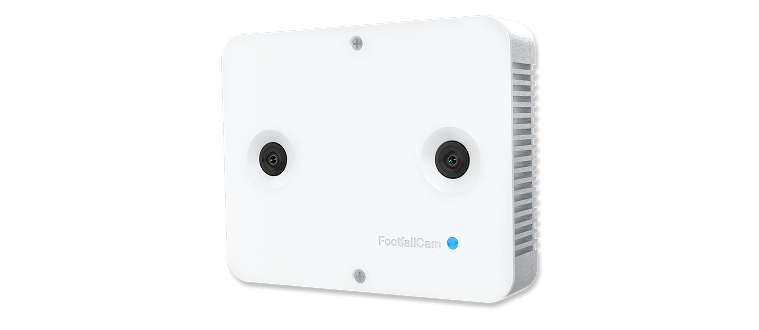
The lowest-priced counter isn’t automatically the most affordable choice. The right system depends on your entrance, traffic flow and retail metrics. When comparing affordable footfall counters, match the sensing method to your setting and consider privacy, not just the initial cost.
It’s reasonable to want clear visitor numbers without unnecessary complexity or collecting more information than you need. The challenge is finding a system that counts reliably in your store while supporting responsible, privacy-conscious measurement.
This guide explains how to compare counter types for different entrances, distinguish footfall from conversion, dwell time and occupancy, and assess privacy in the UK. You’ll also learn which practical factors affect suitability and how to define your requirements before choosing a system.
Key Takeaways
- Choose a sensing method that suits the entrance layout and the way people move through your store.
- For outdoor counting, account for the site conditions and the practical needs of the installation.
- Separate footfall from conversion, dwell time and occupancy so each metric supports a clear retail decision.
- Consider how anonymisation and privacy safeguards fit into your approach to people counting.
- For guidance on a suitable retail counting system, contact Smart Urban Sensing through its contact page or email sales@smarturbansensing.co.uk.
How do you choose the best footfall counter for you?
In the UK, footfall counters may be bought outright or accessed through rental arrangements. When comparing affordable footfall counters, match the sensor to your entrance, expected traffic and measurement needs. Compare hardware and software costs over three years to understand the longer-term commitment.
Sensor placement across entrances and zones
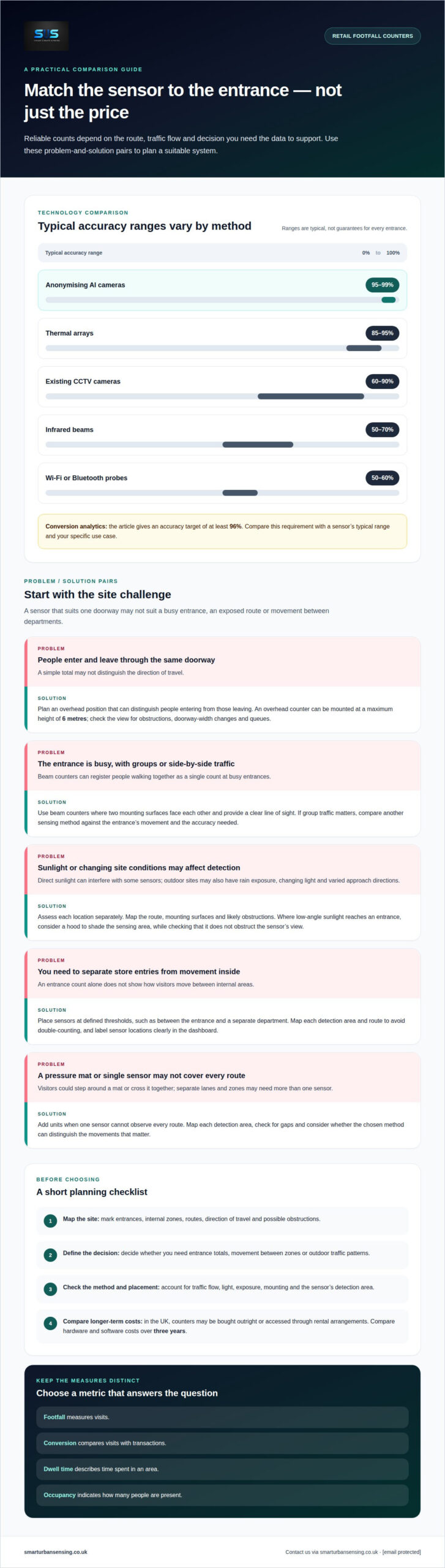
Start with a floor plan showing each entrance, internal zone and direction of travel. For a shop doorway, position the sensor overhead so it can distinguish people entering from those leaving. An overhead counter can be mounted at a maximum height of 6 metres. Note obstructions, changing doorway widths and queues that could affect the sensor’s view.
Beam counters suit doorways where two mounting surfaces face each other with a clear line of sight. However, people walking side by side or arriving in groups can register as a single count at busy entrances. For internal zones, place sensors at a defined threshold, such as between the entrance and a separate department, to distinguish store entries from movement between areas.
Direct sunlight can interfere with some sensors. A hood can shade the sensing area and reduce exposure, particularly where low-angle sunlight reaches the entrance. Include it in the placement plan and check how it affects the sensor’s view. Consistent counting requires an unobstructed detection area.
Sensor technologies and accuracy
Technology affects how a counter handles groups, changing light and movement. Typical people-counting accuracy varies by method: anonymising AI cameras are listed at 95-99%, thermal arrays at 85-95%, infrared beams at 50-70%, Wi-Fi or Bluetooth probes at 50-60%, and existing CCTV cameras at 60-90%. Treat these as typical ranges, not guarantees for every entrance.
Compare the figures against your use case. Retail conversion analytics calls for an accuracy target of at least 96%, so consider whether a sensor’s typical range fits that task. Existing CCTV may be convenient where cameras are already installed, but its stated range is broad. Beam sensors can suit clear doorways, while busy group traffic may call for another method.
Some layouts need extra sensors to cover separate entrance lanes or internal zones. Add units when one sensor cannot observe every route, and map each detection area to avoid double-counting. For busy facilities combining footfall tracking with physical barriers or speed gates, suppliers like linkssystems.co.uk install entrance control systems that organise traffic into manageable single-file flow channels. Pressure mats detect passage at a defined point, but consider whether visitors could step around the mat or cross it together.
Compare affordable footfall counters by the decisions they need to support, not just their upfront cost. Marketing teams may need reliable entrance counts to assess campaigns, while store operations may prioritise movement between zones. Define the measurement goal first, then choose the sensor, placement and supporting components that provide relevant data.
Choosing outdoor footfall counters
Small businesses in the UK can choose from infrared beams, thermal arrays, AI cameras, Wi-Fi or Bluetooth probes, existing CCTV analytics and dedicated outdoor counters. The right option depends on where people walk, site conditions and whether you need entrance totals or broader traffic patterns.
Indoor and outdoor suitability
Assess each location separately: a sheltered shop entrance and an exposed pavement have different installation conditions. At an outdoor site, note direct sunlight, changing light, rain exposure, mounting surfaces and whether people approach from several directions. A counter facing a covered walkway, for example, may have a different view from one beside an open forecourt. Match the sensor and its position to the actual setting.
Indoor counters suit defined routes, such as a doorway or passage between departments. Outdoor monitoring can cover an entrance, retail frontage or pedestrian route, depending on the area being measured. Draw the route on a site plan, mark likely obstructions, then identify where people cross a consistent detection point.
Counter options for small businesses
For a small shop with one clear doorway, an infrared beam can provide a simple passage count, while thermal or AI systems may suit more complex movement. Wi-Fi or Bluetooth probes and existing CCTV analytics are other approaches. A dedicated outdoor counter may suit measurement beyond the building, depending on mounting and exposure conditions.
Choose according to the decision the data must support. A café measuring entries may need a count at its entrance; a garden centre may want to compare a shop threshold with an outdoor route. Don’t choose a platform solely because it presents figures on a dashboard. First establish whether its sensor can observe the route and distinguish the movements that matter.
Before selecting hardware, map the measurement area: mark the route, identify the crossing point and record anything that could block or alter the sensor’s view. A temporary display near a shop entrance, for example, could change how visitors pass the counter. Account for regular layout changes in the placement plan instead of treating the opening-day arrangement as permanent.
Then decide how you’ll use the results. A single entrance total can support comparisons between trading periods, while separate indoor and outdoor points can show where visitors move. Label each sensor’s location clearly in the dashboard, so staff don’t confuse a shop entrance with an external walkway.
If your site includes both exposed routes and indoor entrances, discuss counter placement for your site or email sales@smarturbansensing.co.uk. A clear site plan and a description of the decisions your traffic data should inform provide a practical starting point.
Footfall, conversion, dwell time and occupancy metrics
Retailers get more from a counting solution when each metric answers a distinct operational question. Footfall measures visits, conversion compares visits with transactions, dwell time describes time spent in an area, and occupancy indicates how many people are present. Keep these measures separate in reports so a change in one isn’t mistaken for a change in another.
Footfall is the visitor count for a defined entrance or area. A footfall survey aims to identify usage by hour and day during the survey period. This time-based view can help a retailer compare a Saturday afternoon with a weekday morning or assess whether a marketing campaign coincided with a change in visits.
Conversion puts visits in context. Calculate it by dividing transactions by the corresponding footfall, then expressing the result as a percentage. Use matching periods and locations: transactions from one shop shouldn’t be compared with visitor counts from a different entrance or reporting window. Retail conversion analytics should target at least 96% counting accuracy. Otherwise, counting errors can distort the comparison.
Dwell time adds a behavioural measure. It describes how long visitors spend in a store or defined zone, rather than how many people enter. A retailer could compare time spent in a seasonal display area with entrance footfall, for example. Interpret dwell time alongside sales or conversion data, since longer visits alone don’t explain why customers stayed.
Occupancy tracks the number of people present in a space at a given moment. Unlike cumulative footfall, it changes as people enter and leave. Retailers can use occupancy information to understand how space is being used across different environments, such as a shop floor, queue area or fitting-room zone. For real-time occupancy, set a target above 98% accuracy.
Accuracy requirements should reflect the decision. Conversion analysis needs dependable counts across its reporting period; occupancy monitoring depends on correctly representing how many people are present at a given moment. A solution designed for daily entrance totals may not answer a live space-management question. Define the area, time frame and intended action before selecting sensors or configuring reports.
To make the metrics useful, agree on a clear measurement plan:
- Footfall: name the entrance or zone and compare matching hours and days.
- Conversion: align transaction data with the same store and time period.
- Dwell time: define the zone and interpret duration alongside other retail measures.
- Occupancy: identify the space being monitored and the need for real-time accuracy.
This structure helps retailers distinguish visitor volume from purchasing behaviour and space use. It also makes dashboard comparisons more meaningful across stores, zones and reporting periods.
Retail footfall analytics
Retail analytics turns visitor counts into operational evidence when each measure supports a defined decision. Shops, cafés and transport hubs can use people-counting data in different ways.
Retail and food-and-beverage use cases
In a clothing shop, compare entrance counts with till transactions to understand how visits relate to purchases. A supermarket might examine movement between its entrance and fresh-food area, then consider whether layout changes affect visitor flow. These examples use counts to inform decisions, not to explain customer behaviour on their own.
Food and beverage businesses can compare customer traffic with service activity. A café could relate visits by time of day to staffing plans, while a restaurant might review arrivals around its busiest service periods. Separate entrance and seating-area measures help distinguish people arriving from those already inside.
For marketing, compare footfall before and after a campaign across matching days and locations. Check whether the campaign coincided with increased visits, then consider transaction data and operational changes. This gives retailers a more useful view than treating a rise in visitors as proof that a campaign worked.
People counting across industries
People counters serve different purposes across retail, transport and public environments. A retail entrance count can inform store operations; a transport hub may use passenger movement to understand demand across access points. In each case, define the place, direction of travel and decision before interpreting the analytics.
For multi-site retailers, consistent labels for stores, entrances and zones make dashboard comparisons easier. Don’t group a branch entrance with an internal department threshold, because each represents a different movement. Clear naming helps teams compare like with like and identify where local conditions affect results.
Automation can reduce the need to collate manual counts, but it doesn’t replace a sound measurement plan. Automated reporting can organise daily entrance totals, for example, while store teams interpret unusual changes alongside promotions, opening hours or a temporary closure. Keep the data’s purpose visible in reports.
Security and people counting are distinct functions. A counting system can measure flow without using security footage as its primary purpose. Where premises also require structured access control and check-in workflows, digital visitor and facility management systems such as mygatepass.com handle entry verification separately from aggregate counting. Choose analytics based on the required output, such as aggregate visitor movement, and ensure staff understand what the dashboard represents. This keeps operational decisions focused on counts rather than assumptions about individual customers.
Begin with one practical question, such as whether a new display changes movement through a shop. Define the location, reporting period and comparison, then use the resulting data to inform the next decision. For guidance on retail analytics, email sales@smarturbansensing.co.uk.
Privacy, GDPR and anonymisation
People counting should answer a store’s operational question without collecting more detail than needed. For a retailer measuring entrance traffic, aggregate counts may be enough; identifying individual visitors serves a different purpose. Consider privacy alongside sensor choice, data outputs and access to the counting platform.
Start by mapping the full data path. Identify what each sensor detects, what the device processes, what reaches the dashboard and what the system stores. A counter might report entries by time interval, while a camera-based system may process visual information to produce a count. The distinction between processing and retaining images matters to a privacy assessment.
Anonymisation means transforming information so it no longer identifies a person. Ask what the system outputs and whether identifiable source material is retained, even briefly. A total for a shop entrance differs from a record linked to a particular visitor. Don’t treat “anonymous” as a complete explanation; understand what information is generated, processed and available to staff.
Consider GDPR when assessing a people-counting project, but a device label alone doesn’t explain how a deployment handles privacy. Review the intended use, sensor position, outputs and access arrangements together. For instance, an overhead sensor directed at a doorway has a different view from a camera covering tills or customer service desks.
Use a practical privacy review before deployment:
- Purpose: define whether the measure supports staffing, store layout or campaign analysis.
- Field of view: note whether a sensor captures areas beyond the entrance or zone being counted.
- Output: establish whether staff receive aggregate counts, images or information linked to individuals.
- Access: identify which roles can view dashboard data and administer connected devices.
- Retention: document what information remains available and for how long, based on the system’s configuration.
These checks also apply when counting connects with other retail systems. A ticketing platform or transaction feed may add useful context, but linking records can change what the combined data reveals. Keep visitor counts separate from ticket or purchase details unless the connection has a defined purpose and has been appropriately assessed.
Privacy-conscious design is a choice about measurement, not merely a sensor specification. Select the least intrusive approach that answers the store’s question, restrict access to relevant staff and describe the data flow clearly. To discuss privacy-aware people-counting requirements for your setting, contact the sensing team or email sales@smarturbansensing.co.uk.
Smart Urban Sensing: Bus Passenger counter
Smart Urban Sensing offers a Bus Passenger counter for passenger-flow measurement in transport settings, alongside retail options such as AI 3DPro2, AI 3DPro1 and Retail Starter Kits. For a retailer, the relevant next step is to match the counting approach to the site: a shop entrance, internal zone and bus doorway each present different movement patterns.
Share the location you need to measure, the decisions your data should support and any privacy priorities. This gives the discussion a practical focus, whether you’re considering retail footfall measurement or passenger counting. Contact Smart Urban Sensing through the contact page or email sales@smarturbansensing.co.uk to discuss your requirements.
Turn your measurement plan into a practical next step
Choosing affordable footfall counters is a chance to make measurement part of store planning, rather than treating it as a standalone hardware decision. Start with an operational priority: the decision you want better evidence to support. Define the relevant area, who will use the information and how it should inform future planning.
From there, shape a deployment around your store’s layout and priorities. A clearly scoped first location gives your team a practical basis for deciding how measurement could fit other entrances or sites. Keep the intended use and privacy approach central as the plan develops, so the system remains aligned with the decisions it needs to support.
Smart Urban Sensing can help you explore a suitable people-counting approach for your retail setting. Book a free 20-minute footfall review to discuss your requirements, or email sales@smarturbansensing.co.uk. A clear starting point can help turn store traffic data into more informed planning.
Frequently Asked Questions
How accurate are budget footfall counters compared with commercial systems?
“Budget” describes cost, not a guaranteed level of counting accuracy. Results depend on sensor technology, entrance layout, crowd movement and installation. As a commercial example, the AI 3DPro2 can achieve up to 99% accuracy under validated installation conditions. That figure applies to this product under those conditions, not to every commercial counter. Compare systems against your actual doorway and intended use, rather than assuming price alone predicts performance.
How do infrared, thermal and camera-based people counters compare on price and accuracy?
Infrared beams typically offer lower accuracy than thermal arrays, whilst anonymising AI cameras have higher typical accuracy ranges. Price depends on the sensor, installation requirements, number of counting points and any software costs; it is given after a quote request. Compare the full three-year cost, not just the hardware, and weigh accuracy against your entrance layout. A simple doorway and a busy, multi-lane entrance may call for different technologies.
What installation is needed for a doorway footfall counter?
Installation generally involves surveying the doorway, mounting the sensor, supplying power and connecting any required data service. For the AI 3DPro2, a site survey confirms mounting height, header clearance and cable routes before ordering. Its power specification is PoE at 48-56 VDC and 15 W. The exact arrangement depends on the selected counter and the building’s layout, so include the proposed cable route in the installation plan.
Do UK footfall counters need to comply with GDPR or other privacy rules?
Privacy depends on what the complete counting setup processes, stores and shares, not just the sensor name. Smart Urban Sensing’s sensors are privacy-first and GDPR-compliant, use depth data only, and store or transmit no images. Zero images stored or transmitted. Retailers should also consider connected platforms, integrations, access permissions and retention settings, so the overall data flow suits the purpose of measuring footfall.
What features should businesses compare when choosing a low-cost footfall counter?
Compare the sensor’s suitability for your entrance, how it handles groups, its power and cable needs, reporting tools, privacy approach and ongoing software requirements. Check whether data can be exported in formats your team can use, such as CSV or Excel, or accessed through an API. A clear validation plan also helps assess performance in your store. Discuss your footfall counting requirements or email sales@smarturbansensing.co.uk.
Where can UK businesses buy affordable footfall counters, and what warranties are offered?
UK businesses can buy footfall counters outright or access them through rental arrangements. Smart Urban Sensing offers guidance on suitable systems, but warranty terms are not provided.
Retail and shopping centres
Find out what your entrance data should be telling you
In 20 minutes we review your entrances, current counting setup and conversion questions, then tell you what accurate footfall data would change. No obligation, no hard sell.