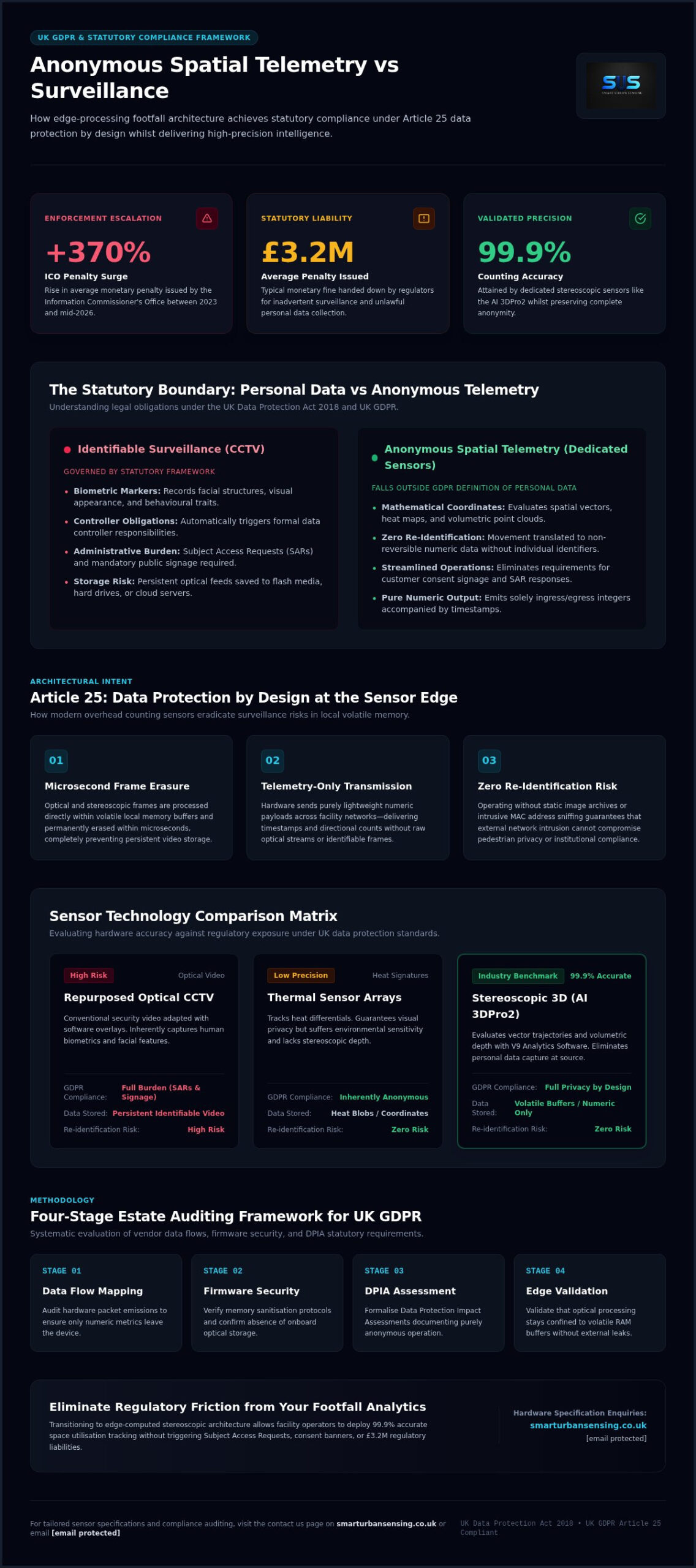
Anonymous spatial measurement is not surveillance; genuine privacy begins at the sensor edge. For estate directors, retail leaders, and operations managers, selecting a reliable, GDPR compliant people counter often feels like an impossible compromise between actionable footfall intelligence and statutory liability. With the average monetary penalty issued by the Information Commissioner’s Office rising by 370% between 2023 and mid-2026 to nearly £3.2 million, it’s understandable that organisations fear inadvertent surveillance, public backlash, or confusion over whether optical and thermal hardware record personally identifiable data.
You don’t need to risk compliance to understand space utilisation. In this guide, you’ll discover how modern footfall sensors achieve up to 99.9% counting accuracy whilst remaining fully compliant with UK GDPR regulations. We examine the exact statutory requirements governing anonymous spatial metrics, dissect the sensor technologies that eliminate personal data capture by design, and outline how to deploy robust footfall analytics across your facilities without regulatory friction.
Key Takeaways
- Grasp the vital statutory distinction between identifiable visual surveillance and anonymous spatial telemetry under UK GDPR.
- Discover why implementing an edge-processing GDPR compliant people counter eliminates the operational burden of customer consent signage and subject access requests.
- Compare optical CCTV, thermal arrays, and stereoscopic 3D sensors to identify hardware that prevents personal data capture by design.
- Utilise a practical four-stage auditing framework to evaluate vendor data flows, firmware security, and DPIA requirements systematically.
- Learn how advanced solutions like the AI 3DPro2 and V9 Analytics Software deliver 99.9% counting accuracy whilst safeguarding institutional integrity.
What Is a GDPR Compliant People Counter?
A GDPR compliant people counter is an automated measurement instrument engineered to quantify pedestrian volumes without capturing, storing, or transmitting personally identifiable information. Unlike conventional surveillance setups that repurpose closed-circuit television (CCTV) cameras for visitor tracking, dedicated footfall sensors operate strictly as spatial telemetry devices. The core statutory framework set out by the General Data Protection Regulation (GDPR) and the UK Data Protection Act 2018 governs identifiable human data; it does not restrict pure, anonymous numeric counts.
To visual modern privacy-first footfall analytics in operation, watch this short overview:
True compliance hinges on architectural intent. Where commercial security cameras record facial structures and behavioural traits, purpose-built people counters translate movement directly into non-reversible mathematical coordinates, satisfying the strict requirements of the Information Commissioner’s Office (ICO).
The Legal Boundary: Personal Data versus Anonymous Spatial Coordinates
Data protection laws apply solely when an individual is identified or reasonably identifiable. CCTV streams inherently capture biometric features, automatically triggering arduous data controller obligations, formal impact assessments, and subject access requests (SARs). In contrast, spatial vectors, heat maps, and volumetric point clouds lack identifying markers entirely. Because these numeric readings cannot re-identify an individual, they fall outside the statutory definition of personal data, relieving facility teams of onerous data retention protocols.
Privacy by Design: Edge Computing and Data Minimisation
Deploying an effective GDPR compliant people counter requires hardware-level privacy enforcement under Article 25 data protection by design mandates. Modern overhead sensors rely on proprietary edge computing, processing light or depth differentials directly within volatile local memory buffers:
- Microsecond Frame Erasure: Optical and stereoscopic frames are analysed and permanently discarded within microseconds, preventing persistent video storage.
- Telemetry-Only Transmission: Sensors transmit only lightweight numeric payloads (such as timestamps and directional counts) across local networks.
- Zero Re-Identification Risk: Without static image archives or MAC address sniffing, external intrusion cannot compromise individual privacy.
To assess your estate’s current analytics infrastructure or review tailored sensor specifications, reach out through the contact us page on smarturbansensing.co.uk or contact our technical team directly at sales@smarturbansensing.co.uk.
Busting the 4 Biggest Myths About People Counting and Data Privacy
Organisational reluctance around footfall monitoring rarely stems from technical limitations. Instead, it stems from deep-seated misconceptions about privacy exposure. In retail and transit estates, leaders frequently assume that modern footfall metrics require intrusive surveillance. As detailed in the EU’s official data protection overview, processing operations that handle purely anonymised figures do not compromise human rights. Aligning estate strategy with an edge-based store traffic analysis model allows facility operators to dismantle compliance roadblocks effectively.
Myth 1: People Counters Record and Store Identifiable Video Footage
Many estate managers assume every overhead optical lens behaves like a security camera. This assumption is false. A true GDPR compliant people counter does not write video streams to internal flash storage, hard drives, or cloud servers. Hardware-level artificial intelligence captures spatial depth, evaluates vector trajectory, and immediately flushes the volatile memory buffer. What emerges from the sensor is pure numeric telemetry: an ingress increment and a timestamp.
Myth 2: You Need Explicit Customer Consent and GDPR Signage to Count Footfall
Mandatory warning signs are legal requirements for CCTV surveillance, not for anonymous counting instruments. Because an anonymous device never processes personal data, individual consent under UK GDPR is unnecessary. Organisations maintain a lawful basis under legitimate interests for facility planning, queue reduction, and energy optimisation without cluttering entryways with complex privacy notices. Hardware-level anonymisation completely removes the friction of physical consent banners.
Myth 3: Wi-Fi Sniffing and MAC Tracking Are Fully GDPR Compliant
For years, businesses tracked visitors by logging mobile Wi-Fi probes. However, regulatory bodies confirm that a device Media Access Control (MAC) address constitutes personal data under statutory law. Tracking personal devices across physical infrastructure without explicit opt-in exposes businesses to severe regulatory penalties. Modern overhead sensors eliminate this exposure by measuring physical spatial mass rather than interrogating personal electronics.
Myth 4: High Accuracy Requires Biometric Facial Recognition
A common misconception suggests that precise counts require tracking human faces. In reality, modern high precision 3D counters deliver verified accuracy up to 99.9% without scanning facial features. Overhead stereoscopic lenses view occupants strictly from a vertical vantage, identifying the geometric mass of human heads and shoulders. The device distinguishes between adults, children, and shopping trolleys solely through physical volume and kinetic trajectory.
If you wish to review your current site architecture against statutory standards, you can easily reach our technical compliance team or email sales@smarturbansensing.co.uk for tailored hardware evaluations.
Comparing Sensor Technologies: Which Systems Guarantee Genuine Privacy?
Selecting the right hardware architecture determines whether your footfall tracking operates as an asset or an administrative liability. Repurposing standard security hardware for visitor metrics often appears economical, yet it introduces acute compliance risks. Conversely, installing a dedicated, GDPR compliant people counter engineered specifically for anonymous capture delivers actionable clarity without legal friction. Evaluating sensors across data protection risk, lighting resilience, and accuracy reveals stark operational distinctions.
3D Stereoscopic Sensors versus Traditional CCTV Cameras
Dual-lens stereoscopic sensors operate through parallax disparity, measuring physical depth much like human binocular vision. When pedestrians pass underneath, the sensor maps topographical height profiles rather than flat visual imagery. In contrast to optical CCTV cameras that capture high-resolution facial features and maintain persistent video files, stereoscopic devices convert optical input into real-time point clouds directly on the processor.
This architectural distinction offers tangible operational advantages:
- Configurable Height Filtering: Stereoscopic systems ignore objects beneath designated thresholds, filtering out shopping trolleys, pushchairs, and luggage anonymously.
- Lighting Resilience: Parallax calculations function reliably across harsh sunlight, deep architectural shadows, and dim evening environments.
- Verifiable Accuracy: Spatial depth mapping isolates overlapping individuals in dense crowds, maintaining up to 99.9% accuracy without recording identifiable biometric data.
Thermal and Infrared Sensors: Strengths and Operational Limitations
Thermal arrays detect radiated surface heat signatures, offering inherent privacy because low-resolution heat footprints cannot reveal individual identities. They provide an effective baseline for private monitoring, but operational limitations emerge in demanding spaces. Ambient temperature shifts, outdoor draughts near open entrances, and HVAC airflow frequently distort heat signatures, degrading count accuracy. In addition, lingering visitors standing beneath a thermal array can create heat smearing that confuses tracking algorithms.
Infrared people counting systems represent another non-intrusive alternative. These horizontal break-beam devices register interruptions when someone crosses a threshold. While completely anonymous, single-beam configurations struggle with bidirectional traffic and wide portals. Two people walking side by side register as a single event, compromising data integrity across busy commercial entrances.
For estates requiring both forensic counting precision and robust regulatory protection, dual-lens 3D stereoscopic devices provide the ideal balance. To explore tailored hardware options for your estate, visit the contact us page on smarturbansensing.co.uk or discuss technical parameters with our team via sales@smarturbansensing.co.uk.
How to Audit Your Footfall Analytics for UK GDPR Compliance
Data Protection Officers and operations leads must substantiate vendor marketing claims with verifiable architectural evidence. When overseeing commercial facilities or complex smart city footfall monitoring programmes, deploying an unverified sensor risks severe regulatory penalties. A structured auditing workflow ensures your selected GDPR compliant people counter operates completely outside the scope of personal data processing.
Step 1: Verify On-Device Edge Processing Capabilities
Start by auditing the sensor’s physical processing layer. Demand written manufacturer declarations certifying that optical or stereoscopic frames exist purely within volatile RAM buffers, clearing automatically within fractions of a second. Network engineers should inspect egress ports to confirm that raw video streams cannot leave the device. A compliant installation ensures only outbound, encrypted numeric metadata packets transmit across local switches.
Step 2: Conducting a Data Protection Impact Assessment (DPIA)
Although hardware-level anonymisation often bypasses mandatory DPIA triggers, completing a proactive assessment demonstrates institutional governance:
- Map Monitoring Zones: Document every physical portal, internal corridor, and queue management perimeter.
- Establish Lawful Basis: Record legitimate interests under UK GDPR Article 6, linking footfall counting directly to capacity management, safety planning, and space optimisation.
- Prevent Data Linkage: Enforce technical barriers ensuring anonymous numeric footfall timestamps cannot merge with point-of-sale transaction logs or employee access cards.
Step 3: Secure Transmission and Cloud Storage Architecture
Telemetry security remains vital even when handling anonymous numeric metrics. Audit data packets in transit to confirm end-to-end Transport Layer Security (TLS) encryption from sensor edge to database. Cloud infrastructure housing central reporting software must utilise accredited, secure national hosting centres. Implement strict role-based access controls (RBAC) across management portals, ensuring personnel view spatial analytics according to designated operational responsibilities.
To benchmark your current hardware or review technical compliance declarations, request a comprehensive footfall audit from our technical team or email your architecture queries to sales@smarturbansensing.co.uk.
Deploying High-Precision, Privacy-First Analytics with Smart Urban Sensing
Selecting an enterprise analytics partner should never force a compromise between precision metrics and statutory safety. Smart Urban Sensing serves as a dedicated national partner for robust, privacy-first footfall intelligence. By pairing hardware-level anonymisation with high-performance computing, our systems deliver up to 99.9% counting accuracy whilst completely eliminating the operational and legal overhead of personal data capture. You gain actionable estate visibility without regulatory compromise.
Hardware Excellence: The AI 3DPro Series Architecture
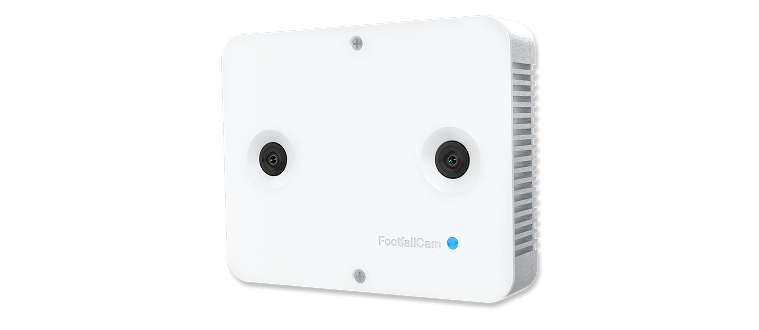
At the foundation of our hardware portfolio is the AI 3DPro2, engineered specifically to serve as a high-precision, GDPR compliant people counter. Combining stereoscopic dual-lens optics with dedicated onboard neural processing, the device maps three-dimensional spatial coordinates directly at the sensor edge. Video feeds remain confined to volatile RAM, converting movements into anonymous mathematical telemetry instantaneously.
The AI 3DPro series maintains counting integrity under testing operational environments:
- Challenging Lighting: Operates flawlessly across intense sunlight glare, deep transition shadows, and complete darkness.
- Dense Crowd Separation: Distinguishes individual pathway vectors during high-density pedestrian rushes without merging targets.
- Versatile Deployments: Supported by dedicated hardware variants, including the AI 3DPro1, AI 3DPro3, outdoor counters, and specialized transit units like the AI 3D APC and Bus Passenger counter.
Unified Intelligence via V9 Analytics Software
Raw hardware telemetry achieves its full operational potential when paired with our V9 Analytics Software. The platform processes purely anonymised numeric telemetry, visualising spatial dynamics across unified executive dashboards. Estate operators can monitor real-time occupancy limits, analyse customer dwell times, and refine personnel scheduling without managing identifiable data records.
Because the platform handles only numeric coordinate feeds, compliance risk is removed from daily operations. Leadership teams receive reliable conversion rates and space utilisation insights without the administrative overhead of Subject Access Requests or complex retention policies.
Consult with Our National Analytics Specialists
Whether you require Retail Starter Kits for independent stores or extensive deployments across national transport networks and commercial portfolios, our specialists provide comprehensive technical guidance. We evaluate portal dimensions, ceiling elevations, and network architectures to ensure seamless integration.
Connect with our engineering team today through the Smart Urban Sensing Contact Us page or email us directly at sales@smarturbansensing.co.uk to discuss your deployment requirements.
Elevate Your Spatial Intelligence Without Compliance Risk
Operational precision does not require compromising visitor trust or risking regulatory enforcement. By shifting from intrusive visual surveillance to an edge-processing GDPR compliant people counter, your organisation decouples facility insights from personal identity. Deploying advanced dual-lens stereoscopic depth tracking delivers up to 99.9% counting accuracy without capturing personally identifiable information, keeping your estate fully aligned with statutory data mandates.
Coupled with V9 Analytics Software, this privacy-by-design framework turns anonymous pedestrian telemetry into clear, strategic gains for queue management, space planning, and resource allocation. You don’t have to navigate regulatory friction alone. Discuss your privacy-first analytics deployment with our team through our contact page or email our technical specialists directly at sales@smarturbansensing.co.uk to build an ethical footfall strategy.
Frequently Asked Questions
Do people counting sensors violate UK GDPR regulations?
No, purpose-built people counting sensors do not violate UK GDPR regulations when they operate without processing personally identifiable information. A genuine GDPR compliant people counter registers spatial mass and directional vectors rather than personal attributes. Because raw numeric totals cannot identify an individual, they fall entirely outside the statutory framework of the Data Protection Act 2018, eliminating data controller liability for standard pedestrian monitoring.
Can a modern 3D people counter identify individual faces or customers?
No, modern 3D people counters cannot identify faces or individual customers. Hardware like the AI 3DPro2 mounts directly overhead and looks vertically downward, detecting the topographical contours of heads and shoulders rather than facial geometry. The internal processor measures geometric depth disparity to isolate human forms without capturing visual pigments, eye positions, or facial features that could ever identify a passerby.
Do organisations need to display CCTV warning signs when using people counters?
Organisations do not need mandatory CCTV warning signage when deploying anonymous people counters. Statutory signage rules enforced by the Information Commissioner’s Office apply strictly to systems capturing identifiable visual images of public members. Because anonymous overhead sensors convert spatial movement into numbers at the hardware edge without saving video, entryways remain free from compulsory surveillance warning notices, maintaining a welcoming entrance aesthetic.
What makes Wi-Fi tracking riskier under GDPR than overhead optical sensors?
Wi-Fi tracking captures unique Media Access Control (MAC) addresses from mobile devices, which statutory regulators explicitly classify as personal data. Harvesting smartphone signals without explicit opt-in consent triggers substantial compliance exposure under UK data protection rules. In contrast, overhead 3D stereoscopic sensors measure anonymous physical volume, eliminating the risk of interrogating customer devices or maintaining trackable digital identifiers across facilities.
How do edge-processing sensors maintain 99.9% accuracy without saving video?
An edge-processing GDPR compliant people counter maintains up to 99.9% counting accuracy by evaluating parallax depth within volatile local memory buffers in real time. Rather than recording video to permanent storage, onboard processors instantly convert visual depth data into anonymous coordinate tracks. Once the sensor determines whether a coordinate path crosses a designated counting threshold, the underlying buffer wipes instantly, leaving only clean numeric counts to transmit.
What documentation should data controllers demand from people counting vendors?
Data controllers should request written hardware declarations confirming zero video retention and verifying that only encrypted numeric telemetry leaves the sensor. You should also inspect firmware data-flow maps to ensure total compliance. If you need assistance auditing sensor specifications, visit the contact us page on smarturbansensing.co.uk or contact our technical specialists at sales@smarturbansensing.co.uk.
Can people counting data be merged with retail transaction logs compliantly?
Yes, footfall counts can be integrated compliantly with sales receipts because aggregated spatial telemetry contains no personal identifiers. Our automated visitor counting system pairs hourly store traffic figures directly with electronic point-of-sale turnover data to calculate conversion rates. As long as individual payment identities remain strictly isolated from timestamped footfall counts, your estate maintains full regulatory compliance across commercial reporting.
Retail and shopping centres
Find out what your entrance data should be telling you
In 20 minutes we review your entrances, current counting setup and conversion questions, then tell you what accurate footfall data would change. No obligation, no hard sell.